
Concord is the largest city in Contra Costa County, California, with roughly 129,000 residents occupying a valley floor framed by the slopes of Mount Diablo to the southeast and the ridgeline of the East Bay hills to the west. Located about 29 miles northeast of San Francisco and 20 miles east of Oakland, Concord occupies one of the key inland corridors of the greater San Francisco Bay Area — connected to the urban core via BART (the Bay Area Rapid Transit system), yet culturally distinct from the dense port cities to its west. The city's economy historically mixed agriculture (walnut orchards, grain) with military and logistics uses — the Concord Naval Weapons Station, a sprawling ammunition depot on the northern edge of the city, was one of the most significant military installations in the western United States during and after World War II, and its eventual decommissioning and redevelopment has been one of the defining civic questions of the post-Cold War era. Today Concord functions as a regional commercial and services hub, with the Sunvalley Shopping Center anchoring its retail corridor and a growing healthcare and professional services economy. The city is bounded by Pleasant Hill, Walnut Creek, Clayton, and Bay Point, and together these East Bay communities form a suburban band that sits just far enough from the Bay's edge to have developed its own neighborhood identity, distinct from the grittier urban cultures of Oakland, Richmond, and Berkeley to the west.
A brief history
The Concord area was long inhabited by the Bay Miwok people, who used the fertile valley floor and the oak woodlands of the surrounding hills for centuries. Spanish missionaries from Mission San José and Mission Dolores incorporated the area into the colonial agricultural network in the early 19th century. Rancho Monte del Diablo — a Mexican land grant covering a large portion of what is now Concord — was granted to Salvio Pacheco in 1834, and Pacheco founded the town of Todos Santos on the site in 1869, which was incorporated as Concord the same year. The city grew slowly through the late 19th and early 20th centuries as a grain and fruit processing center connected to the rail network. World War II transformed Concord dramatically: the Naval Weapons Station brought thousands of military and civilian workers to the area, and the post-war suburban boom filled the valley floor with tract housing, schools, and shopping centers. The 1948 Concord Munitions Explosion — one of the deadliest accidents in the history of the weapons station — killed 320 people and was covered up by military censors for decades, and it remains a defining chapter in the city's relationship with its military-industrial past. The arrival of BART in 1973 opened a direct transit link to San Francisco and accelerated Concord's role as a bedroom community for Bay Area workers. Through the 1970s and 1980s, the city's growing suburban middle class produced the kind of youth culture — bands rehearsing in garages, kids driving to Oakland and San Francisco for shows — that defines the musical geography of the Bay Area's inner suburbs.
Music identity
Concord's most internationally famous musical native is Les Claypool — the bassist, vocalist, and bandleader of Primus, who grew up in El Sobrante (a few miles to the west) and attended El Cerrito High School, but whose creative formation took place largely across the East Bay suburban corridor that includes Concord, El Sobrante, and the surrounding communities. Primus's grotesque, bass-driven alternative rock — filtered through Larry LaLonde's dissonant guitar work and Tim Alexander's precision drumming — became one of the defining sounds of early-1990s American alternative rock, with the debut Suck on This (1989) and the breakthrough Sailing the Seas of Cheese (1991) establishing Primus as one of the most idiosyncratic bands in rock. Claypool's bass technique — slap, pop, and melodic runs across complex odd-meter figures — made him one of the most technically influential bassists in rock history, and his work filtered directly from the East Bay suburban garage culture into mainstream American rock.
Beyond Primus, the broader East Bay music corridor in which Concord sits has been enormously consequential for American popular music. Oakland and Berkeley produced the Green Day and Operation Ivy strains of East Bay punk and pop-punk in the late 1980s and early 1990s; Concord and the surrounding East Bay suburbs were the peripheral territory where those bands played their early shows and recruited their first audiences. The 924 Gilman Street DIY venue in Berkeley — the founding institution of the East Bay punk scene — drew young musicians from across Contra Costa and Alameda County, and Concord's suburban youth were part of that geography.
Concord has a distinct relationship with jazz through an institutional connection rather than a local scene: the Concord Jazz label, founded in 1973 by Carl Jefferson (a Concord car dealer) and Jake Hanna, became one of the most important American jazz record labels of the late 20th century, releasing recordings by Scott Hamilton, Mel Tormé, Rosemary Clooney, Tuck & Patti, Cal Tjader, and hundreds of others. Jefferson's vision was a label anchored in mainstream, swing-oriented jazz at a time when avant-garde sounds dominated critical attention, and Concord Records — operating from the city for decades before eventual acquisition and relocation — gave the city an unexpected jazz institutional identity that belied its suburban character. The label's name lives on through Concord Music Group, which now encompasses multiple imprints.
The Concord Pavilion — formally the Sleep Train Pavilion and now the Concord Pavilion (names have shifted with sponsorship) — is the city's major concert facility: a 12,500-capacity amphitheatre on the hills above the city that has hosted nearly every major touring rock, pop, and country act of the past five decades. The Pavilion opened in 1975 and became one of the standard Bay Area summer concert destinations, alongside the Shoreline Amphitheatre in Mountain View. The Rolling Stones, Fleetwood Mac, Bruce Springsteen, U2, Tom Petty, Pearl Jam, Dave Matthews Band, and hundreds of others have played the Pavilion's outdoor stage. In the summer months, the Pavilion is the dominant entertainment destination in the East Bay suburbs, drawing audiences from across Contra Costa and Alameda Counties.
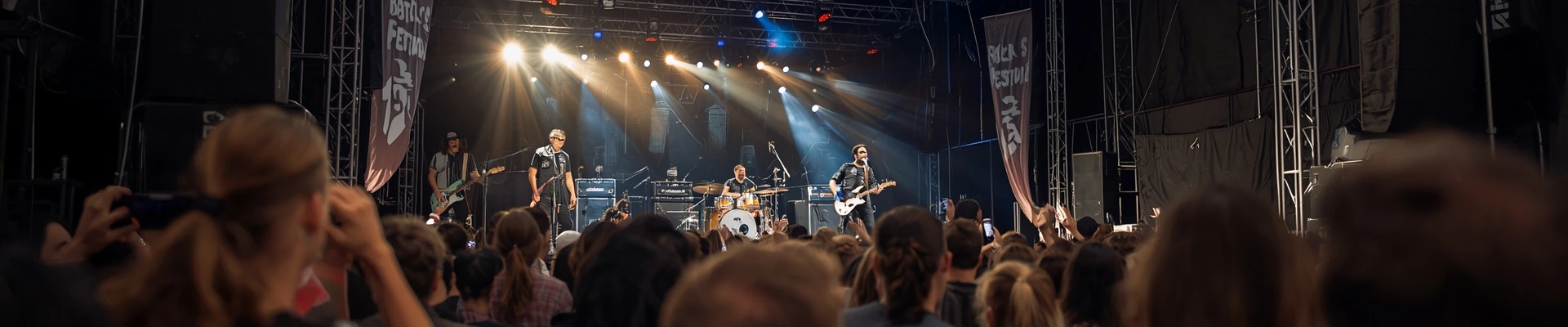
The city's heavy music scene runs through a network of local venues, rehearsal spaces, and band communities connected to the broader East Bay metal and hardcore corridor. Bands from Concord and the surrounding East Bay suburbs have fed into the established regional circuits through The Metro in Oakland, Slim's and The Fillmore in San Francisco, and the DIY spaces in Berkeley and Richmond. Thrash metal — the genre associated above all with the Bay Area — was born partly in the East Bay suburbs where Concord sits: Metallica, Exodus, and Testament came directly from the East Bay suburban high school network that extended through Concord's generation of young musicians in the early 1980s.
The city's R&B, soul, and hip-hop dimensions are modest compared to Oakland but real — the African-American community centered in the neighborhoods around Monument Boulevard and the North Concord area has sustained a consistent presence in regional R&B and gospel performance. The Latino community — which has grown significantly through the 2000s and 2010s — sustains norteño, banda, cumbia, and regional Mexican performance through quinceañeras, community events, and a small cluster of Spanish-language-oriented venues and social halls.
Venues and neighborhoods
The venue landscape is anchored by the outdoor Concord Pavilion (12,500 capacity) for national touring acts, which remains the dominant large-venue music destination in Contra Costa County. The Todos Santos Plaza — the city's central public square and historic core — programs outdoor concerts and community events including an annual summer concert series. The Willows Shopping Center area, Todos Santos neighborhood, and Clayton Road corridor host the city's bars and smaller live music venues. Hijinx and other multi-use venues in the downtown-adjacent area program local and regional rock, cover bands, and DJ nights. The Ygnacio Valley corridor and Concord BART station area are active entertainment zones. The Lesher Center for the Arts in adjacent Walnut Creek (technically a separate city but effectively the East Bay suburban arts campus for the region) programs theatrical, classical, and concert events that draw Concord audiences.
Festivals and signature events
The Concord 4th of July Celebration at Todos Santos Plaza typically incorporates live music. The Concord Jazz Festival — historically associated with the Concord Jazz label — drew national jazz talent to the city in its peak years. Food Truck Fridays at Todos Santos incorporate live music into the weekly market format. The Diablo Valley Beer Festival programs live music alongside craft beer. Art and Wine Festivals in the downtown plaza area are standard suburban event programming with live music components. The seasonal programming at the Concord Pavilion defines the summer concert calendar for the entire East Bay inland region.
What ties it all together
Concord is not a city whose music history announces itself loudly — it has no single neighborhood that defines a sound the way Haight-Ashbury defines San Francisco or Fruitvale defines Oakland. What it has is a specific suburban formation: the garage bands, the high school corridors, the cheap rehearsal spaces, and the proximity to Oakland and Berkeley that made the East Bay inner suburbs the breeding ground for some of the most consequential American rock of the 1980s and 1990s. Les Claypool's bass-obsessed childhood in the East Bay hills, the Concord Jazz label's unexpected championing of swing in the midst of the avant-garde era, and the Concord Pavilion's decades as the outdoor amphitheatre where the Bay Area's suburban majority met the national touring circuit — these three things define a city whose musical footprint is larger than its modest downtown suggests. Concord is, above all, East Bay suburban rock territory: a place where music grew in the space between the fog and the mountain.