
El Cajon sits in a broad inland valley about 24 kilometres east of downtown San Diego, rimmed on three sides by chaparral-covered hills and accessed through the El Cajon Pass — the natural corridor through the Peninsular Ranges that gives the city its Spanish name ("the box" or "the drawer"). With approximately 104,000 residents inside the city limits, El Cajon is the county seat of San Diego County for Superior Court purposes and the largest city in the East County subregion. It occupies roughly 62 square kilometres of valley floor at an elevation near 130 metres, warmer and drier in summer than coastal San Diego — inland temperatures regularly exceed 38°C during heat waves, a climatic reality that shapes the after-hours culture of bars, clubs, and air-conditioned venues. The economy has historically revolved around retail, light manufacturing, and services, with a significant military presence driven by proximity to Naval Air Station North Island, Marine Corps Air Station Miramar, and the broader San Diego defense infrastructure. The city's most internationally noted demographic fact is its extraordinary Chaldean and Iraqi-American community: El Cajon has become the primary destination for Chaldean Christian refugees from Iraq, hosting the largest such community in the United States outside the Detroit metropolitan area — a community whose cultural organizations, churches, restaurants, and festivals have fundamentally reshaped the city's identity over the past four decades.
A brief history
The Kumeyaay people occupied the El Cajon Valley for millennia before Spanish contact, managing the land with seasonal burning and sustaining communities around the reliable water sources of the valley floor. The valley came under Mission San Diego de Alcalá's ranching operations in the early 1800s, and after Mexican secularization, the Rancho El Cajon land grant was issued in 1845. American settlement accelerated after the Mexican-American War, and the El Cajon Valley became a productive agricultural district known for raisins, honey, and citrus. The Southern California land boom of the 1880s drove the first townsite platting, and El Cajon was incorporated as a city in 1912. The mid-twentieth century brought suburban growth along the US Route 8 corridor — El Cajon's Main Street and Broadway became retail arterials for the growing East County population. The 1975 fall of Saigon brought the first wave of Vietnamese refugees to the San Diego region, with a significant community settling in El Cajon. Through the 1990s and especially the 2000s, the wars in Iraq and the persecution of Chaldean Christians drove successive waves of Iraqi and Chaldean refugees to El Cajon — drawn by existing community networks, affordable housing, and the presence of Chaldean Catholic churches. By the 2010s, El Cajon had become so closely identified with the Chaldean-American community that local media routinely referred to it as "Little Baghdad," a framing community members embraced with mixed feelings. The city has also absorbed significant Mexican-American, Somali, Filipino, Hmong, and Pacific Islander populations, making it one of the most demographically complex mid-sized cities in California.
Music identity
El Cajon's most nationally consequential music contribution is its role as a punk and hardcore incubator during the 1980s and early 1990s. The suburban valley geography — far enough from San Diego's beach scene to feel isolated, close enough to the Tijuana border to absorb the energy of the Mexican punk and rock underground — created conditions for a fierce DIY music culture. Rocket from the Crypt, formed by John "Speedo" Reis and largely associated with San Diego but with deep East County connections, emerged from the broader scene. The East County hardcore circuit fed through all-ages shows at community centers, church halls, VFW posts, and the small clubs on El Cajon's Main Street. Drive Like Jehu — the San Diego post-hardcore band whose two albums (Drive Like Jehu, 1991; Yank Crime, 1994) are among the most acclaimed records in the American post-hardcore canon — drew from the same regional pool of musicians and venues. The broader San Diego punk ecosystem that produced Blink-182 (formed in Poway but with East County connections), Jawbreaker, and the Epitaph Records and Merge Records roster ran through El Cajon as much as any other San Diego suburb.
The city's metal tradition is equally potent. Cattle Decapitation — the San Diego death metal and grindcore band whose 2019 album Death Atlas was widely recognized as one of the decade's most important extreme metal records — formed in the El Cajon/San Diego area and has maintained a devoted following in East County. The inland valley's working-class character has always been hospitable to heavy music, and the East County metal scene has cycled through death metal, thrash, black metal, and metalcore with consistent energy.
The Chaldean and Iraqi-American community has built a substantial music scene that is largely invisible to mainstream music coverage but enormously lively within the community. Chaldean pop — a modern genre blending traditional Chaldean melodic forms, Arabic pop production, and Western electronic elements — has its own local artists, recording studios, and streaming presence. The Ishtar Cultural Center and various Chaldean Catholic church halls program Iraqi and Chaldean music year-round. Iraqi oud players, dabke dance troupes, and Chaldean wedding musicians form a robust traditional music infrastructure. Shamiram and other local Chaldean artists have national followings within the diaspora community. The community's music is documented through a network of Arabic and Assyrian-language media outlets, YouTube channels, and streaming platforms that operate largely outside the English-language music press.
The Latin music scene in El Cajon reflects the large Mexican-American community's presence, with norteño, banda, cumbia, and regional Mexican staples running through bars and venues on Main Street and El Cajon Boulevard. The Vietnamese-American community programs đờn ca tài tử traditional music events and Vietnamese pop through cultural associations and restaurants. The Somali and East African communities — El Cajon has one of the larger Somali populations in California — sustain a small Somali music scene through community gatherings.
Hip-hop has grown steadily through East County, with local artists navigating between the San Diego rap ecosystem (which produced Murs, Mitchy Slick, and eventually connected to Terrace Martin's Los Angeles orbit) and a more DIY East County scene. Bobby Brown (not the R&B artist, but local rapper Bobby Brown) and various East County MC collectives have kept the local hip-hop circuit active. The gospel tradition runs through the city's African American churches along the Marshall Avenue corridor, with mass choirs and traditional Black church music anchoring a smaller but committed community.
The recording infrastructure is modest — El Cajon lacks a flagship commercial recording studio, but home studios and small independent facilities serve the local scene. The broader San Diego studio ecosystem, including Signature Sound and various Mission Hills and Hillcrest facilities, is accessible to East County artists. Cargo Records (San Diego-based) and smaller labels have distributed East County artists, but the city has no signature label of its own.
Venues and neighborhoods
El Cajon's venue landscape is built around small and mid-size clubs rather than arena-scale facilities. The Sycuan Casino (operated by the Sycuan Band of the Kumeyaay Nation on tribal land southeast of El Cajon proper) is the region's largest entertainment facility, with a 4,600-seat amphitheatre that has hosted Pitbull, Earth, Wind & Fire, Los Lonely Boys, and mid-tier country and pop touring acts. The Magnolia (formerly the Magnolia Performing Arts Center at the Knox Center) is El Cajon's primary mid-size theatre, a 1,250-seat renovated venue that programs diverse touring acts across folk, world music, comedy, and roots genres. The Bancroft in El Cajon hosts local and regional rock, metal, and punk acts. Main Street and El Cajon Boulevard anchor the downtown bar and live music circuit, with a rotating cast of bars and clubs programming local acts on weekends.
Different neighborhoods carry different sonic identities. Downtown El Cajon — centered on Main Street between Magnolia and 2nd Street — anchors the commercial music corridor, including venues and bars. The Chaldean business district along El Cajon Boulevard east of downtown is lined with Iraqi and Chaldean restaurants and hookah lounges that program Middle Eastern music on weekends. Fletcher Hills and Granite Hills to the north are primarily residential but have sustained home recording studios and rehearsal spaces. Rancho San Diego to the south anchors the suburban bedroom community that feeds the broader East County scene.
The proximity to San Diego (24 km, 30 minutes on Highway 8) means El Cajon musicians regularly access the larger city's venue infrastructure: The Observatory North Park (1,900 capacity), House of Blues San Diego (1,000 capacity), Belly Up Tavern in Solana Beach, 4th & B, and the broader San Diego club ecosystem. El Cajon's own venues operate as the entry rung for acts graduating to the larger San Diego stages.
Festivals and signature events
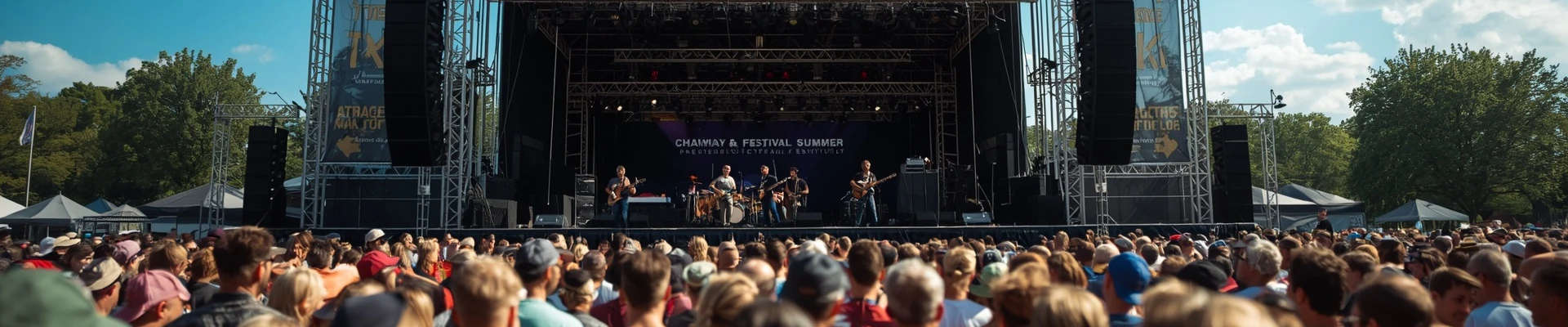
The Chaldean Shumaya — the Assyrian/Chaldean New Year celebrated on April 1st according to the traditional Assyrian calendar — brings the largest annual public celebration in El Cajon's Chaldean community, with music, dance, and cultural programming. The El Cajon Oktoberfest in Prescott Promenade (the downtown outdoor plaza) is one of the best-attended regional Oktoberfests in Southern California, programming polka bands, folk music, and traditional Bavarian entertainment alongside the beer gardens. The Mother Goose Parade — El Cajon's most famous annual event, running since 1947 and drawing 100,000+ spectators — includes marching bands and musical floats and is the largest parade in San Diego County. The Sycuan Amphitheatre concert season programs a summer series that draws regional and national touring acts. The El Cajon Boulevard Bikeways annual community event programs outdoor music. The Vietnamese Lunar New Year (Tết) celebrations, Somali cultural festivals, and the Chaldean-American parade in East El Cajon round out the community cultural calendar.
What ties it all together
El Cajon is a city of refugee stories and working-class grit, and its music reflects both. The punk and hardcore inheritance of the 1980s and 1990s was made by kids in a hot inland valley who had nowhere to go and everything to say — and that restless energy persists in the metal clubs and DIY spaces that still operate on the valley floor. The Chaldean community's music runs on a different frequency, ancient and modern simultaneously, shaped by centuries of Mesopotamian musical tradition and the traumas of displacement and resettlement — it is perhaps the most globally distinctive musical contribution El Cajon makes, a sound carried in the oud lines and dabke rhythms of a community that came to the valley to survive and stayed to thrive. Latin, Vietnamese, Somali, and Filipino musical cultures layer on top, making El Cajon's music landscape one of the most genuinely diverse in Southern California even if it lacks the visible infrastructure of larger cities. The Sycuan Casino amphitheatre brings national touring acts to the valley; The Magnolia keeps the mid-size presentation scene alive; and the bars and DIY spaces keep the local originals working. It is a city where the largest Chaldean community west of Detroit celebrates the Assyrian New Year with oud music in April, where post-hardcore and death metal bands rehearse in garages through the summer heat, and where the Mother Goose Parade's marching bands have been rolling down Main Street since Harry Truman was president — a place whose music is inseparable from the overlapping communities that made the valley their home.