
The Jewel City at the Edge of the San Fernando Valley
Glendale occupies a topographically compressed wedge of the eastern San Fernando Valley — roughly 79 square kilometres of canyon-footed flatland bounded by the Verdugo Mountains to the north, the San Rafael Hills to the east, and the Los Angeles River to the west. Sitting at an elevation of about 132 metres, the city is ten minutes from downtown Los Angeles by freeway yet functions as a distinct civic entity with its own downtown grid, its own cultural institutions, and a demographic character unlike any other city in Southern California. With approximately 201,000 residents, Glendale is the third-largest city in Los Angeles County. It is also, per capita, one of the most Armenian cities on earth outside the Republic of Armenia itself.
That demographic fact is not incidental to Glendale's musical identity. The Armenian-American community — estimated to account for roughly 40 percent of the city's population, concentrated in the Montrose and Adams Hill corridors as well as the central downtown blocks along Brand Boulevard — has sustained a rich and largely self-contained music ecosystem for decades. Traditional Armenian folk music, duduk, dhol percussion, and rabiz (a folk-pop hybrid that blends Armenian melodies with Russian and Middle Eastern influences) circulate through community halls, Armenian-owned restaurants and banquet venues, and the broadcasting reach of KVME 89.3 FM ("Armenian Public Radio"), which has delivered Armenian-language programming to the diaspora since 2006.
The Alex Theatre: Glendale's Marquee Address
No single venue has done more to shape Glendale's cultural identity than the Alex Theatre, the 1923 movie palace at 216 N. Brand Blvd. that was restored and reopened as a performing arts centre in 1993. The Alex seats approximately 1,400 in a vaulted Mediterranean Revival auditorium, its neon-lit blade sign one of the most recognisable marquees in the San Fernando Valley region. Since its restoration it has hosted an eclectic mix of touring comedians, theatrical productions, film screenings, orchestral performances, and live music spanning classical, world, Armenian folk, and pop.
The theatre's acoustic warmth — superior to most venues of comparable capacity — makes it a preferred room for acts who want a mid-size Los Angeles-area date outside the Hollywood theatre circuit. Artists including Aimee Mann, various Armenian national ensembles, and touring jazz and classical acts have anchored the Alex's programming calendar. The venue is operated by City of Glendale's Arts and Culture division, which has made community access and Armenian cultural programming explicit institutional priorities.
The adjacent Brand Library & Art Center — housed in a 1904 Moorish Revival mansion in Grandview Park — maintains a substantial music collection and hosts free chamber music and folk performances year-round. Its architecture is remarkable: a two-storey white stucco building modelled loosely on the East India Pavilion at the 1893 World's Columbian Exposition, surrounded by oak trees and hiking trails. The library's music branch, one of only a handful of dedicated music libraries in the Los Angeles public system, holds scores, recordings, and archival materials that serve both scholars and working musicians.
Armenian Music: The Dominant Sonic Register
Understanding Glendale's music culture requires understanding rabiz — a word derived from the Russian abbreviation for "workers in art" (rabochiy iskusstvo) that came to describe a populist, syncretic Armenian folk-pop form developed primarily in Soviet Armenia and exported wholesale by the Armenian diaspora. Rabiz is party music, celebration music, the sound of weddings and baptisms and community events, and in Glendale it is ambient: audible from banquet halls along San Fernando Road, from Armenian-owned nightclubs in the central district, from taxi stereos and corner grocery stores.
More internationally known Armenian musical exports have ties to the Glendale corridor. System of a Down — the Armenian-American metal band whose four members all grew up in the Glendale–Burbank–Hollywood triangle — embedded Armenian musical elements (odd time signatures, modal scales, the quarter-tone inflections of duduk music) into a ferocious thrash-metal framework. Guitarist Daron Malakian attended Rose and Alex Pilibos Armenian School in Hollywood; bassist Shavo Odadjian grew up in Glendale. Their 1998 self-titled debut and the subsequent run of albums through Mezmerize and Hypnotize (2005) sold over 40 million copies and brought Armenian musical identity to global metal audiences who had never previously encountered it.
Serj Tankian, the band's vocalist, has maintained a Glendale-area base for much of his career while developing a parallel solo catalogue and pursuing activist and film-scoring work. His connections to the local Armenian community — and the community's pride in the band's success — are a constant in Glendale civic culture.
Burbank's Gravitational Pull on Glendale Musicians
Glendale's music scene cannot be understood without acknowledging the Burbank entertainment corridor immediately to its west. Warner Bros. Records (now Warner Records), historically headquartered in Burbank, has been one of the most powerful record companies in American music history. Capitol Records is three miles south in Hollywood. The Village Recording Studios, EastWest Studios, Ocean Way Recording, and dozens of smaller tracking rooms are within a fifteen-minute drive. This concentration means that Glendale has functioned for decades as a bedroom community and residential base for musicians, session players, composers, and industry professionals who work in the Los Angeles entertainment complex.
Decca Studios operated at its Burbank facility adjacent to the NBC Radio City complex from the 1950s through the 1970s, recording pop, jazz, and soundtrack material for a roster that included Judy Garland and dozens of other mid-century stars. The physical proximity of these facilities to Glendale's housing stock — affordable relative to coastal Los Angeles, well-served by the Glendale Freeway (California Route 2) and the Ventura Freeway (US 101) — made it a logical landing point for working musicians who needed to be commutable to studio sessions without paying Hollywood or Silver Lake rents.
The Glendale Community College music program has for decades fed trained players into the studio session economy, producing graduates who work as orchestral contractors, session guitarists, and pit musicians for productions across the San Fernando Valley.
The Metal and Hardcore Underground
Partly as a result of System of a Down's foundational influence, Glendale has sustained an outsized metal and hard rock underground relative to its size. Rehearsal studios along the industrial corridors of San Fernando Road and the western Glenoaks Boulevard strip have housed dozens of bands working in metal, progressive rock, and adjacent heavier styles. The proximity to Los Angeles's broader heavy music infrastructure — The Roxy Theatre, Whisky a Go Go, The Troubadour, and the Wiltern are all within thirty minutes — has made Glendale a viable home base for bands building careers in the L.A. metal scene.
Armenian-American musicians have been disproportionately represented in this underground. The intersection of Armenian musical culture — with its complex rhythmic traditions, minor-key modal sensibility, and a community identity forged through historical trauma — and Southern California's heavy music infrastructure has been generative. Beyond System of a Down, bands including Sargas, Ovid's Withering, and various smaller acts have emerged from the Glendale-adjacent Armenian-American metal community.
DreamWorks Animation and the Composer Economy
DreamWorks Animation maintained its primary studio campus at 1000 Flower St. in Glendale from 2004 until its acquisition by NBCUniversal/Comcast in 2016, after which operations were partially consolidated. At its height the campus employed thousands of animators, story artists, and technical staff whose work generated a substantial demand for film scores and soundtracks — work performed by Los Angeles-area orchestral musicians and composers who lived throughout the San Fernando Valley, Glendale included.
Hans Zimmer's Remote Control Productions (headquartered nearby in Santa Monica but networked throughout the valley) contributed scores to numerous DreamWorks Animation features. The ecosystem of subsidiary composers, orchestrators, and music editors who worked on Shrek, Kung Fu Panda, How to Train Your Dragon, and other DreamWorks properties created a non-trivial local music economy invisible to most accounts of Glendale's cultural life.
Neighborhoods, Corridors, and Live Music Infrastructure
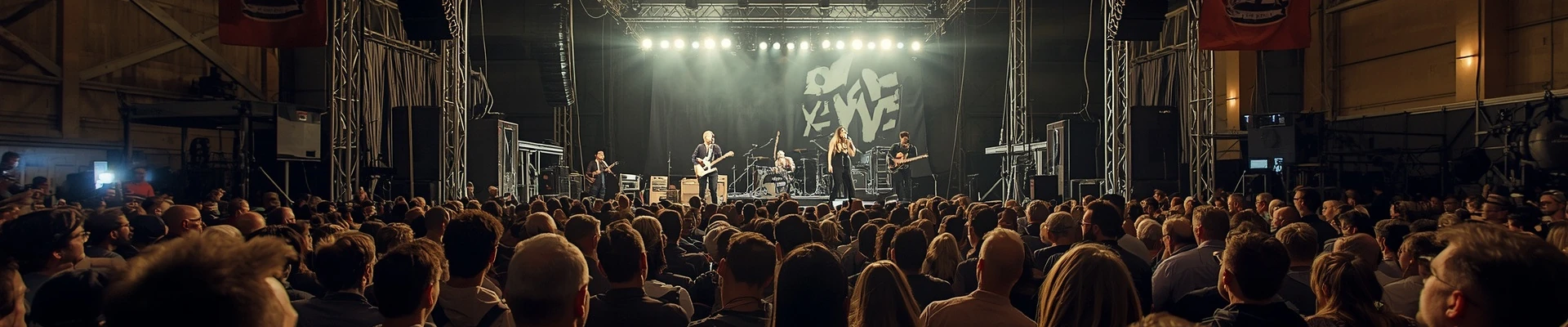
Glendale's live music geography is concentrated in a few key zones. Downtown Glendale along Brand Boulevard and Colorado Street has the highest density of bars, restaurants, and event spaces with live music programming. The Americana at Brand — an outdoor lifestyle shopping centre that opened in 2008 — hosts occasional outdoor music events and maintains a performance calendar that skews toward family-oriented and tourist-friendly bookings.
The Tropicana Bar and various lounges along San Fernando Road into the city's industrial and working-class zones carry a rougher, less curated live music calendar that is more representative of what Glendale's working musicians actually play. Armenian nightclubs scattered through the central city carry live rabiz and pop programming on weekends, largely for community audiences who do not interface with the Anglophone entertainment press.
The Verdugo Woodlands neighbourhood and the foothill corridors above Brand connect Glendale to its outdoor recreation identity and to a folk and acoustic music scene that overlaps with the hiking and nature communities of the Verdugos.
What Ties It Together
Glendale's musical signature is the sound of a diaspora city doing two things at once: maintaining an intensely specific ethnic cultural identity — Armenian, with all its historical weight and musical complexity — while simultaneously being embedded in the most commercially consequential entertainment industry in the world. System of a Down is the loudest expression of that duality: a band that is simultaneously a product of suburban Los Angeles metal culture and an unmistakably Armenian musical statement. The Alex Theatre embodies a different register of the same tension: a restored 1923 movie palace that now hosts both touring pop acts and Armenian national ensembles, in a city where both audiences are the same people.
For working musicians, Glendale's practical appeal is straightforward: studio proximity, reasonable rents relative to the Westside, a dense community of fellow professionals, and a freeway grid that puts every major venue and recording facility within commuting distance. The city does not produce a single genre; it produces musicians, some of whom become famous, most of whom sustain careers in the invisible economy of session work, film scoring, teaching, and weekend gigging that is the real foundation of Los Angeles's music industry.