
San Francisco is the fourth-largest city in California and the 17th-largest in the United States, with roughly 828,000 residents inside the city limits and more than 4.7 million across the surrounding San Francisco Bay Area that includes Oakland, Berkeley, San Jose, and dozens of other cities. Stretched across the 49 square miles at the tip of a peninsula between the Pacific Ocean and San Francisco Bay, ringed by the Golden Gate to the north and a chain of hills that rise into Twin Peaks at its center, it is one of the most architecturally and culturally distinctive cities in the United States — and, despite its small population by national standards, one of the most important music cities in the world. San Francisco's musical identity reflects its geography and its history: a port city, a Gold Rush boomtown, a counterculture capital, a center of Black migration during World War II, the global epicenter of the gay liberation movement, and the headquarters of the technology industry that has remade the world's economy.
A brief history
The peninsula was Ramaytush Ohlone territory for thousands of years before Spanish soldiers and Franciscan missionaries established the Presidio of San Francisco and the Mission San Francisco de Asís ("Mission Dolores") in 1776. The settlement remained a small mission and military outpost until the 1848 discovery of gold at Sutter's Mill triggered the California Gold Rush, which transformed San Francisco from a town of fewer than 1,000 people in 1848 to more than 25,000 by 1850 and 150,000 by 1870. The 1906 earthquake and fire destroyed roughly 80% of the city; rebuilding was rapid and largely complete within a decade. World War II brought hundreds of thousands of new residents — including many Black Southerners drawn by shipyard work in nearby Hunters Point and Richmond — and made the Bay Area one of the most important industrial regions on the Pacific Coast. The 1950s Beat Generation at North Beach's City Lights Bookstore, the 1960s Summer of Love in the Haight-Ashbury, the 1970s gay liberation movement and the Castro, the 1980s and 1990s rise of personal computing in the South Bay, and the 21st-century explosion of social media, biotech, and venture capital have all left their mark on the city. Successive waves of migration — from Mexico, Central America, China (San Francisco's Chinatown is the oldest in North America), the Philippines, Vietnam, Korea, India, and the wider Pacific Rim — have built a city that has been majority-minority for decades and continues to be reshaped by displacement and gentrification.
Music identity
San Francisco's most internationally famous musical chapter is the psychedelic rock explosion of the mid-1960s. The convergence of Beat poets, Stanford LSD experiments, an exploding Haight-Ashbury hippie population, and a generation of musicians produced the Grateful Dead, Jefferson Airplane, Big Brother and the Holding Company with Janis Joplin, Quicksilver Messenger Service, Country Joe and the Fish, Moby Grape, It's a Beautiful Day, the Steve Miller Band, and Sly and the Family Stone — collectively redefining American rock and roll. Bill Graham's Fillmore Auditorium (and later Fillmore West at Market and Van Ness, and the Winterland Ballroom) became the most influential rock venues in the world from 1965 to 1971, hosting almost every major American and British band of the era. The Monterey Pop Festival in 1967 (held two hours south but driven by San Francisco musicians and promoters) and the Summer of Love that same year made the city the global capital of the counterculture. The Grateful Dead, in particular, built a 30-year touring catalog that turned them into one of the most influential American bands of the 20th century.
The same decades produced one of the foundational catalogs of Latin rock. Carlos Santana, raised in the Mission District, formed Santana in 1966 and broke globally with their performance at Woodstock in 1969 and the Santana (1969) and Abraxas (1970) albums. The fusion of blues, rock, Latin percussion, and jazz that Santana built became one of the foundational templates for Latin rock, fusion, and world music, and the band's continued ties to San Francisco — through the Mission, the Fillmore, and a long lineage of Bay Area Latin musicians — remain central to the city's identity. Pete Escovedo, his daughter Sheila E., Malo, and a deep Bay Area Latin-rock circuit ran through San Francisco clubs alongside.
San Francisco's Black music lineage is equally deep. Sly and the Family Stone, formed in San Francisco in 1966 by Sylvester Stewart (Sly Stone), built one of the most influential Black music catalogs of the 20th century — fusing soul, funk, rock, and psychedelia in albums like Stand! (1969) and There's a Riot Goin' On (1971). Tower of Power, formed in Oakland but a constant San Francisco presence, built the East Bay Grease funk-and-soul horn-driven sound. Sylvester ("You Make Me Feel (Mighty Real)") was San Francisco's defining disco voice and one of the central figures in the gay liberation movement; the city's gay disco scene at clubs like the Trocadero Transfer, the End Up, the I-Beam, and the Stud in the 1970s and 1980s helped define the broader American disco era. Two Tons O' Fun (later the Weather Girls), the Cockettes's music programming, and a generation of San Francisco gay performers built a parallel disco and dance music tradition that would later feed house and electronic music globally.
The 1980s and 1990s remade the city again. Faith No More, formed in San Francisco in 1979, became one of the most influential alternative metal bands of the late 1980s and 1990s. Primus, Mr. Bungle, Operation Ivy (Berkeley-based but a constant San Francisco presence), Green Day (East Bay-based but constantly playing San Francisco's 924 Gilman scene before relocating to global stardom), Counting Crows (Berkeley-based), Third Eye Blind (formed in San Francisco), Train (formed in San Francisco), and Metallica (which relocated from Los Angeles to San Francisco / El Cerrito in 1983 and built much of its career out of the East Bay) all came up in or worked through the broader San Francisco scene. Punk and hardcore had a deep San Francisco lineage through the Mabuhay Gardens in North Beach (the city's foundational late-1970s punk venue), The Dead Kennedys, The Avengers, Crime, Flipper, and a generation of late-1970s and early-1980s punk bands. The Maximum Rocknroll zine and the 924 Gilman Street project across the Bay in Berkeley made the broader Bay Area one of the most important global hubs for hardcore and DIY punk.
San Francisco hip-hop has its own foundational lineage. The Bay Area broke from the East Coast / West Coast hip-hop binary with a distinctive sound built through Too Short (Oakland-based but a constant San Francisco presence), MC Hammer (Oakland), E-40 (Vallejo), Andre Nickatina, San Quinn, Messy Marv, The Jacka, JT the Bigga Figga, RBL Posse, Cellski, and the Hyphy movement of the early-to-mid 2000s, with anthems by Mac Dre (Vallejo), Keak da Sneak (Oakland), the Federation, and E-40. Latin music — primarily Mexican, Salvadoran, Honduran, Nicaraguan, and Guatemalan — runs through the Mission District and the Excelsior, with cumbia, salsa, bachata, and reggaeton circuits at clubs across the city. Indie rock runs through bands working out of clubs across the Mission, the Lower Haight, and South of Market — including Deerhoof, Thee Oh Sees (now Osees), Ty Segall (San Francisco-based for years), Sleater-Kinney's adopted Bay Area home, Joanna Newsom's Bay Area roots, Vetiver, The Fucking Champs, and a current generation of bands. Electronic and club music run through deep house, techno, and breakbeat scenes anchored by the EndUp, Public Works, F8, Halcyon, the Mighty, the DNA Lounge, and a long DJ tradition from the Wicked Crew and Hardkiss Brothers through Doc Martin's residencies. The San Francisco Symphony, the San Francisco Opera, and the San Francisco Ballet anchor one of the most respected classical and contemporary music traditions in the United States; the SFJAZZ Center in Hayes Valley is the country's most prominent dedicated jazz venue.
Venues and neighborhoods
San Francisco's venue ecosystem is unusually deep for the city's size. At the top sit the Chase Center (home of the Warriors and the city's largest indoor concerts), Oracle Park (which hosts stadium tours), Outside Lands's Golden Gate Park footprint, the Bill Graham Civic Auditorium, the Warfield, the Masonic, the Fillmore (still operating as one of the most legendary rock venues in the world), the Great American Music Hall (a 1907 Beaux-Arts hall, one of the most beautiful clubs in the country), the Davies Symphony Hall (home of the SF Symphony), the War Memorial Opera House, the Herbst Theatre, and the SFJAZZ Center. The midsize tier includes the Regency Ballroom, the Independent, the Chapel in the Mission, Bimbo's 365 Club, the DNA Lounge, Rickshaw Stop, Bottom of the Hill, Slim's (now closed), Brick & Mortar, August Hall, and the UC Theatre in Berkeley. Beneath them is a deep club layer — the Boom Boom Room, the Saloon (the oldest continuously operating bar in San Francisco, anchoring the city's blues circuit), Hotel Utah, Make-Out Room, El Rio, Amnesia, Knockout, Hemlock Tavern's legacy, Public Works, F8, Halcyon, the Stud's legacy, the EndUp, the Café, and a network of bars and DIY rooms across the Mission, North Beach, the Haight, the Castro, and SoMa.
Different neighborhoods carry different musical identities. The Haight-Ashbury anchors the city's psychedelic rock history. The Mission is the heart of the city's Latin scene, the modern indie and punk scenes, and a deep bar and club circuit. SoMa anchors the warehouse and electronic music scene through Public Works, F8, and a long lineage of after-hours clubs. The Castro retains its central role in gay disco and dance music history. North Beach anchors the Beat Generation history, Italian-American music tradition, and the Saloon. The Fillmore District — historically the "Harlem of the West" — was, before mid-20th-century redevelopment displaced much of its Black population, one of the great Black jazz and blues districts in the United States; the modern Fillmore venue and the Fillmore Heritage Center preserve elements of that history. Bayview-Hunters Point anchors the city's Black music traditions. Chinatown, the Sunset, the Richmond, Japantown, the Excelsior, and Visitacion Valley support immigrant music scenes from across Asia and Latin America. The Tenderloin has a complicated music history that includes everything from punk and hip-hop venues to drag and ballroom traditions.
Festivals and signature events
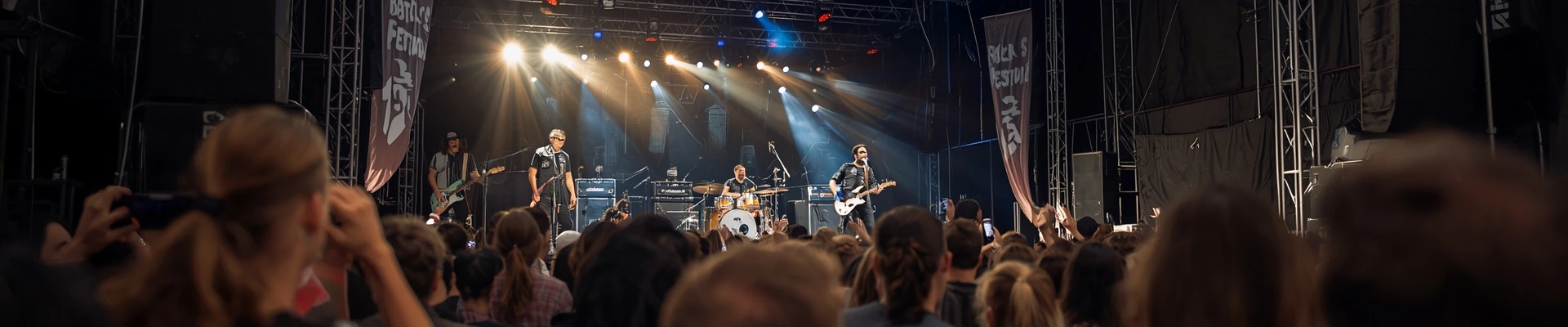
The festival calendar reflects the city's range. Outside Lands in Golden Gate Park each August is one of the largest U.S. festivals, drawing more than 200,000 attendees over three days. Hardly Strictly Bluegrass in Golden Gate Park each fall is the largest free music festival in the United States, drawing more than 750,000 attendees and programming roots, country, bluegrass, and Americana on multiple stages. Stern Grove Festival, founded in 1938, is the country's oldest free admission outdoor music festival. Noise Pop each February is one of the most respected indie discovery festivals on the West Coast. Treasure Island Music Festival's legacy, Portola Music Festival (electronic music), The Up Your Alley and Folsom Street Fair music programming, Pride San Francisco (one of the largest Pride festivals in the world), Carnaval San Francisco in the Mission, Chinese New Year Parade, Dia de los Muertos in the Mission, Cherry Blossom Festival in Japantown, Castro Street Fair, Up Your Alley, DNA Lounge anniversary parties, and the SFJAZZ Festival add cultural and community programming. Burning Man (held in Nevada but largely organized from San Francisco) and the broader decompression culture feed the city's electronic and experimental scenes year-round.
What ties it all together is the city's combination of compact density, immigrant diversity, and a continuous tradition of musical reinvention from the Gold Rush dance halls of the 1850s through the Summer of Love, the gay disco era, the Hyphy movement, and the modern indie and electronic scenes. San Francisco is the city where the Grateful Dead built improvisation into the foundation of American rock, where Santana fused Latin and rock and roll, where Sylvester remade disco from the gay clubs of the Castro, where the Fillmore programmed almost every great band of the 1960s, and where the SFJAZZ Center and Davies Symphony Hall continue to make the city one of the most important music cities in the world for its size.