
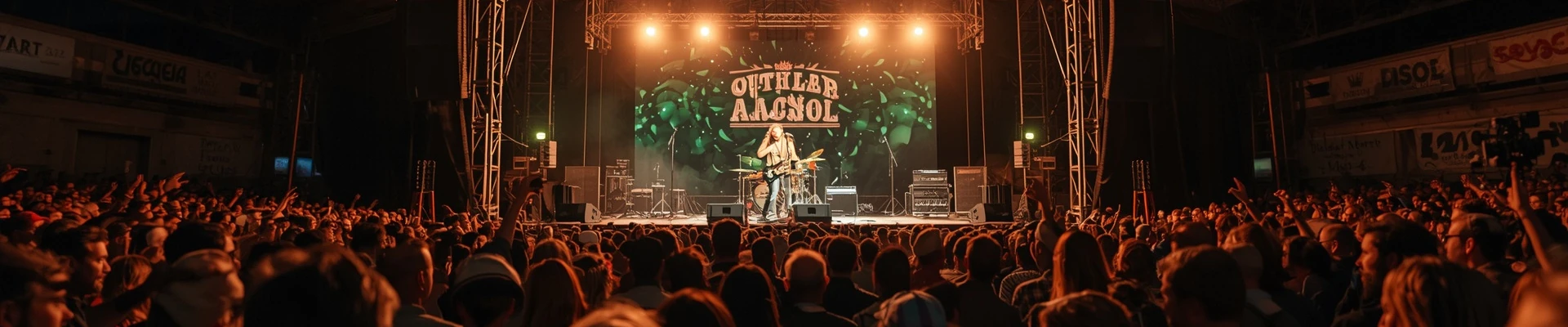
Athens sits in the northeastern Georgia Piedmont, roughly an hour east of Atlanta along the US-78 corridor, cradling the University of Georgia campus — the oldest public university chartered in the United States (1785). The Oconee River bends around the city's southern edge, and the surrounding Clarke County landscape is a patchwork of old hardwood forest and sprawling college-town sprawl. A population hovering around 127,000 makes Athens modest by national standards, but its outsized cultural footprint has earned it a reputation as one of the most musically fertile small cities in North America.
A Scene Built on College Town Energy
Athens became a music town not through industrial wealth or port city traffic but through the peculiar alchemy of a large student body, cheap rent, lax ID enforcement at bars, and an art school (the UGA Lamar Dodd School of Art) that put experimental attitudes into the same rooms as rock bands and Southern gothic literary sensibilities. By the late 1970s, those conditions had crystallized into something unique: a local scene that sounded like nothing coming out of New York, London, or Los Angeles.
The catalytic moment arrived in 1978–79. Pylon — formed by UGA art students Vanessa Briscoe Hay, Randy Bewley, Michael Lachowski, and Curtis Crowe — debuted at the Tyrone's O.C. bar playing jagged, rhythmically locked post-punk that UK music press would later call one of the defining sounds of American post-punk. Simultaneously, a group calling themselves R.E.M. played their first show on April 5, 1980, in the deconsecrated St. Mary's Episcopal Church. Within two years they had signed to I.R.S. Records and were becoming one of the most important American rock bands of the decade.
R.E.M. and the Athens Sound
R.E.M. — Michael Stipe, Peter Buck, Mike Mills, and Bill Berry — spent their formative years in Athens, recording their first single "Radio Free Europe" (1981) at Bombay Recording Studio with producer Mitch Easter in Winston-Salem, but cutting much of their early catalog at local studios and performing constantly at The 40 Watt Club and The Georgia Theatre. Their sound — jangly guitar arpeggios over melodic basslines, cryptic lyrical abstraction, Stipe's mumbled baritone — became known as "the Athens Sound" even though Pylon, the dB's, and the Love Tractor had helped define that aesthetic first. Their commercial breakthrough with Murmur (1983) put Athens on the map for rock journalism worldwide.
The scene R.E.M. came out of was dense with talent. The B-52s — Fred Schneider, Kate Pierson, Cindy Wilson, Ricky Wilson, and Keith Strickland — had emerged from the same late-1970s Athens party circuit, making their New York debut at Max's Kansas City in 1978 before anyone had called them a band. Their debut single "Rock Lobster" (1979) on DB Records (Daniela Belcher and Danny Beard's Atlanta-Athens indie) became an international new wave anthem. Ricky Wilson's unorthodox guitar tunings and the band's campy, thrift-store surf-kitsch aesthetic were as distinctly Athens as the kudzu on the highway embankments.
Widespread Panic and the Southern Rock Continuum
While the post-punk wing got national attention, Athens also developed a parallel strand rooted in Southern rock, blues, and improvisational jamming. Widespread Panic formed at UGA in 1983 around guitarist John Bell and pianist John Hermann, building a devoted following through relentless touring and a loose, exploratory sound that drew on the Allman Brothers Band tradition — the Allmans themselves having emerged from Macon, three hours south. By the 1990s Widespread Panic was consistently selling out arenas and had become one of the most successful touring acts in American rock without significant mainstream radio play, a testament to the depth of their Athens-grown fanbase.
Indie Infrastructure: Labels, Studios, and Venues
The 1980s Athens scene ran on a small but functional indie infrastructure. DB Records (Atlanta, deeply Athens-connected) released early singles by the B-52s and Pylon. Bar/None Records and Midnight Records handled some distribution; later Drive-By Truckers' own New West Records relationship grew from Athens roots. The 40 Watt Club — originally opened in 1979 by Atlanta Rhythm Section roadie Curtis Crowe's friend Jared Bailey in a space with a single 40-watt bulb — is the scene's spiritual home, having operated continuously in various locations on College Avenue and Washington Street. Every major Athens band has played the 40 Watt; touring artists from Nirvana to Neutral Milk Hotel treated it as a pilgrimage stop.
The Georgia Theatre on Lumpkin Street is the city's mid-capacity flagship, a 1935 building converted from a YMCA to a cinema to a music venue. A 2009 fire gutted the interior but the venue was rebuilt and reopened in 2011, now holding around 1,000 standing. Caledonia Lounge, a 200-cap dive room on Washington Street, has served as a DIY incubator for newer acts. Normal Bar and the now-defunct The Uptown Lounge have hosted local scenes across multiple generations.
Neutral Milk Hotel, Of Montreal, and the Elephant 6 Collective
In the mid-1990s a second wave of internationally significant music emerged from Athens via the Elephant 6 Recording Company — a loose collective of bands including Neutral Milk Hotel (Jeff Mangum), Of Montreal (Kevin Barnes), the Olivia Tremor Control (Bill Doss and Will Cullen Hart), and the Apples in Stereo. Their aesthetic was lo-fi, orchestral, and psychedelic, with four-track cassette recordings and deliberately anti-commercial production values. Neutral Milk Hotel's In the Aeroplane Over the Sea (1998) on Merge Records is now canonized as one of the greatest indie rock albums ever made; it spent years as a cult item before achieving widespread critical recognition in the 2010s.
Of Montreal established a lengthy catalog of kaleidoscopic baroque pop and glam-influenced art rock through the 2000s and 2010s, producing albums like Hissing Fauna, Are You the Destroyer? (2007) on Polyvinyl Records that remain beloved by a dedicated global fanbase. The Elephant 6 bands shared musicians, artwork, and a communal recording philosophy centered on Pet Sounds Studio in Athens and home recording setups scattered across town.
Drive-By Truckers and Southern Narrative Rock
Drive-By Truckers — formed by Patterson Hood (son of Muscle Shoals session bassist David Hood) and Mike Cooley — came together in Athens in 1996 and became a kind of living argument for Southern complexity. Their double album Southern Rock Opera (2001) was a sprawling meditation on the Lynyrd Skynyrd mythology and the contradictions of Southern identity that earned them enormous critical respect. The band recorded at Chase Park Transduction in Athens, a studio also used by Widespread Panic and dozens of local acts. Though the Truckers eventually relocated between Athens and other Southern cities, Athens remained their artistic home base through their most celebrated period.
The University of Georgia's Cultural Infrastructure
UGA's Hugh Hodgson School of Music provides classical and jazz training, feeding musicians into the local scene. The university's Tate Student Center and various campus quad spaces host major touring acts. Athfest — the annual Athens Music and Arts Festival launched in 1997 — takes over College Avenue and adjacent blocks each June, showcasing dozens of local bands alongside national indie acts and serving as an annual reassertion of the scene's vitality. A companion AthFest Educates nonprofit funds school music programs in Clarke County.
Neighborhoods and Geographic Identity
The city's music geography is concentrated in the downtown core: the stretch of College Avenue, Clayton Street, and Washington Street running west from the UGA arch holds most of the clubs, bars, and rehearsal spaces. The Five Points neighborhood north of downtown is a quieter residential and commercial district where many musicians have lived. The Normaltown area west of downtown has developed a secondary cluster of smaller venues and studios. West Broad Street connects downtown to historically Black neighborhoods that have their own deep roots in gospel, soul, and R&B separate from the university-adjacent indie scene — a cultural divide that Athens has grappled with imperfectly.
Legacy and Continuing Scene
Athens has never fully repeated the concentrated commercial success of the 1980s wave, but the scene has remained consistently active. Bands like Reptar, Mothers, the New Madrid, Damien Jurado (based briefly here), and countless other indie and experimental acts have kept the 40 Watt and Georgia Theatre busy. The city's festival calendar includes not just Athfest but the Athens Intensified showcase and the Slingshot Festival of creative economy events. Flagpole Magazine, the alt-weekly, has covered the scene since 1987, maintaining a meticulous archive of Athens music history.
What ties it all together is a persistent belief — reinforced by repeated evidence — that something generative happens when art school sensibility meets cheap Southern real estate meets a captive audience of 40,000 undergraduates. Athens is small enough that everyone knows everyone, which breeds both competition and collaboration. The city has produced bands in virtually every genre of post-1960s rock — post-punk, new wave, jam, lo-fi indie, Southern rock, art pop — and continues to attract musicians who sense that its particular combination of affordability, culture, and community might produce the next thing nobody saw coming.