
St. Louis is the largest city in Missouri and one of the great historic cities of the American interior, sitting on the western bank of the Mississippi River at its confluence with the Missouri River — the geographic gateway through which the Lewis and Clark Expedition passed in 1804 and through which the entire westward expansion of the United States flowed. With roughly 300,000 residents inside the city limits and more than 2.8 million across the bi-state metropolitan area spanning Missouri and Illinois, St. Louis is the dominant economic and cultural centre of the middle Mississippi Valley. The city's iconic Gateway Arch — completed in 1965, the tallest man-made monument in the United States — rises 630 feet above the riverfront as a monument to that westward expansion. St. Louis is home to Washington University in St. Louis, Saint Louis University, University of Missouri–St. Louis, and Harris-Stowe State University, and it supports a sprawling network of world-class cultural institutions: the Saint Louis Art Museum, the Saint Louis Symphony Orchestra (founded 1880, one of the oldest in the United States), the Missouri Botanical Garden, and the Saint Louis Zoo (famously free). The city is roughly 45% Black and has historically been one of the most segregated major American cities — a fact that has profoundly shaped both its culture and its music.
A brief history
The land along the western bank of the Mississippi was Osage and Illini territory when French fur traders established a trading post here in 1764, naming it after the French king Louis IX. St. Louis grew rapidly as a commercial hub — by the mid-19th century it was the fourth-largest city in the United States, a staging point for westward expansion, a riverboat trading capital, and one of the busiest ports on the continent. The city hosted the 1904 World's Fair (the Louisiana Purchase Exposition) and the 1904 Olympic Games, events that placed St. Louis at the centre of American cultural ambition. The fair's lasting music legacy: it introduced Scott Joplin's ragtime compositions to the world, cementing St. Louis's foundational role in the development of American popular music.
The 20th century brought industrial expansion, a thriving jazz and blues scene, and eventually the suburban white flight and deindustrialization that hollowed out the city's core after the 1950s. The 1904 World's Fair corridor along Lindell Boulevard; the Gaslight Square entertainment district that burned bright in the 1950s and 60s; the Pruitt-Igoe housing project (demolished in 1972–76, its failure becoming a defining symbol of American urban policy's failures) — all of these mark the city's complicated 20th-century arc. The decline was severe: St. Louis had 857,000 residents in 1950 and fewer than 300,000 by the 2020 census. But the post-industrial landscape it left — cheap rents, dense brick architecture, vacant warehouses — has made the city's music and arts communities among the most dynamic and affordable in the United States.
Music identity
St. Louis's most internationally consequential musical contributions are foundational. Scott Joplin — the "King of Ragtime" — lived and composed in St. Louis from 1900 to 1907, writing the "Maple Leaf Rag" (1899, the first sheet music to sell over one million copies) and his opera Treemonisha during this period. Joplin's ragtime — a syncopated, piano-driven fusion of African American musical traditions — directly seeded the development of jazz and the entire trajectory of American popular music. The Scott Joplin House on Delmar Boulevard is now a state historic site.
The St. Louis Blues tradition is the other great foundational contribution. The city's Mississippi riverfront position made it a magnet for blues musicians travelling the river circuit from the Deep South, and by the 1920s and 1930s St. Louis had developed its own blues dialect — earthier than the Delta style, more urban and piano-driven, with a particular affinity for boogie-woogie and barrelhouse. Henry Townsend, Lonnie Johnson, and Victoria Spivey represent the classic St. Louis blues lineage. The city gave its name to W.C. Handy's "St. Louis Blues" (1914), one of the most recorded songs in American music history.
The most internationally consequential figure in St. Louis music history is Chuck Berry — born in the Ville neighborhood in 1926, raised in North St. Louis, and the single most important architect of rock and roll. Berry's synthesis of country guitar, blues rhythm, and teenage lyrical themes — on songs like "Maybellene" (1955), "Roll Over Beethoven" (1956), "Johnny B. Goode" (1958), and dozens more — created the vocabulary that the Beatles, the Rolling Stones, and virtually every rock band of the subsequent six decades built upon. Berry was a regular performer at Blueberry Hill in The Loop, his home venue for decades; he played there monthly until his death in 2017. A bronze statue of Chuck Berry stands outside Blueberry Hill. Johnnie Johnson — Berry's pianist and co-creator of the Chuck Berry sound, whose boogie-woogie right hand was the engine behind those records — was a St. Louis native who lived in the city throughout his life.
Ike Turner (born in Clarksdale, Mississippi, but long based in St. Louis) launched his recording career here, and it was in St. Louis that he and Tina Turner (born Anna Mae Bullock in Nutbush, Tennessee, who came to St. Louis as a teenager) built the Ike & Tina Turner Revue in the late 1950s and 1960s — one of the most electrifying live acts in American music history.
Miles Davis grew up across the river in East St. Louis, Illinois — technically a separate city but culturally inseparable from the greater St. Louis music world. East St. Louis was also home to Oliver Lake, founding member of the Black Artists Group (BAG) — the St. Louis avant-garde collective (active 1968–1972) that was a peer institution to Chicago's AACM, launching Lester Bowie, Julius Hemphill, Hamiet Bluiett, and David Murray (later founding the World Saxophone Quartet) into internationally important jazz careers.
In the hip-hop era, St. Louis produced one of the biggest commercial acts in American music: Nelly (Cornell Iral Haynes Jr.), whose 2000 debut Country Grammar sold over ten million copies and made "Country Grammar (Hot Shit)" and "E.I." into national anthems. Nelly's success opened doors for a generation of St. Louis hip-hop artists — Chingy ("Right Thurr," 2003), Murphy Lee (a member of Nelly's St. Lunatics crew), and the Field Mob lineage. Huey ("Pop, Lock & Drop It," 2006) further extended St. Louis's commercial hip-hop profile. More recently, Smino (Monte Lloryn Smith) has emerged as one of the most critically acclaimed artists in neo-soul and alternative R&B, his 2017 blkswn placing St. Louis squarely in the conversation of contemporary Black American music innovation. JMSN, Travis Thompson, and the EarDrummers collective have extended the city's R&B and soul lineage into the streaming era.
The city's punk and indie rock scene has been productive since the 1980s. Urge Overkill had St. Louis connections; Stl-Sly, Foxing (their 2013 The Albatross helped define Midwest emo's second wave), Wavves, The Conformists, and the Bruiser Queen rock duo are among the bands that have given the city's indie scene national attention. The Cherokee Street corridor in South St. Louis has been the primary locus of the DIY music scene since the 2000s — record shops, rehearsal spaces, house shows, and small venues clustered in a walkable strip through a historically Bohemian and now gentrifying neighborhood.
Venues and neighborhoods
The Pageant on Delmar Boulevard in The Loop is the city's flagship mid-size venue — a 2,500-capacity room that has hosted virtually every major touring act for two decades. Blueberry Hill, also on The Loop, is a legendary music pub with a duck room stage that Chuck Berry made his home. The Sheldon in Midtown is the most beautiful room in the city — a 700-seat concert hall in a 1912 Beaux-Arts building, home to jazz, classical, and world music programming. Delmar Hall (also on The Loop) handles the 1,000-1,200 capacity tier. Plush in the Grove neighborhood is the city's pre-eminent LGBT+ music and events venue. The Ready Room in Grand Center has become a key indie booking room. The Factory in suburban Maryland Heights handles arena-adjacent touring. Stifel Theatre (formerly the Fox Theatre's neighbor — actually the 4,000-seat Stifel Centre for the Performing Arts) handles the larger touring market. The Fabulous Fox Theatre — a 4,600-seat 1929 atmospheric movie palace — books Broadway touring shows and major concert events.
The Loop (Delmar Boulevard through University City and St. Louis) is the city's most concentrated music and entertainment corridor — record shops, clubs, restaurants, and the Walk of Fame (inducting St. Louis musical luminaries into sidewalk stars). Cherokee Street in South St. Louis is the indie/DIY scene's center of gravity. Soulard — the city's oldest neighborhood, settled by French Creoles — sustains a dense blues-bar scene around the Soulard Farmers Market and the annual Soulard Mardi Gras celebration (one of the largest in the country outside New Orleans). Grand Center is the city's designated arts district, home to the Saint Louis Symphony, Jazz St. Louis, and several performing arts organizations. The Grove on Manchester Avenue has a dense concentration of LGBT+-friendly bars and music venues.
Festivals and events
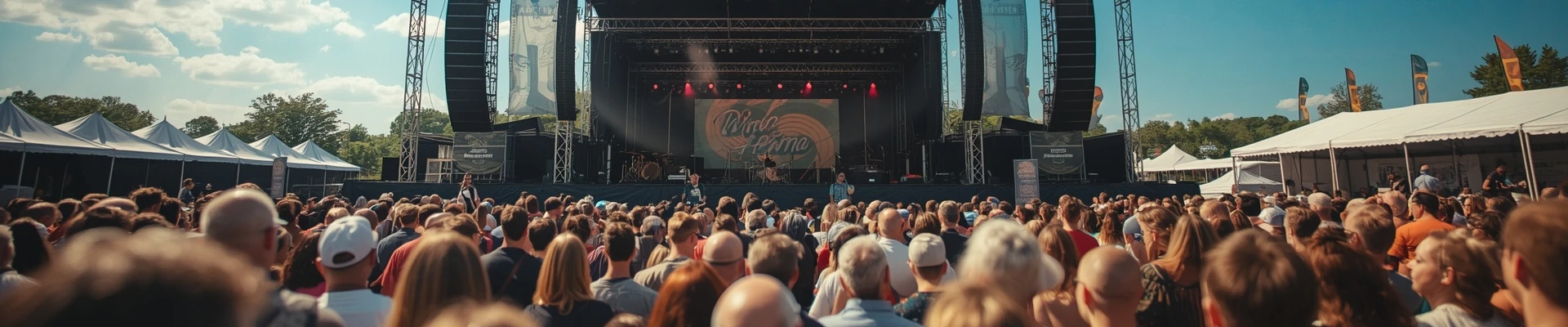
The Big Muddy Blues Festival at Laclede's Landing on Labor Day weekend is the city's signature free blues festival — two days of national and regional blues acts on outdoor stages along the Mississippi riverfront. Fair Saint Louis (the Fourth of July celebration along the Gateway Arch grounds) has hosted major free concerts for decades. LouFest — a two-day indie/rock/pop festival in Forest Park — ran from 2010 to 2018 and at its peak booked acts like LCD Soundsystem, Chance the Rapper, and The Avett Brothers before financial collapse ended it. Jazz St. Louis presents the Jazz Festival annually in Grand Center and runs year-round programming at its performance space. Soulard Mardi Gras brings live brass bands and zydeco acts to the streets each February. HEC Media's B-97 Summer Jam and similar radio-station events sustain the urban contemporary market.
What ties it all together
St. Louis is a city whose music has always been bigger than the city itself — a place that gave the world ragtime, gave rock and roll its guitar grammar, gave jazz one of its most innovative avant-garde chapters, and gave hip-hop one of its most commercially dominant voices of the 2000s, and yet has never fully received the cultural credit those contributions deserve. Its position as a majority-Black city with a history of deep segregation has meant that its musical contributions — from Joplin's ragtime through Chuck Berry's rock and roll through the BAG's free jazz through Nelly's rap — have been innovations born in African American communities that crossed over to reshape global popular music while the city's infrastructure and economy deteriorated around the artists making them. The gateway through which American expansion flowed has always been better at sending things out than holding them in. But the music keeps coming — from Smino's neo-soul to Foxing's emo to the blues bars of Soulard to the DIY stages of Cherokee Street — and St. Louis's place in American music history, grounded in the convergence of the Mississippi and Missouri rivers and the lives of the people who built this city, remains essential.