

Abbotsford sits in the eastern Fraser Valley, roughly 70 kilometres east of Vancouver, at the foot of Sumas Mountain with the peaks of the Cascade Range looming to the south across the Canada–United States border. The Trans-Canada Highway and the Canada–US Peace Arch crossing at nearby Huntingdon run directly through Abbotsford's geography, giving the city a dual character: it's simultaneously a working agricultural and logistics hub and one of the fastest-growing cities in British Columbia. With a population approaching 150,000 in the city proper and close to 200,000 across the wider Abbotsford–Mission Census Metropolitan Area, it is the largest city in the Fraser Valley and the fifth-largest in BC. Its economy is built on agri-business (the Fraser Valley is Canada's most productive farmland per hectare), light manufacturing, and a logistics corridor that handles traffic flowing between Metro Vancouver and the interior.
That agricultural and suburban foundation might suggest a modest cultural landscape — but Abbotsford's music scene is more layered than its geography implies, shaped by three large and culturally distinct communities: a South Asian (predominantly Punjabi Sikh) diaspora that represents more than 20 per cent of the population and is one of the largest outside of Greater Vancouver; a deeply rooted Mennonite population descended from settlers who arrived from Russia via the Canadian Prairies in the 1920s; and a second- and third-generation settler community that has produced a thriving evangelical Christian music scene, a surprisingly productive metal and hard rock underground, and a growing indie pop circuit tied to the trans-corridor between Abbotsford and Vancouver.
A brief history
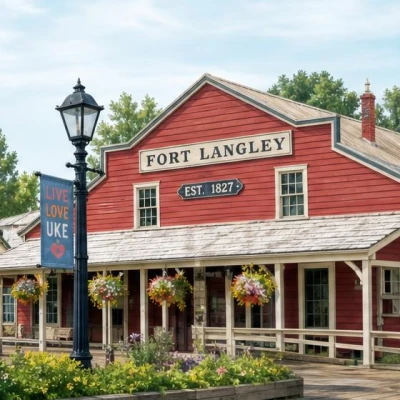
The Stó:lō Nation — whose name means "people of the river" — have lived in the Fraser Valley for thousands of years. Their territory stretches along the Fraser River from its mouth near Fort Langley east through Chilliwack and beyond, and Abbotsford sits squarely within traditional Stó:lō lands. The Matsqui, Sumas, and Semiahmoo peoples maintained villages, fisheries, and trade routes throughout this valley long before European contact. The Fort Langley National Historic Site, just west of the city, marks the 1827 Hudson's Bay Company post that became the economic pivot of the lower Fraser.
Abbotsford's European settlement accelerated in the 1880s with the arrival of the Canadian Pacific Railway and was reinforced by waves of Mennonite migration in the 1920s and again in the postwar period. Russian Mennonites — Low German-speaking families who had fled the Soviet Union — established farms and church communities across the eastern Fraser Valley, building a distinctive cultural and religious infrastructure that still defines parts of the city's identity. Mennonite Central Committee (MCC) has a significant regional presence; the Mennonite Heritage Museum in nearby Abbotsford documents this history. The Matsqui and Abbotsford municipalities merged in 1995 to form the current City of Abbotsford. The city was also home to Canadian Forces Base Borden's western satellite until the Abbotsford International Airport became a civilian-military joint facility that now hosts the Abbotsford International Airshow — one of the largest airshows in North America, drawing 300,000 visitors annually and running since 1962.
Music identity
Abbotsford's music scene is a study in parallel worlds that rarely fully intersect — each anchored in a distinct community — but the city has been producing artists and scenes that punch above its weight since the 1990s.
Bhangra and Punjabi music
The city's South Asian community is its most culturally productive music constituency. The Punjabi Sikh population settled heavily in Abbotsford from the 1970s onward, building gurdwaras (Sikh temples) that function as the primary community gathering spaces and the centre of shabad kirtan — the devotional music of the Sikh faith, performed by ragis (trained musicians) who play harmonium, tabla, and taus in the langar hall and darbar sahib. The Gur Sikh Temple and the Ross Road Gurdwara (among others) anchor this devotional tradition.
Beyond the religious context, Abbotsford's South Asian community is deeply embedded in bhangra — the percussive, celebratory Punjabi folk music that has become one of the dominant popular music forms in the Canadian diaspora. Fraser Valley bhangra crews and competitive dance teams travel to bhangra competitions in Surrey, Brampton, and Vancouver. The city's community halls, wedding banquet halls, and cultural centres program Punjabi pop, bhangra remix, qawwali, and classical Indian music through the wedding season and through cultural events tied to Vaisakhi (the Sikh harvest festival) in April — one of the largest Vaisakhi celebrations outside of the Punjab itself happens in Surrey, and Abbotsford's community participates with processions and nagar kirtans.
Mennonite choral tradition
The Low German Mennonite community carries one of Canada's oldest continuous choral traditions. Four-part unaccompanied singing — rooted in the Mennonite Brethren and General Conference Mennonite church traditions — has been practised in the Fraser Valley since the first Russian Mennonite settlers arrived. The Mennonite Brethren Church and its related music institutions support choir programs, children's choral festivals, and the annual Song Fest gatherings that bring together choirs from across BC and the prairies. The King Road Mennonite Brethren Church and South Abbotsford Mennonite Brethren Church field large community choirs. Columbia Bible College — a Mennonite Brethren institution in Abbotsford — runs a music program that has produced gospel singers, worship leaders, and sacred choral composers who work across Western Canada.
Evangelical and Christian music
Abbotsford is among the most church-dense cities in British Columbia, with evangelical and charismatic megachurches drawing large congregations that fund professional-grade worship music programs. Sevenoaks Alliance Church, one of the larger evangelical congregations, runs a worship arts program. The presence of Trinity Western University in nearby Langley and Columbia Bible College in Abbotsford creates a pipeline of young Christian musicians who move between campus worship bands, studio work, and the broader BC Christian music market. Several Christian recording artists and worship leaders have built careers based out of the Fraser Valley, releasing records that circulate within the Canadian Christian music network.
Rock, metal, and indie
Abbotsford has been quietly productive in rock and heavy music. The city's distance from Vancouver — close enough for touring bands to route through but far enough to develop its own circuit — supported a metal and hardcore scene through the 1990s and 2000s. Comeback Kid, the Winnipeg-based hardcore band, built significant Fraser Valley touring support through the early 2000s; the Abbotsford and Chilliwack youth-hall circuit was a reliable stop. Local bands like Herd of Instinct and a rotating cast of metal acts used the Argo and other venues on Essendene Avenue and South Fraser Way to build regional followings.
On the indie and alternative side, Abbotsford has produced musicians who migrated to Vancouver to build careers — the corridor between the two cities is short enough that artists based in Abbotsford regularly play the Vancouver circuit and vice versa. The Zolas, while Vancouver-based, built early Fraser Valley audiences. The city's arts and music community is loosely organized around the Reach Gallery Museum and the Multicultural Heritage Society. The Abbotsford Arts Council programs live music alongside visual arts events.
Jay Sparrow (the Abbotsford-bred country and roots artist) and several BC worship pop acts have built national profiles from a Fraser Valley base. The indie pop and alt-country scenes connect through the Commodore Ballroom in Vancouver (90 minutes away) and the festival circuit.
Venues and neighborhoods
Abbotsford's venue geography is spread across a car-oriented suburban grid rather than concentrated in a traditional entertainment district. The Seven Oaks Shopping Centre corridor and South Fraser Way support commercial entertainment. The Argo (a bar and live music room on Essendene Avenue) has been a cornerstone of the local rock and alternative circuit. The Reach Gallery Museum Abbotsford — a publicly funded arts centre on Clearbrook Road — programs concerts, world music, and chamber performances alongside its gallery exhibitions; it's the city's most important arts institution for music programming outside the churches. The Abbotsford Entertainment & Sports Centre (cap. 6,000+) hosts touring concerts alongside its primary function as a hockey arena.
The gurdwaras — particularly the Gur Sikh Temple on Sumas Way — function as the most significant live music spaces for bhangra and kirtan. Community halls in the Clearbrook neighbourhood (a historically Mennonite district) and the South Asian corridor along South Fraser Way and Clearbrook Road anchor the two largest diaspora communities. The MSA Arena supports smaller touring acts.
Festivals and signature events
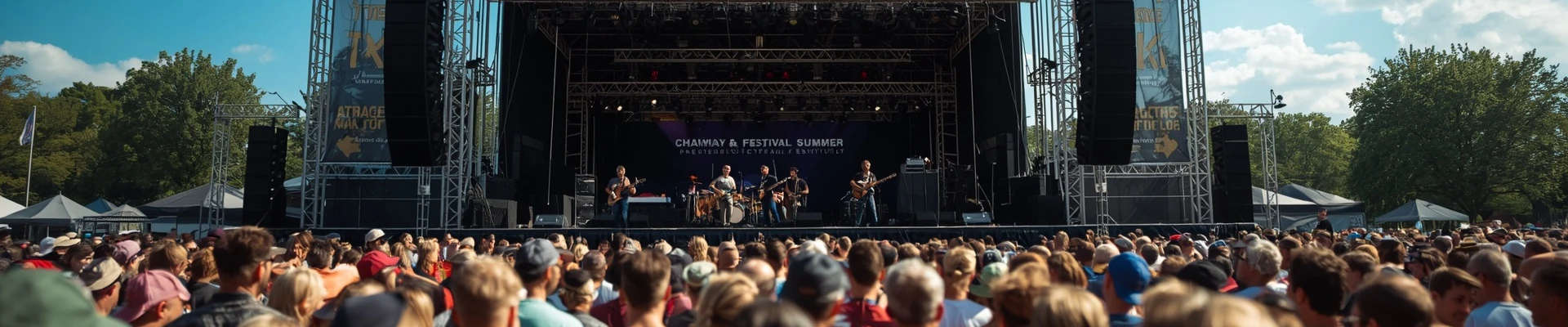
The Abbotsford International Airshow (August) is the city's signature annual event by scale — three days of aviation displays drawing hundreds of thousands of visitors, with live music programming on the grounds. The airshow's music stage has historically booked Canadian country, rock, and pop acts to accompany the aerial program.
Mela: South Asian Arts Festival is the Fraser Valley's primary celebration of South Asian music, dance, and visual arts, programming bhangra, classical Indian music, Bollywood dance, and contemporary South Asian fusion. The festival has grown alongside the South Asian community and represents one of the more substantive South Asian arts events in BC outside Metro Vancouver.
The Abbotsford Agrifair (August) — BC's second-largest fair — programs live country, folk, and roots music on its stage alongside agricultural competitions and midway. The fair has been running since 1892. The Mennonite Heritage Week and Vaisakhi Nagar Kirtan are community-scale events that draw participation from across the Fraser Valley.
The proximity to Vancouver means that Abbotsford residents treat the city's festival calendar — Vancouver Folk Music Festival, Squamish Valley Music Festival, Coastal Jazz and Blues Festival — as accessible daytrips or short drives.
What ties it all together
Abbotsford's musical identity doesn't resolve into a single signature sound the way that a port city or university town might — it's a city of three strong communities running their own musical lives in relative parallel, occasionally intersecting in the same multipurpose halls and on the same fairground stages. The shabad kirtan rising from the gurdwara on Sumas Way, the four-part Mennonite choir rehearsing in a Clearbrook church basement, the metal band loading into the Argo, and the bhangra crew drilling footwork in a community centre gymnasium — these scenes coexist without much synthesis, but that diversity itself is Abbotsford's defining musical fact. In a Fraser Valley that is rapidly urbanizing and diversifying, Abbotsford carries more musical worlds than its suburban surface suggests.