
Brantford sits on the Grand River in southwestern Ontario, roughly 100 kilometres west of Toronto and 30 kilometres east of Hamilton, at an elevation of about 239 metres above sea level. The city covers approximately 72 square kilometres and is home to around 104,000 residents — a mid-size manufacturing and education hub that carries one of the most consequential invention stories in Canadian history. Two facts define Brantford to the outside world: Alexander Graham Bell first conceived the telephone here in 1874, and Wayne Gretzky was born here in 1961. Between those twin landmarks of communication technology and hockey mythology lies a city shaped by industrial resilience, deep Indigenous adjacency, and a music culture rooted in community halls, restored theatres, and the living traditions of the Haudenosaunee people next door.
History and geography
The Grand River Valley was home to the Haudenosaunee (Iroquois Confederacy) peoples long before European contact, and the extraordinary decision by Joseph Brant — the Mohawk war chief and British ally — to lead the Six Nations to this stretch of the Grand River after the American Revolution gave the city its name and its most enduring neighbour. Six Nations of the Grand River, immediately south of Brantford, is the most populous First Nations reserve in Canada, home to more than 27,000 registered members across the Six Nations — Mohawk, Oneida, Onondaga, Cayuga, Seneca, and Tuscarora. That proximity shapes Brantford's cultural and musical life in ways that distinguish it from most Ontario cities of comparable size.
European settlement accelerated through the 1820s and 1830s. Brantford was incorporated as a town in 1847 and as a city in 1877. The Buffalo and Lake Huron Railway passed through in 1854, opening the city to commerce, and through the late 19th century Brantford became a manufacturing powerhouse — farm implements, textiles, telephones. Massey Harris (later Massey-Ferguson), one of the world's largest agricultural equipment manufacturers, had major operations here. The Bell Homestead National Historic Site preserves the farm on Tutela Heights Road where Melville Bell's family lived when Alexander Graham Bell transmitted the world's first long-distance telephone call in 1876 — from Brantford to Paris, Ontario, roughly 13 kilometres away. The city has traded on that identity ever since.
The 20th century brought manufacturing cycles of boom and contraction. The decline of heavy industry in the 1970s and 1980s hit Brantford hard, and the city became associated in Canadian media with post-industrial hollowing-out. The 2000s brought a sustained downtown revitalisation effort — the Wilfrid Laurier University Brantford Campus (established 1999) and the Nipissing University Brantford Campus brought thousands of students into a downtown that had suffered decades of disinvestment, anchoring coffee shops, bars, and live music spaces that revitalised the core. The Sanderson Centre for the Performing Arts — a meticulously restored 1919 Capitol Theatre — became the flagship of the city's arts revival.
Music identity
Brantford's most internationally significant music connection runs through Robbie Robertson, the guitarist, songwriter, and co-founder of The Band. Robertson's mother, Dolly Doreen Klegerman, was a Mohawk woman from the Six Nations reserve — and Robertson, who grew up in Toronto, spent formative summers on the reserve and in Brantford with his mother's family. That Indigenous upbringing, and specifically the music he absorbed at Six Nations — the ceremonies, the traditional songs, the overlay of country and R&B that filtered through reserve communities — shaped the sound he brought to Ronnie Hawkins's Hawks and ultimately to The Band. Albums like Music from Big Pink (1968) and The Band (1969) carry within them the sonic DNA of the Grand River Valley: a rootedness, a darkness, a sense of American and Canadian folk memory that Robertson has repeatedly traced to his Six Nations summers. He explored this heritage explicitly on his later solo albums, particularly Storyville (1991) and Music for the Native Americans (1994), which featured collaborations with the Ulali vocal group and recorded traditional Haudenosaunee music.
The Six Nations reserve itself sustains one of the richest traditional music and ceremony cultures in North America. The Six Nations Pageant — a summer theatrical performance of Haudenosaunee history staged on the reserve — and the Six Nations Powwow (one of the largest in Ontario) anchor the ceremonial calendar. Traditional social dance songs, Longhouse ceremonies, Haudenosaunee hymns sung in Mohawk and Cayuga, and the overlay of contemporary Indigenous country, hip-hop, and folk — exemplified by artists who have emerged from the Six Nations community — form a living musical tradition largely invisible to mainstream Canadian music coverage but foundational to the region.
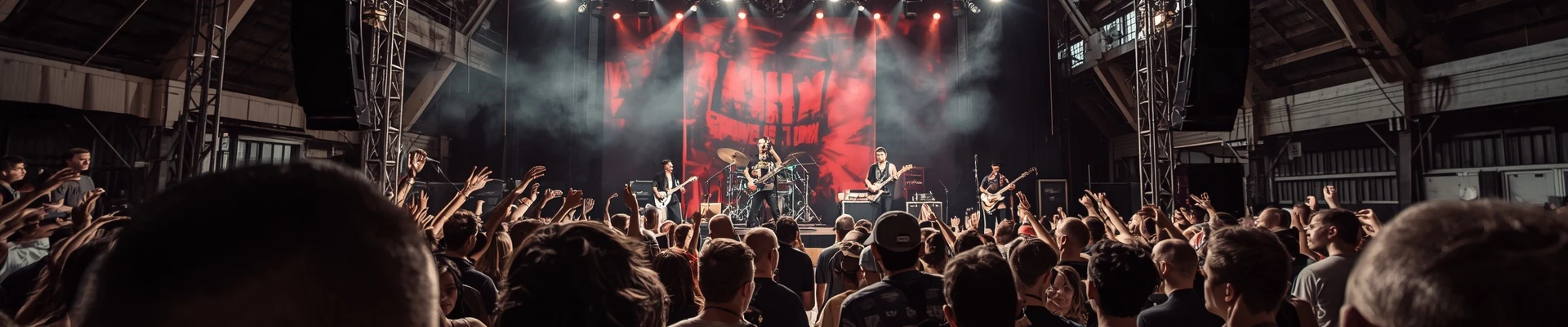
Brantford itself has a working live music scene built on the infrastructure of a mid-size Ontario city. Country and classic rock dominate the pub circuit — the city has a strong working-class music culture rooted in cover bands, open mics, and original country and rock acts playing venues across the downtown and the surrounding suburbs. The Sanderson Centre programs touring Canadian and international acts across the spectrum — touring theatrical productions, comedy, classical, roots, and pop — and serves as the city's connection to the provincial touring circuit. The Icomm Centre (the multi-use arena) handles larger touring events and community sports. Downtown pubs and bars along Colborne Street and the revitalised core run regular live music programming, energised by the student population from Wilfrid Laurier and Nipissing.
The Indigenous music ecosystem centred on Six Nations extends into Brantford's cultural programming. Indigenous artists from the reserve — spanning powwow drum groups, contemporary Indigenous country and folk, and new-generation hip-hop — increasingly move between the reserve and city venues, and cultural events organised by the Woodland Cultural Centre (which houses a significant museum of Haudenosaunee history on Mohawk Street in Brantford, housed in the former Mohawk Institute Residential School building) bridge the Indigenous and settler communities.
Brantford's gospel scene runs through the city's Black churches — the African-Canadian community in Brantford has historical roots in the Underground Railroad, and churches that were stops on that route maintain strong musical traditions. The Brantford Black History Society programs events that include musical performance. The city's Portuguese and Italian communities, established through mid-20th-century immigration waves, sustain cultural clubs that include traditional music programming.
The student population has seeded a growing indie and alternative scene. A handful of original bands working in indie rock, folk-pop, and alternative country have emerged from the Wilfrid Laurier Brantford campus environment, using downtown venues, open mics, and the Brantford connection to the Hamilton and Toronto music circuits.
Venues and neighbourhoods
The Sanderson Centre for the Performing Arts on Dalhousie Street is the heart of Brantford's performing arts life — a 1,130-seat restored theatre of exceptional beauty, programming touring productions, classical concerts, comedy, and a broad range of live performance. Its restoration and operation have been central to the downtown revitalisation story. The Icomm Centre on Market Street South provides the arena-scale option (around 5,000 capacity) for larger touring acts and sports events.
Downtown Brantford along Colborne Street and the Market Square area anchors the pub and bar live music circuit. Harmony Square — the outdoor public square in the heart of downtown — serves as a gathering point for free outdoor concerts, festivals, and community events through the warmer months, often animated by local and regional touring acts. The Myrtleville House Museum (a heritage property used for cultural events), the Glenhyrst Art Gallery (which hosts chamber concerts and cultural programming), and community halls throughout the residential neighbourhoods complete the mid-tier.
Six Nations itself is home to the Iroquois Lodge Powwow Grounds and the Six Nations Community Hall, where traditional ceremonies, social events, and powwow gatherings take place across the year. The Woodland Cultural Centre on Mohawk Street in Brantford — a striking former residential school building, now a museum and cultural centre — is the institutional anchor for Haudenosaunee cultural programming in the city.
The student districts around Wilfrid Laurier's Brantford campus — clustered near Colborne Street and Market Street — feed the bar and open-mic scene. Eastwood and North End are residential areas with community event infrastructure. The Eagle Place neighbourhood, historically a working-class district, runs its own community events and local music culture.
Festivals and signature events
Six Nations Powwow is the anchor event of the regional cultural calendar — a multi-day gathering on the reserve drawing thousands of visitors, featuring traditional drum groups, dance competitions, artisan markets, and a profound living demonstration of Haudenosaunee culture. The Woodland Cultural Centre's annual programming includes workshops, performances, and cultural festivals that extend this tradition into the city.
Harmony Square hosts free summer concerts and winter skating events — a civic programming tradition that brings original and cover acts to an outdoor stage in the heart of downtown. The Brantford International Jazz Festival has run in various incarnations, bringing jazz, blues, and roots programming to the city. The Sanderson Centre anchors its own season of touring events — theatre, comedy, classical, and pop — that constitute Brantford's most consistent high-quality music presenting program. Brantford's Canada Day celebrations traditionally include live music on the Harmony Square stage.
The annual Memorial Cup — when the Brantford Bulldogs (OHL) are in contention — draws city-wide celebration events that include live music programming. Wayne Gretzky's Restaurant (the brand associated with Brantford's most famous son) is a commercial anchor with cultural resonance. The Bell Homestead runs seasonal events connecting the invention story to community celebration.
What ties it all together
Brantford is a city whose most internationally resonant music story — Robbie Robertson and the roots of The Band — flows directly from the Six Nations connection, from summers spent on the Grand River reserve absorbing Haudenosaunee ceremony, country radio, and the deep-soil Americana that Robertson would help invent. That legacy lives alongside the living traditional music of Six Nations itself, one of the richest Haudenosaunee ceremonial cultures in North America, largely unacknowledged in Canadian rock history but foundational to one of its greatest achievements. In the city proper, the Sanderson Centre anchors a genuine performing arts culture, the student influx has seeded a working indie scene, and the pub circuit sustains the country and rock cover-band tradition that forms the backbone of live music in working Ontario cities. Brantford is not a music-industry city, but it is a city where music runs deep — in the longhouses and powwow grounds of Six Nations, in the restored Capitol Theatre downtown, and in the Grand River Valley soil that shaped one of North America's great rock guitarists.