



Oshawa sits on the northern shore of Lake Ontario in Durham Region, roughly 60 kilometres east of downtown Toronto and firmly within the gravitational pull of the Greater Toronto Area. With approximately 175,000 residents in the city proper and a regional population approaching 400,000 across Oshawa, Whitby, Ajax, Pickering, and Clarington, it is the largest single city in Durham Region and one of the anchor municipalities on the eastern edge of the GTHA. The 401 corridor connecting Oshawa to Toronto is among the most-travelled highway segments in North America, and for decades it was the commuter and touring artery that brought Toronto music east — and pushed Oshawa talent west.
The city's defining economic fact is General Motors Canada. For most of the twentieth century, Oshawa was the production engine of the Canadian auto industry: the GM plant on Woodfield Road employed tens of thousands of workers from the 1920s through the 2010s, earning the city its persistent nickname "The Motor City of Canada." That manufacturing identity — union wages, shift work, immigrant-sourced labour from Poland, Ukraine, Italy, Portugal, and the Caribbean — produced a working-class culture in which the bar, the community hall, and the arena floor were the primary entertainment venues. It is in that social geography that Oshawa's music scene took root.
History and character
The Oshawa area was Mississauga Anishinaabe territory before European settlement. The town was incorporated in 1850 and granted city status in 1924. Its early growth tracked the carriage and then automobile industries: McLaughlin Motor Car Company (later absorbed by GM) was founded here in 1907 by Robert McLaughlin, whose family mansion, Parkwood Estate, became a landmark and filming location. By the postwar boom years, Oshawa was a firmly working-class city — prosperous by industrial standards, with enough disposable income in GM families to support a lively bar and club circuit, but without the bohemian or arts-district infrastructure of larger cities.
That working-class character defined its relationship with music. Oshawa venues did not cater to art-rock experimentalism or avant-garde jazz. They booked rock bands, cover acts, metal, and whatever was loud and physical enough to hold a beer-hall crowd on a Friday night. That function — more than any particular scene identity — drove the musical life of the city for decades and created a formidable circuit for Ontario bands willing to grind the highway.
Music identity
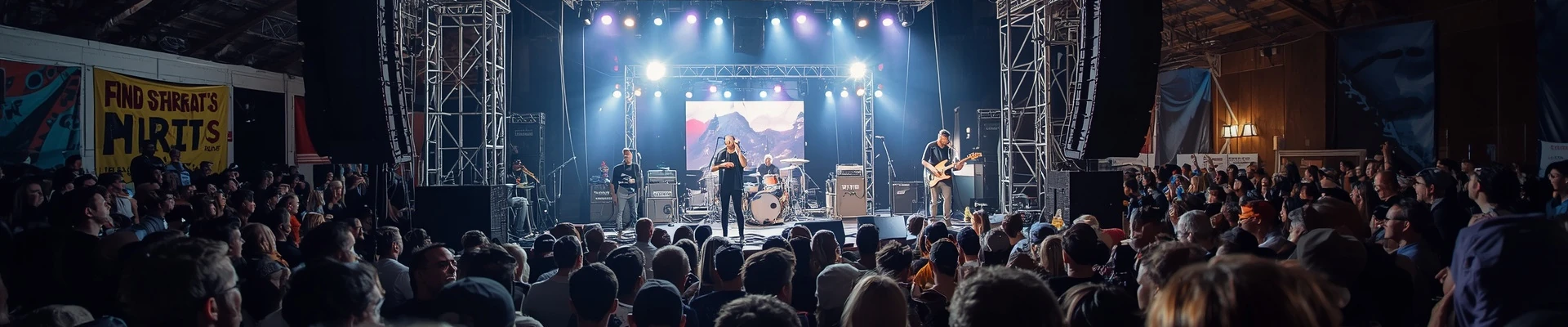
Oshawa's primary musical identity is rock and metal — specifically the hard, no-nonsense Ontario club-rock tradition that stretches from the 1970s bar-band era through 1990s grunge and post-grunge into the 2000s and 2010s punk and metalcore circuits. The proximity to Toronto meant that Oshawa was a natural feeder city: Toronto bands played the Oshawa corridor on the way up, and Oshawa artists used the city as a launchpad into the broader Ontario market.
The most internationally significant band to come out of the immediate Oshawa–Whitby–Durham region is Protest the Hero, formed in Whitby (immediately adjacent to Oshawa's western edge) in the late 1990s while its members were still teenagers. Their albums Kezia (2005), Fortress (2008), and Scurrilous (2011) established them as one of the defining progressive metal and metalcore acts of their generation — technically demanding, lyrically political, and self-managed through the Vagrant and independent-label ecosystem. Protest the Hero came directly out of the same Durham Region basement circuit that Oshawa's clubs fed into, and their career trajectory demonstrated that serious international-level talent could emerge from this industrial suburban geography.
The Tragically Hip, based in Kingston, regularly worked the 401 corridor and played Oshawa venues repeatedly throughout their arc from bar band to national icons. The durability of the Hip's connection to blue-collar Ontario communities — industrial cities, mid-sized towns, hockey arenas — maps directly onto Oshawa's identity as an audience and as a touring market.
Oshawa has produced a consistent stream of punk, post-punk, and hardcore artists who fed into the Toronto independent scene. The Durham Region punk circuit of the 1990s and 2000s ran through basement shows, all-ages community hall gigs, and a handful of licensed rooms willing to take a chance on original acts. That infrastructure — informal, transit-linked to Toronto, energised by the proximity of Durham College and later University of Ontario Institute of Technology (Ontario Tech University) — sustained a working independent scene.
The hip-hop scene in Oshawa reflects the city's Caribbean and West Indian diaspora communities (Jamaican, Trinidadian, and Barbadian communities that arrived from the 1970s onward) as well as its connection to Toronto's rap scene. Artists and producers from Oshawa have worked fluidly in the Toronto market, treating the 401 as a short commute rather than a barrier. The R&B and dancehall traditions in the city's Caribbean community sustain a network of community hall events, church-based programming, and club nights.
The Ukrainian, Polish, and Italian immigrant communities — who arrived largely in the 1940s, 1950s, and 1960s to work the GM lines — sustain active cultural association music programming. The Ukrainian Canadian Club of Oshawa and the Polish Alliance of Canada (Oshawa Branch) run regular dances, banquet-hall events, and folk music performances. These communities produce the kind of Saturday-night community hall dancing and singing culture — polka, Ukrainian folk, Italian tarantella — that rarely makes festival programs but represents a genuine layer of Oshawa's musical life.
The Oshawa Gospel choir tradition and its affiliated evangelical and Black church communities — sustaining strong choral and gospel programming — is another significant strand, connecting to the city's Jamaican and West African immigrant communities of more recent decades.
Venues and neighbourhoods
The dominant venue in Oshawa is Tribute Communities Centre (formerly GM Centre, originally the Oshawa Civic Auditorium) — a purpose-built arena on Centre Street South that opened in 2006 with approximately 6,000 seats for concerts and serves as the home of the Oshawa Generals OHL hockey team. It is the city's top-capacity concert venue, hosting touring rock, country, and pop acts that don't quite fill Toronto arenas but can anchor a full building in Oshawa.
The historic Regent Theatre on King Street East is the city's cultural anchor for mid-size programming — a restored single-screen cinema and live events space that hosts community concerts, film programming, performing arts, and intimate touring acts. Its preservation through community effort gives downtown Oshawa a visual and functional cultural anchor that many comparable industrial cities have lost.
Brock Street and King Street East form the traditional downtown entertainment corridor, with a mix of bars and licensed rooms. The Black Dog Pub, Fionn MacCool's Oshawa, and similar hospitality venues provide the working live-music bar circuit. The Simcoe Street North corridor near Durham College and Ontario Tech has supported student-oriented music programming and bar venues for decades.
The Harbour area on Lake Ontario — the Lakeview area and the Port of Oshawa lands — has seen ongoing redevelopment proposals that include cultural and entertainment components, though as of the mid-2020s the corridor's musical life remains primarily industrial rather than artistic.
Whitby immediately to the west (sharing a seamless suburban fabric with Oshawa) and Bowmanville–Courtice to the east form a cultural continuum with Oshawa, sharing venues, bands, and audiences so thoroughly that the "Oshawa scene" in practice means the Durham Region scene.
Festivals and signature events
Oshawa's festival calendar is community-driven rather than music-industry focused. Fiesta Week — the city's multicultural festival running in late June and early July — is the flagship summer event, incorporating international food, cultural performances, and music programming that reflects the city's Caribbean, European, South Asian, and East Asian communities. Its Fiesta Week parade is one of the larger community events in Durham Region.
The Oshawa Peony Festival, held in Alexandra Park each June, draws on the city's heritage peony collection (one of the largest in North America) and incorporates outdoor music programming. While not a dedicated music festival, it represents the community-outdoor-live-music format that anchors summer programming in mid-sized Ontario cities.
Ontario Tech University and Durham College both run active student events programming, including showcases, battle-of-the-bands competitions, and touring-act bookings that function as incubators for local and regional talent. The campus circuit is a significant venue ecosystem in a city without a large independent club scene.
Regional event promoters also use Tribute Communities Centre for periodic arena-level concerts — country tours, heritage rock package tours, and pop acts that use the 401 circuit as a single-night routing stop between Toronto and the Kingston–Ottawa corridor.
The Motor City sound
What defines Oshawa musically is not a specific genre but a specific condition: the music of an industrial city in the shadow of a larger one. Toronto is close enough to matter — close enough to draw away the most ambitious artists, to supply touring acts, to provide a music industry infrastructure — but far enough that Oshawa developed its own club culture, its own regular audiences, and its own artists who built careers without needing to leave. The GM plant, its union halls, and its shift-work rhythms shaped when people went out, what they spent, and what they wanted to hear. The working-class bar-band tradition that the plant culture generated — loud, unpretentious, physically demanding music for a crowd that came to drink and move — is the baseline of Oshawa's sound.
That baseline produced the conditions for Protest the Hero, for a durable punk and metal underground, for a bar-rock circuit that kept original music alive through the 1990s when cover-band economics drove out original acts in smaller cities, and for a community-music culture in church halls, cultural associations, and school gymnasiums that has no public profile but enormous depth. Oshawa is not a city with a globally recognised sound. It is a city that has consistently made music — seriously, seriously, without fanfare — because the culture demanded it.