
Detroit is the largest city in Michigan and the 26th-largest in the United States, with roughly 646,000 residents inside the city limits and more than 4.3 million across the surrounding metropolitan area, which spans into Windsor, Ontario across the Detroit River. Sitting on the Detroit River between Lake St. Clair and Lake Erie, ringed by the suburbs of Dearborn, Hamtramck, Highland Park, and the broader Wayne, Oakland, and Macomb counties, it is the largest city on the U.S.–Canada border and the historical heart of the American automobile industry. Detroit's population peaked at 1.85 million in 1950 and has since declined by roughly two-thirds — the largest population loss of any major American city — through suburbanization, the collapse of the auto industry, the 1967 uprising, the 2013 municipal bankruptcy, and a slow ongoing recovery. But musically, Detroit punches enormously above its current weight: it is one of the most consequential music cities in the world, the home of Motown Records, Detroit techno, the foundational protopunk of the MC5 and the Stooges, the legacy of Eminem and J Dilla, and a Black gospel and jazz tradition that has fed American music for a century.
A brief history
The land at the narrows of the Detroit River was Anishinaabe (Three Fires Confederacy) territory before French explorer Antoine de la Mothe Cadillac established Fort Pontchartrain du Détroit in 1701. The settlement passed to British control after the French and Indian War in 1763 and to American control after the American Revolution in 1796. Through the 19th century Detroit grew as a major Great Lakes shipping and manufacturing hub. The early 20th century rise of the automobile industry — Henry Ford's Model T (1908), the moving assembly line, and the founding of Ford, General Motors, and Chrysler — transformed Detroit into the "Motor City" and one of the wealthiest industrial cities in the world. The Great Migration brought hundreds of thousands of Black Southerners to Detroit through World War II shipyard and auto-plant work. The 1967 Detroit uprising (the largest urban uprising in American history at the time), the parallel collapse of the auto industry, and the long demographic shift from a 70%-white city in 1960 to a roughly 78%-Black city today have all shaped the modern city. Successive waves of migration — Polish, Italian, Lebanese (Dearborn has the largest Arab-American population in the United States), Bangladeshi, Yemeni, Mexican, and Bosnian — have built a metropolitan area that remains one of the most diverse in the Midwest. The 2013 municipal bankruptcy, the ongoing rebuilding of Downtown and Midtown, and the continuing displacement and gentrification of historically Black neighborhoods like Corktown and Brush Park have shaped recent civic memory.
Music identity
Detroit's most internationally famous musical chapter is the rise of Motown Records. Founded in 1959 by Berry Gordy Jr. in a small house at 2648 West Grand Boulevard — known to the world as Hitsville U.S.A. — Motown became the most commercially successful Black-owned record label in American history and one of the defining engines of 20th-century popular music. The Motown roster included The Supremes (Diana Ross, Florence Ballard, Mary Wilson), The Temptations, The Four Tops, Smokey Robinson and the Miracles, Marvin Gaye, Stevie Wonder, The Jackson 5, Gladys Knight & the Pips, Martha and the Vandellas, The Marvelettes, Mary Wells, Edwin Starr, The Isley Brothers' Motown years, The Spinners' early career, Rare Earth, and Lionel Richie and the Commodores. The Motown house band — the Funk Brothers — anchored the studio sound through bassist James Jamerson, drummer Benny Benjamin, keyboardist Earl Van Dyke, and a rotating cast of Detroit jazz musicians who created what came to be called the Motown Sound. Motown's relocation to Los Angeles in 1972 ended its Detroit chapter but the catalog remains foundational to American popular music.
Detroit's parallel Black music lineage is equally consequential. Aretha Franklin — born in Memphis but raised in Detroit from age two — built her early career in the New Bethel Baptist Church choir led by her father, the Rev. C.L. Franklin, before becoming the Queen of Soul. John Lee Hooker, the Mississippi-born blues guitarist, lived in Detroit from 1943 onward and recorded much of his foundational catalog at Joe Von Battle's record shop on Hastings Street. Little Willie John, Jackie Wilson (Detroit's foundational R&B vocalist of the 1950s), The Falcons (with Wilson Pickett), and a deep R&B tradition ran through the Hastings Street corridor of Black Detroit before the construction of the Chrysler Freeway destroyed the neighborhood in the 1960s. Anita Baker, born in Toledo and raised in Detroit, became one of the most acclaimed jazz-soul vocalists of the 1980s. Yusef Lateef, Donald Byrd, Elvin Jones, Pepper Adams, Tommy Flanagan, Hank Jones, and the broader Detroit jazz tradition produced an extraordinary number of foundational bebop and post-bop musicians. Dorothy Ashby, the harpist, was Detroit-born.
The 1960s and 1970s also produced one of the foundational catalogs of rock and roll. The MC5 ("Kick Out the Jams"), formed in Lincoln Park in 1964, are widely credited with helping invent proto-punk through their politically radical, sonically aggressive 1969 debut. Iggy Pop and the Stooges, formed in nearby Ann Arbor in 1967, built one of the most influential rock catalogs in history through The Stooges (1969), Fun House (1970), and Raw Power (1973) — directly seeding the entire international punk movement. Bob Seger, raised in Ann Arbor and Detroit, built a 50-year arena-rock catalog. Alice Cooper, the band, formed in Detroit and built much of its early career through the city. Ted Nugent, Grand Funk Railroad (Flint-based but Detroit-active), Mitch Ryder and the Detroit Wheels, Brownsville Station, and The Romantics built the broader Detroit rock identity. George Clinton, while New Jersey-raised, relocated Parliament-Funkadelic to Detroit in the early 1970s and built one of the most influential funk catalogs of the 20th century at the United Sound Studios. KISS's Detroit Rock City, Madonna (raised in Bay City and the Detroit suburbs), and Glenn Frey (raised in Royal Oak) all came out of the broader Detroit metropolitan area.
The defining Detroit musical innovation of the late 20th century, however, is Detroit techno. Built in the early 1980s by three friends from suburban Belleville High School — Juan Atkins, Derrick May, and Kevin Saunderson, collectively known as the Belleville Three — Detroit techno fused European electronic music (Kraftwerk, the Italo disco scene), Black American funk and electro, and a uniquely Detroit post-industrial sensibility into a new genre that became, by the late 1980s, one of the most influential electronic music idioms in the world. The Belleville Three were joined by Eddie Fowlkes, Carl Craig, Jeff Mills, Stacey Pullen, Mike Banks of Underground Resistance, and a generation of Detroit techno producers who built the foundational catalogs of the genre on labels like Metroplex, Transmat, KMS, and Underground Resistance. The Movement Electronic Music Festival (formerly DEMF, now in its third decade) at Hart Plaza each Memorial Day weekend remains the world's most important Detroit techno gathering.
The 1990s and 2000s brought one of the most commercially successful runs in modern hip-hop. Eminem (Marshall Mathers), raised in Detroit and St. Joseph, broke globally with The Slim Shady LP (1999) and The Marshall Mathers LP (2000) and became one of the best-selling artists of all time. His Detroit-based Shady Records label and his ongoing presence in the city — through 8 Mile, Mom's Spaghetti, and his continued home base in Rochester Hills — have kept Detroit central to modern hip-hop. J Dilla (James Yancey), born and raised in Conant Gardens on Detroit's east side, built one of the most influential hip-hop production catalogs of all time before his death in 2006 at age 32; his Slum Village group, his collaborations with A Tribe Called Quest and the Soulquarians, and his Donuts (2006) album have made him a posthumous icon. Big Sean, raised in Detroit and signed to Kanye West's GOOD Music label, has been one of the most commercially successful Detroit rappers of the 2010s. Royce da 5'9", Black Milk, Phat Kat, Elzhi, Guilty Simpson, Danny Brown (Detroit's most acclaimed underground rapper of the 2010s), Tee Grizzley, Sada Baby, 42 Dugg, Babyface Ray, Veeze, and a current generation of Detroit hip-hop artists continue the lineage. The Detroit hip-hop sound — minimal, drum-heavy, with a distinctive sample-driven and conversational style — has become one of the most influential regional sounds in the country.
The 21st century has also seen a major rock revival through The White Stripes, the duo of Jack White and Meg White formed in Detroit in 1997. Elephant (2003) made them one of the most acclaimed rock acts of the era. The Von Bondies, The Dirtbombs, Electric Six, The Hentchmen, and a thriving Detroit garage rock scene around clubs like the Magic Stick and the Garden Bowl built the modern Detroit rock identity. Latin music — primarily Mexican — runs through Mexicantown in Southwest Detroit and a long lineage of restaurants and dance halls. Arab-American music runs through Dearborn's Yemeni, Lebanese, and Iraqi communities. Polish music runs through Hamtramck.
Venues and neighborhoods
Detroit's venue ecosystem is unusually deep. At the top sit Little Caesars Arena (home of the Red Wings and Pistons, and the city's largest indoor concerts), Ford Field, Comerica Park, Pine Knob Music Theatre (formerly DTE Energy Music Theatre, the largest outdoor amphitheater in the country, in nearby Clarkston), the Fox Theatre (a 5,000-seat 1928 movie palace, one of the most beautiful concert venues in America), the Fillmore Detroit, the Masonic Temple Theatre, Music Hall Center for the Performing Arts, Orchestra Hall at the Max M. Fisher Music Center (home of the Detroit Symphony Orchestra), and the Detroit Opera House. The midsize tier includes Saint Andrew's Hall (the legendary downtown rock venue, opened in 1980 and the room where Eminem won several rap battles in his early career), the Royal Oak Music Theatre, the Crofoot Ballroom in Pontiac, and the Magic Bag in Ferndale. Beneath them is a deep club layer — Saint Andrew's Hall, the Magic Stick, PJ's Lager House, Small's Bar in Hamtramck, The Loving Touch in Ferndale, El Club in Mexicantown, Marble Bar, Spot Lite, The Russell Industrial Center (warehouse parties), TV Lounge, the Old Miami, Lincoln Factory, Northern Lights Lounge, and a network of bars, lofts, and DIY rooms across Hamtramck, Mexicantown, Corktown, Eastern Market, the Cass Corridor / Midtown, and the East Side. Cliff Bell's anchors the modern jazz scene; Baker's Keyboard Lounge (the oldest continuously operating jazz club in the world, opened in 1934) anchors the historic jazz tradition.
Different neighborhoods carry different musical identities. Midtown / Cass Corridor anchors the indie rock, jazz, and DIY scenes through the Magic Stick, the Garden Bowl, the DSO, and a deep cultural corridor. Hamtramck (a small enclave city completely surrounded by Detroit) anchors the punk and DIY scene through Small's Bar and a deep Polish, Bangladeshi, and Yemeni music tradition. Corktown anchors a higher-end bar and venue circuit. Mexicantown / Southwest Detroit anchors the Latin scene through El Club. Eastern Market has emerged as a warehouse music corridor. The east side retains echoes of the historic Black music tradition. Ferndale, Royal Oak, and Detroit's inner-ring suburbs support a complementary venue ecosystem. Dearborn anchors the Arab-American music scene. Belleville, the suburban high school where the techno founders met, remains a touchstone of the genre.
Festivals and signature events
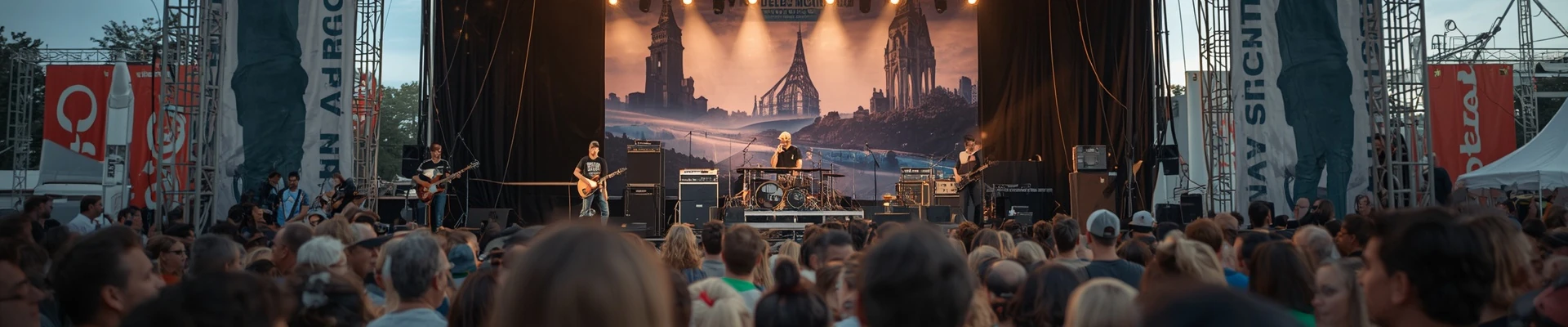
The festival calendar reflects the city's range. Movement Electronic Music Festival at Hart Plaza each Memorial Day weekend, founded in 2000, is the most important Detroit techno gathering in the world, drawing hundreds of thousands of attendees over three days with a lineup that spans the Belleville Three's lineage and the international electronic music scene. Mo Pop Festival (formerly held at Detroit's RiverWalk and West Riverfront Park) has been the city's flagship modern indie and pop festival. Detroit Jazz Festival at Hart Plaza each Labor Day weekend, founded in 1980, is the largest free jazz festival in the world, drawing more than 300,000 attendees over four days. Concert of Colors in Midtown each summer programs world music and Detroit-area roots and global music. Hash Bash in Ann Arbor's Diag, Arts, Beats & Eats in Royal Oak, Detroit Pride, Fash Bash, Cinco de Mayo in Mexicantown, Hamtramck Music Festival, Detroit Music Awards, Bayview Yacht Club's music programming, and Comerica CityFest add cultural and community programming.
What ties it all together is the city's combination of foundational musical influence, deep Black creative tradition, post-industrial sensibility, and continuous reinvention. Detroit is the city where Berry Gordy built Motown into the most commercially successful Black-owned record label in American history, where Aretha Franklin learned to sing in her father's Baptist church, where John Lee Hooker built electric blues at Joe Von Battle's record shop, where the MC5 and the Stooges seeded global punk, where George Clinton remade funk at United Sound, where Juan Atkins, Derrick May, and Kevin Saunderson invented Detroit techno in suburban Belleville, where Eminem rose through Saint Andrew's Hall rap battles, where J Dilla built one of the most influential hip-hop production catalogs in history, where the White Stripes rebuilt rock and roll, and where Movement, the Detroit Jazz Festival, and Baker's Keyboard Lounge continue to anchor one of the most musically consequential cities in the world.