


Amherst is the most populous town in New York State — a distinction that surprises people who expect the title to go to a suburb of New York City rather than a suburb of Buffalo in the western reaches of Erie County. With around 122,000 residents spread across 132 square kilometres of land between the Niagara River plain and the rolling terrain of the Niagara Escarpment, Amherst occupies the northeast quadrant of the greater Buffalo metropolitan area. Its western edge abuts Buffalo proper; to the north lies Tonawanda; to the east, the town of Clarence; to the south, Cheektowaga and the Buffalo airport corridor. The Ellicott Creek and the Tonawanda Creek drain much of the town's landscape, and the Erie Canal — now the New York State Canal System — passes through the southern townships.
What defines Amherst's civic character above all else is the presence of the University at Buffalo (UB), the flagship campus of the State University of New York system. UB's North Campus — a massive mid-century modernist complex designed partly by the firm of I.M. Pei — spreads across the southeastern quadrant of the town near Amherst hamlet and Eggertsville, and enrolls roughly 30,000 students. The South Campus, historically the original UB site, sits just across the Buffalo city line, but the North Campus is definitively Amherst's — and it is the North Campus that drives the town's cultural and nightlife economy. The Main Street corridor between the North Campus and downtown Buffalo, along with the Maple Road commercial strip, anchors the local live music and bar ecosystem that services the UB student population.
Economically, Amherst is one of western New York's most affluent communities. It is home to the headquarters of Delaware North (one of the largest food service and hospitality companies in North America), Rich Products Corporation, and a substantial pharmaceutical and medical device sector around the Hauptman-Woodward Medical Research Institute and UB's health sciences programs. The Amherst Industrial Development Agency has attracted significant commercial and light-industrial investment to the Transit Road and Niagara Falls Boulevard corridors. The town consistently ranks among the safest and most prosperous communities in New York State — a fact that has shaped both its demographics (predominantly white, college-educated, professional) and its cultural geography (a music scene driven more by institutional infrastructure than street-level urgency).
A brief history
The Town of Amherst was established in 1818, carved from the town of Clarence, and named after Field Marshal Jeffrey Amherst — the British commander whose name is also attached to the Massachusetts college town and to a long history of controversy over his documented use of biological warfare against Indigenous peoples during the colonial era. The land was part of the Holland Purchase and was settled primarily by New Englanders moving west along the new Erie Canal corridor. The northern part of the town — the Snyder, Eggertsville, and Williamsville districts — developed as prosperous farming communities in the 19th century; the southern reaches closer to Buffalo urbanized rapidly in the mid-20th century post-war boom.
Williamsville, now the largest of Amherst's four incorporated villages, is one of the older settlements — its Old Grist Mill (circa 1811) on Mill Street along Ellicott Creek is one of western New York's most photographed heritage landmarks. Eggertsville and Snyder developed as streetcar suburbs of Buffalo in the early 20th century, with the International Railway Company running lines that connected these neighborhoods to downtown. The arrival of UB's North Campus in the 1970s transformed the town's eastern quadrant from farmland to institutional campus, reshaping land use, demographics, and the local economy permanently.
Music identity
Amherst's music identity is best understood in relation to Buffalo — a city with one of the most surprising and consequential rock and metal pedigrees in North America. The two communities are functionally continuous; artists, venues, promoters, and audiences move between them constantly, and many of Buffalo's most significant musicians have Amherst addresses or Amherst formative years.
The most globally consequential artist with deep Amherst roots is Goo Goo Dolls lead vocalist and guitarist John Rzeznik, who grew up in Buffalo and spent significant time in the Amherst corridor before the band's breakthrough. The Goo Goo Dolls — formed in Buffalo in 1986 with Rzeznik and bassist Robby Takac — became one of the defining alternative rock acts of the 1990s, with Dizzy Up the Girl (1998, Warner Bros.) producing the landmark single "Iris" — one of the most streamed rock ballads in history, written for the City of Angels soundtrack and spending 18 consecutive weeks at number one on the Billboard Hot 100 Airplay chart. The Goo Goo Dolls' trajectory — from the bar rooms of Cheektowaga and Amherst to MTV ubiquity — tracks the geography of the greater Buffalo scene perfectly.
The town's University at Buffalo campus is the institutional anchor of its music scene. UB's Department of Music is a serious academic program with significant jazz, classical composition, and new music components. The Slee Concert Hall on the South Campus programs faculty and guest recitals of regional and national significance. The Center for the Arts on the North Campus — UB's principal performance venue — is a 1,700-seat proscenium theatre that has hosted touring Broadway productions, orchestral performances by the Buffalo Philharmonic Orchestra, and popular music acts ranging from indie rock to world music. For Amherst, the Center for the Arts functions as the town's highest-capacity cultural venue by a considerable margin.
The UB student music community has historically been a fertile breeding ground. The North Campus bars and the off-campus housing corridors between the campus and Eggertsville and Snyder have sustained a generational conveyor belt of college rock, indie, and experimental bands. UB's radio station WBFO (88.7 FM) — a long-running NPR affiliate — and the student station WRUB have historically programmed local artists alongside national alternatives. The proximity of the Buffalo club circuit (particularly Nietzsche's on Allen Street, and historically The Marquee and Hemisphere) means UB students cycle through the Buffalo scene freely.
In heavy metal and hard rock, the Amherst–Buffalo corridor has produced a number of significant artists. Cannibal Corpse — formed in Buffalo in 1988 by members who met in the suburban school corridors of the eastern Erie County towns including the Amherst area — became the best-selling death metal band in history, with over two million records sold and a catalog of technically ferocious albums on Metal Blade Records that defined the genre. The band relocated to Tampa, Florida in 1990 to be closer to the emerging death metal scene there, but their formation story belongs to the Buffalo–Amherst suburban metal underground of the late 1980s — the basements, the rehearsal rooms, the record shops on Sheridan Drive and Main Street where young musicians traded dubbed cassette tapes of Possessed, Death, and Celtic Frost.
Winger — the arena rock / glam metal band fronted by Kip Winger (born in Denver but shaped by his time in the New York rock scene) — was not Amherst-native, but the band's bassist and co-founder Paul Taylor is from the western New York region. More substantially: Billy Sheehan, the virtuoso bassist widely regarded as one of the most technically accomplished rock bassists in history, is from Buffalo and spent years active in the Amherst–Buffalo bar band circuit before his work with David Lee Roth (the Eat 'Em and Smile album, 1986, Warner Bros.) and Mr. Big made him a global name. The Amherst–Buffalo bar rock ecosystem of the 1970s and 1980s — demanding, highly competitive, with a knowledgeable blue-collar audience — produced musicians of exceptional technical ability.
The jazz tradition in Amherst is anchored institutionally by UB's jazz program but also by the presence of the Tri-Tone Jazz and Blues community and the broader Jazz at the AAC programming that uses Amherst venues and college rooms as satellite performance spaces. Buffalo has a legitimate jazz legacy — trumpeter Don Ellis, a radical harmonic innovator, studied in western New York; vibraphonist Milt Jackson played the Buffalo circuit extensively — and Amherst has inherited that tradition through the university pipeline.
Venues and neighborhoods
Amherst's live music geography is concentrated in a few corridors. Main Street running northeast from the Buffalo city line through Eggertsville and toward the North Campus is the primary commercial and nightlife spine. The stretch between the campus and the Snyder neighborhood has historically supported a cluster of college bars, many of which program local bands on weekends. Stamm House (in the village of Williamsville, on Transit Road) is one of western New York's oldest and most beloved restaurants and performance venues — a converted 19th-century farmhouse that programs acoustic and folk acts in an intimate setting. Sportsmen's Tavern (while geographically across the city line in Buffalo, it draws heavily from the Amherst audience) is one of the most respected Americana and roots venues in the region.
The Center for the Arts at UB North Campus is the institutional anchor for larger touring productions. Marist Hall and various campus multipurpose spaces at UB program smaller student-facing events. The Amherst Theatre (Maple Road) programs community productions. Club Paradise and the bars along Maple Road and Niagara Falls Boulevard fill the mid-tier club function.
Neighborhoods within the town each have their own character. Williamsville village — with its preserved 19th-century mill district along Ellicott Creek, its boutique shops, and its Saturday farmers market — programs outdoor acoustic events in summer. Snyder is the most affluent residential district, a quiet tree-lined neighborhood of Tudor revival houses with minimal nightlife. Eggertsville blends mid-century housing stock with the student-adjacent bars and restaurants of the Main Street corridor. The UB North Campus area itself — the dense apartment zones along Rensch Road, Sweet Home Road, and Northwood Drive — is the most energetically active music zone, with the student population providing a reliable audience for local and touring indie acts.
Festivals and signature events
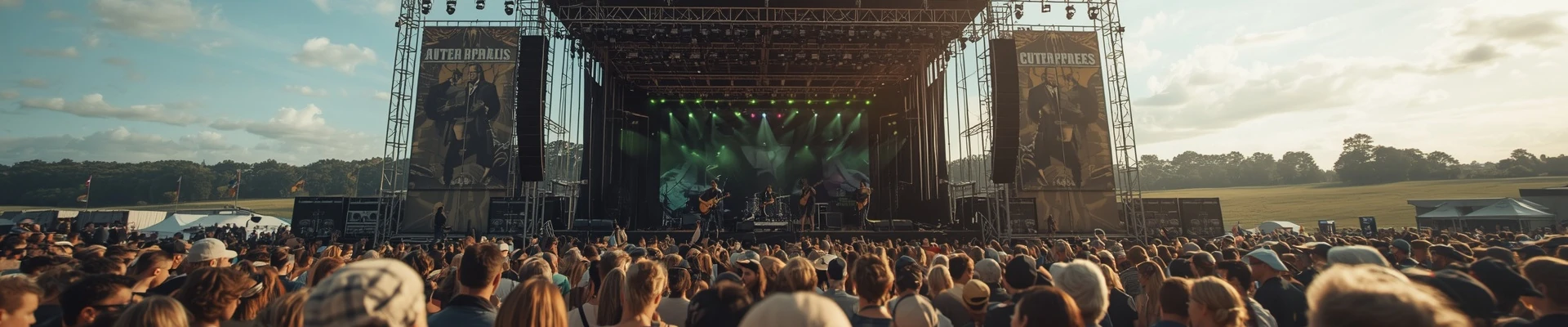
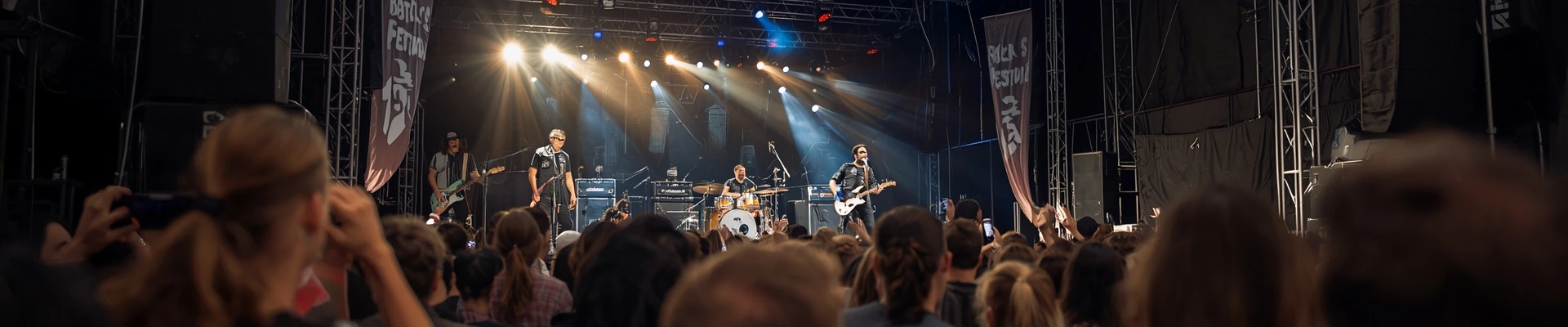
The Taste of Amherst (held annually in the parking lots around Harlem Road and town parklands) programs local bands across several stages and is one of Erie County's better-attended community festivals, drawing a mix of families and young adults. Eggfest (the annual community event at Amherst Audubon) has featured local music performance. UB programs the Fallfest and Springfest student music events that bring mid-tier touring acts to campus — historically, the Center for the Arts courtyard and Alumni Arena have hosted acts ranging from Diplo to Weezer for the campus audience. The Amherst Symphony Orchestra programs its season at the North Forest Middle School auditorium and draws a dedicated community audience.
The broader western New York festival circuit that Amherst residents participate in — Buffalo Porchfest (a city-wide front-porch music festival in adjacent Buffalo neighborhoods), the Artpark summer concert series in Lewiston, and the KeyBank Rochester International Jazz Festival two hours east — means the town's music calendar extends well beyond its own borders.
What ties it all together
Amherst's music identity is shaped by the classic suburban paradox: proximity and distance simultaneously. Close enough to Buffalo that its residents have always accessed the city's bar rooms, its clubs, its recording studios, and its professional music infrastructure; far enough that the town has developed its own institutional layer — the university, the concert hall, the neighborhood bars — that sustains a genuine local scene. The musicians who emerged from the Amherst–Buffalo corridor in the 1980s — the death metal architects of Cannibal Corpse, the arena-filling songwriters of the Goo Goo Dolls, the technically extraordinary bassists and guitarists forged in the blue-collar bar band tradition — carry the imprint of a particular western New York musical culture: work-hardened, technically serious, competitive, and deeply unimpressed by hype. Amherst may be one of the most comfortable and prosperous communities in the region, but its music flows from the same deep wells of Great Lakes grit and ambition that have always defined western New York sound.