
Winston-Salem is the second-largest city in North Carolina and the seat of Forsyth County, with roughly 241,000 residents inside the city limits and more than 670,000 across the broader Winston-Salem metropolitan area. Situated in the North Carolina Piedmont, where the rolling foothills of the Blue Ridge Mountains begin their gentle rise toward the west, Winston-Salem sits roughly 80 miles southwest of Greensboro, 100 miles northeast of Charlotte, and 275 miles west of Raleigh. The city is known as the "Twin City" — the legal merger in 1913 of Winston (the industrial tobacco town) and Salem (the Moravian religious settlement founded in 1766) produced a combined municipality whose split personality still echoes in its neighborhoods, institutions, and cultural temperament. R.J. Reynolds Tobacco Company and Hanes are the industrial giants that built the city's wealth; both companies' headquarters, factories, and legacies remain central to Winston-Salem's identity even as tobacco's dominance has faded. The city is home to Wake Forest University, UNC School of the Arts, Winston-Salem State University, Salem College, and Forsyth Technical Community College, giving it a university presence disproportionate to its population.
A brief history
The land that became Winston-Salem was home to the Saura people before European arrival. In 1753 the Unity of Brethren — the Moravians, a Central European Protestant community with origins in 15th-century Bohemia — received a land grant in the North Carolina backcountry and began establishing their planned community of Wachovia. Salem was founded in 1766 as the trade and craft centre of the Wachovia tract, and the Moravians brought with them a musical culture of extraordinary richness: choral singing, brass bands, organ performance, and the practice of Lovefeast — a service of bread, coffee, and hymn-singing that became one of the most distinctive religious-musical traditions in American history. The Moravians composed and performed sacred music continuously, and Old Salem (the restored 18th-century Moravian village at the city's core) maintains those traditions to this day through Salem Band, the Collegium Musicum, and the annual Moravian Music Festival.
Winston was founded in 1849 as the county seat of the newly created Forsyth County. When Richard Joshua Reynolds established R.J. Reynolds Tobacco Company in 1875, Winston was transformed almost overnight into one of the most productive tobacco manufacturing centres in America. By the early 20th century Winston-Salem was producing Camel cigarettes — the first modern blended cigarette, introduced in 1913 — and the wealth generated by the tobacco trade funded schools, hospitals, museums, and civic institutions. The Hanes family built a parallel textile empire. Winston and Salem merged in 1913, and through the first half of the 20th century Winston-Salem was a city of considerable industrial muscle. The civil rights era revealed the city's stark racial geography — Winston-Salem State University (a historically Black university founded in 1892) was a centre of Black intellectual life, and the city's East Winston neighborhood sustained a deep African American community through the mid-century. The 1934 Winston-Salem tobacco workers' strike was one of the earliest significant interracial labor organizing drives in the South.
Music identity
Winston-Salem's music identity is unusually layered for a mid-size Southern city, because the Moravian tradition, the Piedmont Blues, gospel, country, and a strong contemporary indie-rock scene all exist as fully realized parallel scenes rather than a single dominant sound.
The Moravian musical tradition is Winston-Salem's most singular contribution to American music. The Moravians carried European art music into the North Carolina backcountry two centuries before similar traditions took root in cities many times larger. The Salem Band — organized in 1771 as a trombone choir — is one of the oldest continuously active musical organizations in the United States. The Moravian Music Festival, held biennally, draws participants from Moravian communities across North America and has been running since 1950. The Lovefeast service — particularly the Christmas Eve Lovefeast at Home Moravian Church — is broadcast across North Carolina and draws thousands. This tradition produced trained musicians, a culture of serious choral and instrumental performance, and an institutional base (Salem College, founded 1772, with one of the oldest college music programs in the South) that has sustained serious music-making in the city for two and a half centuries.
The city's most internationally recognized musical export is Ben Folds, the singer-songwriter and pianist who attended UNC School of the Arts in Winston-Salem before forming Ben Folds Five in Chapel Hill in 1993. The band's sardonic, piano-driven alt-rock — Whatever and Ever Amen (1997), The Unauthorized Biography of Reinhold Messner (1999) — made them one of the most beloved American indie-rock acts of the 1990s, and Folds has remained a central figure in American pop-rock for three decades. UNC School of the Arts itself — one of the premier arts conservatories in the United States, opened in Winston-Salem in 1963 — has produced generations of professional musicians across classical, jazz, drama, and film. The school's presence gives Winston-Salem a steady flow of young, seriously trained musicians that sustains the city's arts ecosystem beyond what raw population would predict.
The Piedmont Blues tradition runs deep through the Winston-Salem region. The Piedmont style — fingerpicked, ragtime-influenced, lighter in feel than Delta blues — was the dominant form of Black folk and popular music across the North Carolina and Virginia Piedmont through the first half of the 20th century, and Winston-Salem's East Winston neighborhood sustained blues and gospel performers through church circuits, house parties, and club dates for decades. The gospel tradition at Winston-Salem State University and in the city's historic Black churches — including St. Philips Moravian Church, one of the oldest Black Moravian congregations in America — represents a continuous sacred music tradition stretching back to the Moravian mission era.
Country and bluegrass run through the surrounding Piedmont and Blue Ridge foothills. Winston-Salem sits at the edge of Appalachian country music territory, and a continuous circuit of honky-tonks, square dances, and string band traditions have operated through Forsyth County and the adjacent mountain counties for generations. The city's Piedmont Craftsmen Fair and related folk arts events sustain traditional string band and old-time music.
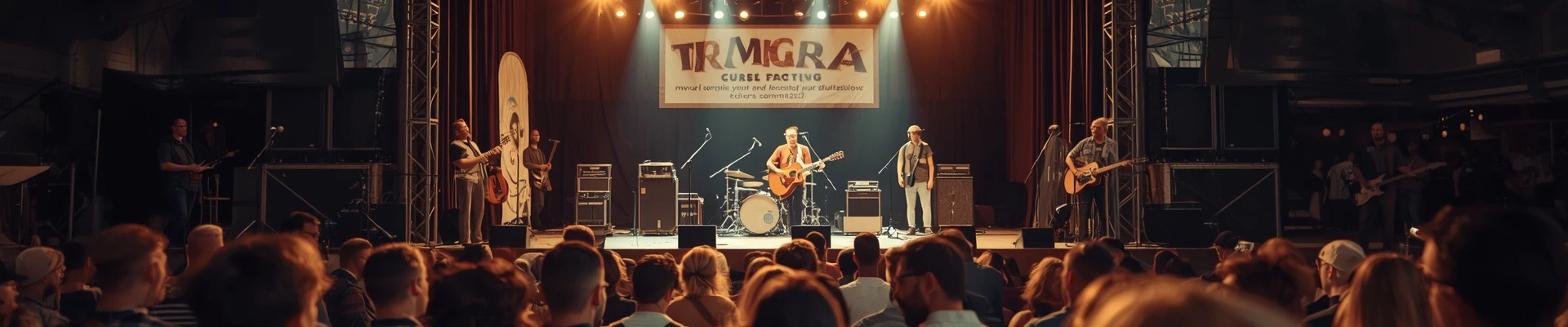
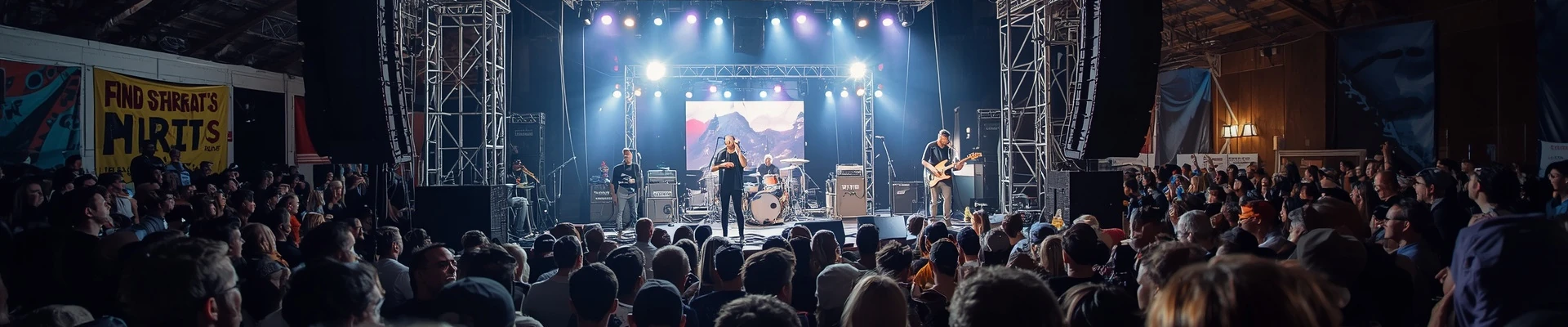
The city's indie rock and alternative scene coalesced around Ziggy's — the legendary Winston-Salem club that operated at various Downtown locations from the 1980s through the 2000s and hosted hundreds of nationally touring indie, rock, and alternative acts before closing. The Ramkat (opened in 2017 on West Fifth Street in the Downtown Arts District) carries on the legacy of serious indie booking in a properly equipped mid-size club. The Millennium Center programs larger touring acts in an elegant ballroom venue. Foothills Brewing runs a music program alongside its craft beer operation. The city's DIY scene operates through house shows, gallery spaces, and small clubs in the West End, Ardmore, and Downtown Arts District neighborhoods.
Venues and neighborhoods
Winston-Salem's venue ecosystem is anchored at the top by Lawrence Joel Veterans Memorial Coliseum — the 14,000-capacity arena that has hosted major touring rock, country, pop, and R&B acts since 1974 and remains the city's largest indoor venue. The Benton Convention Center programs large-scale events. The Millennium Center (a 4,000-capacity ballroom and event venue in a restored 1920s building) and The Ramkat (1,000-capacity, the city's primary indie rock club) anchor the mid-size tier. Brenner Children's Hospital's Anderson Auditorium, the Hanesbrands Theatre, and Reynolda House Museum of American Art program chamber music and classical performance. Winston-Salem Symphony performs at the Stevens Center, a restored 1929 movie palace now operated by UNC School of the Arts. Sawtooth School for Visual Art hosts music events. Foothills Brewing and a circuit of Downtown bars and clubs support the live music scene.
Different neighborhoods anchor different musical cultures. Downtown Winston-Salem — anchored by Trade Street, the Arts District, and Fifth Street — holds the city's major clubs, performance venues, and the contemporary indie-rock scene. Old Salem (the restored Moravian village) is the home of Moravian musical performance. East Winston anchors the historic African American community and gospel tradition. West End and Ardmore (established residential neighborhoods west of Downtown) carry the city's folk, acoustic, and house-show DIY scenes. Reynolds Village and the Reynolda area near Wake Forest University anchor an academic music culture. Historic West End, home of the Twin City Quarter entertainment district, programs touring country and classic rock acts in a bar-and-restaurant corridor.
Festivals and signature events
The festival calendar reflects Winston-Salem's unusual blend of Moravian heritage, African American arts culture, and contemporary arts programming. The National Black Theatre Festival — held biennially since 1989 and recognized as one of the most important African American performing arts events in the world — draws theatre and music programming to the city for a week in August. The Moravian Music Festival (biennial) draws participants from Moravian congregations across North America. RiverRun International Film Festival programs film-related music performance. SECCA (the Southeastern Center for Contemporary Art) hosts music events tied to its visual arts programming. Camel City BBQ Factory blends music and food programming. Reynolda Bloom at Reynolda Gardens programs outdoor classical and folk performance. Winston-Salem Wakes and the Twin City Chili Cook-Off incorporate live music. The North Carolina Folk Festival (in nearby Greensboro) draws significant attention to the region's folk music traditions. Winston Cup Market programs local bands at its weekend market gatherings.
What ties it all together is Winston-Salem's peculiar duality — the solemn Moravian trombone choirs ringing across Old Salem on Easter morning, and the indie rock clubs programming touring acts in the Downtown Arts District on Saturday nights, both existing as fully realized musical worlds within the same mid-size Southern city. Winston-Salem is the place where Ben Folds learned his piano craft at UNC School of the Arts, where the Salem Band has been playing brass music since 1771, where the Piedmont Blues ran through East Winston for generations, and where Ziggy's put Winston-Salem on the national indie touring map before The Ramkat picked up the torch. The city's musical identity is less about a single signature sound than about the richness of parallel traditions — classical, Moravian, gospel, blues, country, and indie rock all coexisting in a compact Piedmont city that punches significantly above its weight.