

Amarillo is the largest city in the Texas Panhandle and the seat of Potter County (with portions extending into Randall County), home to roughly 200,000 residents inside the city limits and a metropolitan area approaching 280,000 across the Amarillo MSA. Positioned on the Llano Estacado — the vast, nearly perfectly flat tableland that defines the Southern High Plains — Amarillo sits at an elevation of approximately 3,600 feet above sea level, making it one of the highest-elevation major cities in Texas. The Canadian River cuts through the broad canyon country north of the city, and Palo Duro Canyon — the second-largest canyon in the United States — lies roughly 25 miles to the southeast, a dramatic geological counterpoint to the flatness that defines everything for hundreds of miles in every direction. Amarillo is roughly 360 miles northwest of Dallas, 280 miles northeast of Albuquerque, and 110 miles east of New Mexico, sitting at the intersection of Interstate 40 (the successor to U.S. Route 66) and Interstate 27. The city's economy has long been anchored in cattle ranching, meatpacking, and more recently in oil and natural gas from the Anadarko Basin and the Permian Basin approaches, as well as helium production — Amarillo sits atop the world's largest known helium reserve and for decades dominated global helium supply.
A brief history
The land of the Texas Panhandle was home to the Comanche and Kiowa peoples for centuries before European contact, and the region's history of Spanish colonialism, Mexican sovereignty, and Texas statehood layered onto that Indigenous foundation a complex colonial legacy. The town of Amarillo was formally platted in 1887 when the Fort Worth and Denver City Railway extended its line through the Panhandle, and the name — Spanish for "yellow," likely referring to the yellow wildflowers or yellow soil of the nearby creek banks — was adopted from the existing settlement. Within a decade Amarillo had become a major cattle shipping point, and the XIT Ranch — at roughly 3 million acres one of the largest ranches in history, established to fund the construction of the Texas State Capitol — made the surrounding Panhandle synonymous with vast-scale ranching operations. Beef processing became the city's industrial backbone: the IBP (Iowa Beef Processors) plant established in Amarillo in 1960 transformed the city into one of the most productive beef-processing centres in the world, and the meatpacking industry drew generations of Mexican and Mexican American workers who transformed Amarillo's cultural demographics over the 20th century. The Route 66 era — from the road's designation in 1926 through its decommissioning in 1985 — made Amarillo a critical waypoint on the highway of dreams, and motels, diners, and neon signage from that era still define large stretches of Sixth Street (formerly Route 66 through Amarillo). The installation of the Cadillac Ranch in 1974 by the art collective Ant Farm — ten Cadillacs buried nose-first in a Panhandle wheat field west of the city — became one of the most photographed and parodied public art installations in American history and anchored Amarillo in the imagination of travelers and artists well beyond its geographic isolation.
Music identity
Amarillo's musical identity is inseparable from the mythology of the American West — from cowboy culture, honky-tonk country, Western swing, and the particular brand of Texas pride that generates outsized musical feeling about landscape, distance, and longing. The city is best known internationally through one of the most recognizable songs in country music history: "Amarillo by Morning" by George Strait, released in 1983 on the album Right or Wrong. Written by Terry Stafford and Paul Fraser and first recorded by Stafford in 1973, Strait's version became one of the defining recordings of the neotraditionalist country movement and cemented Amarillo's name in the American songbook as a symbol of the hardworking, road-weary, Panhandle-tough life. Although Strait himself is from the San Antonio area, the song's cultural weight belongs to Amarillo, and the city has embraced it fully: "Amarillo by Morning" is effectively the city's anthem, performed at countless local events and beloved by generations of residents who hear in it the particular loneliness and beauty of the High Plains.
The deeper musical heritage begins in Western swing — the Texas and Oklahoma-born hybrid of country, jazz, and big-band that flourished in dance halls and ballrooms from the 1930s through the 1950s. The Texas Panhandle was prime Western swing territory, and Amarillo's dance halls hosted the touring bands of the genre's giants: Bob Wills and His Texas Playboys, Milton Brown and His Musical Brownies, and the broader circuit of Southwest dance bands that made the region one of the most musically active in America during the pre-rock era. Western swing's DNA — the twin fiddles, the steel guitar, the jazz-inflected chord vocabulary, the irresistible danceable groove — runs through Amarillo's country music scene to this day, and the city's country dance culture at venues like The Fiddler and Midnight Rodeo has maintained that tradition across generations.
Tanya Tucker was born in Seminole, Texas, about 150 miles south of Amarillo, and spent formative years in the Panhandle before her family relocated to Phoenix. Her hard-country soprano and the transgressive energy of records like Delta Dawn (1972) and Would You Lay with Me (In a Field of Stone) (1973) — recorded when she was 13 and 14 years old — established her as one of country's most distinctive voices. Although she is claimed by multiple Texas cities and her career bloomed in Nashville, the Panhandle shaped her earliest musical identity.
Amarillo's rock and pop scene developed through the 1960s and 70s on the back of a thriving local radio ecosystem. KGNC and the broader Amarillo radio dial exposed Panhandle audiences to rock and roll, soul, and the British Invasion as fast as those sounds traveled westward, and local clubs along Sixth Street and in the developing suburban corridor sustained original rock bands through the classic rock era. The Nat Ballroom — a historic Amarillo venue that hosted touring acts across multiple decades — brought national acts through a city that geographic isolation would otherwise have kept off many touring itineraries.
Terry Allen — the Lubbock-born, Amarillo-adjacent singer-songwriter, visual artist, and playwright — represents perhaps the most intellectually serious artistic lineage connected to the Panhandle region. Allen's landmark double album Juarez (1975) and the follow-up Lubbock (on everything) (1979) established him as one of the most idiosyncratic and literate voices in American roots music, and his influence on subsequent Texas songwriters — including Joe Ely, Butch Hancock, and Jimmie Dale Gilmore of the Lubbock scene — is deep. Allen's art has circled back to Panhandle imagery and mythology throughout a career that spans music, sculpture, and theater, and his work constitutes a high-water mark for the intellectual ambitions of the Texas Panhandle's artistic output.
The norteño and conjunto traditions, brought north by generations of Mexican and Mexican American workers in the meatpacking industry, have given Amarillo a parallel music culture of genuine depth. The city's South Side neighborhoods sustain a network of cantinas, dancehalls, and community events where accordion-led norteño, corridos, and tejano music are central to social life. Amarillo's Mexican American community — one of the largest proportionally in the Texas Panhandle — has produced musicians, DJs, and promoters who connect the city to the broader Southwest Texas Spanish-language music circuit centered on San Antonio and Corpus Christi.
Venues and neighborhoods
Amarillo's most storied live-music corridor runs through the Sixth Street Historic District — the original Route 66 alignment through downtown, now a stretch of preserved mid-century commercial architecture that has been redeveloped as a walkable arts and entertainment district. The 806 Coffee + Lounge has served as an independent music room and coffee shop anchoring the Sixth Street scene. Midnight Rodeo Amarillo — a classic Texas-scale honky-tonk and dance hall — has been one of the city's preeminent country and Western venues for decades, with a dance floor large enough to accommodate genuine two-stepping crowds.
Globe-News Center for the Performing Arts (officially the Amarillo Civic Center Complex) is the city's primary performing arts hall, a 1,300-seat venue that hosts touring concerts, Broadway productions, and classical performances. The Amarillo Symphony — founded in 1924 and one of the oldest orchestral organizations in Texas — performs there regularly and represents a serious classical music tradition embedded in the city's cultural life. Palo Duro Canyon State Park becomes a performance venue every summer through TEXAS — an outdoor musical drama celebrating Panhandle history that has been performed in the canyon's natural amphitheatre since 1966, one of the longest-running outdoor dramas in the United States.
Bishop Hills and the Wolflin neighborhood to the west of downtown have historically housed the city's arts community. The Don Harrington Discovery Center and the broader Medical Center district along Georgia Street sit within the western residential corridor. The Amarillo Livestock Auction district on the city's east side is the geographic and spiritual center of the cattle industry that built the city, and the working-class neighborhoods of the South Side — along South Georgia, South Polk, and the Southside residential grid — are where the city's norteño and Mexican American music culture is most densely concentrated.
Festivals and signature events
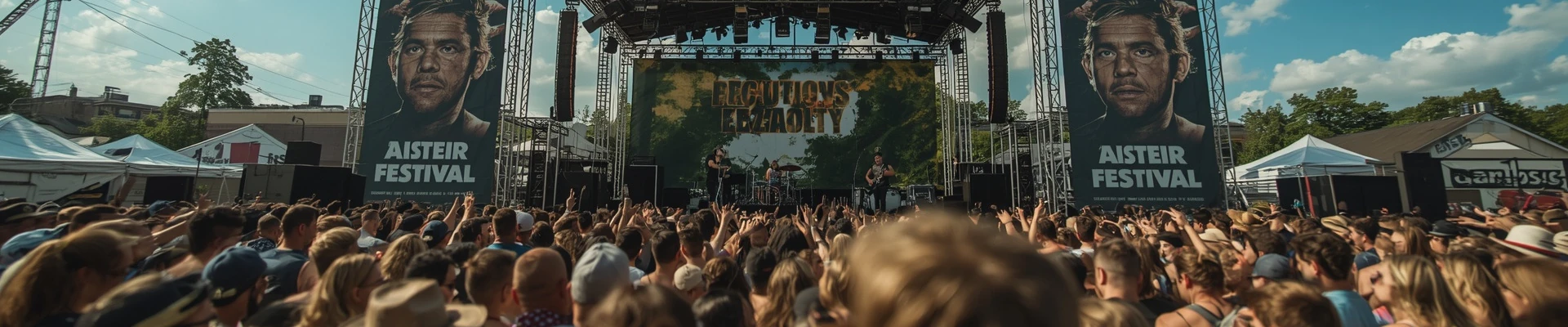
Tri-State Fair & Rodeo is Amarillo's signature annual event — held each September at the Amarillo Tri-State Fairgrounds, it draws hundreds of thousands of attendees from across Texas, New Mexico, and Oklahoma and includes a substantial live-music component alongside rodeo competition and agricultural exhibitions. The fair's concert stage has hosted major country and regional acts across its multi-decade history.
The Amarillo National Cutting Horse Tournament — one of the premier cutting horse competitions in the world — brings together ranching culture, Western heritage, and the related Western music and entertainment that surrounds elite rodeo events. PanFest is a community music and arts festival held in summer that showcases regional and local talent across multiple stages.
The Cowboy Morning Breakfast experiences at the Figure 3 Ranch and similar Panhandle ranch tourism events place live Western and cowboy music in an authentic working-ranch context — a form of music tourism specific to the Panhandle's ranching heritage that distinguishes Amarillo from Texas cities without that agricultural backbone.
Demographics and community
Amarillo's population is approximately 40 percent Hispanic or Latino, reflecting the multi-generational presence of Mexican and Mexican American workers and families who came north through the meatpacking and agricultural industries across the 20th century. This demographic composition is the largest driver of the city's vibrant norteño, conjunto, and tejano music scenes. The city also has significant communities of Vietnamese Americans — Amarillo received among the highest per-capita Vietnamese refugee resettlement numbers of any American city in the post-1975 period, and the Vietnamese American community along Western Street and in the northeast has established restaurants, community organizations, and a cultural presence that enriches the city's diversity. A smaller but historically significant African American community centered around the Northeast neighborhoods and the historically Black churches along North Hughes Street has sustained gospel and R&B traditions since the early 20th century.
What ties it all together
Amarillo is a city of distances — from everything, and to everything. The High Plains impose a particular kind of isolation that breeds a fierce local pride and a music culture that turns inward on its own myths: the cowboy, the highway, the cattle drive, the wide sky. The Western swing dance halls, the norteño cantinas on the South Side, the honky-tonks along Sixth Street, the symphony in the civic center, the outdoor drama in Palo Duro Canyon — these are not competing scenes so much as parallel expressions of a city that has always had to make its own culture because the nearest metropolis is four hours away in any direction. "Amarillo by Morning" is a song about coming home with nothing but your pride, and it resonates because the city itself understands that feeling. The Texas Panhandle produces artists who name their landscapes, mourn their distances, and celebrate the particular dignity of lives lived at the edge of everywhere — and Amarillo is the capital of that sensibility.