

Bellevue, Washington
Bellevue sits on the eastern shore of Lake Washington, directly across from Seattle, connected to its larger neighbor by the SR-520 floating bridge and I-90. At roughly 140,000 residents spread across 143 square kilometers, it is the fifth-largest city in Washington State and the commercial capital of the Eastside — the cluster of suburban cities, tech campuses, and mixed-use corridors that have redefined what a Pacific Northwest city can look like in the twenty-first century. The skyline downtown has been redrawn almost yearly since the mid-2000s: glass towers for Amazon, Microsoft, T-Mobile, Valve, and dozens of smaller companies have replaced older strip malls, and a network of parks, trails, and pedestrian plazas weave through the density. Elevation at the city center sits around 100 meters above sea level; the terrain rolls gently before dropping sharply down to the lake's edge at Meydenbauer Bay, where a new park and waterfront development have given Bellevue a proper lakeside identity distinct from Seattle's industrial waterfront.
Economically Bellevue is one of the wealthiest mid-sized cities in the United States, with median household incomes well above national averages and a real-estate market that has trailed only San Francisco and New York for growth intensity. That affluence creates both opportunity and tension for local music: performance budgets are generous, audiences are educated and curious, but rising rents have squeezed rehearsal spaces and forced smaller acts to anchor in neighboring Kirkland, Redmond, or Renton rather than Bellevue itself.
Music Identity
Bellevue has never produced a genre the way Seattle spawned grunge, but it has been a quiet incubator for musicians who later made their marks nationally and internationally. Death Cab for Cutie vocalist Ben Gibbard grew up in Bremerton but came of age musically in the Seattle–Eastside orbit, rehearsing in spaces across the 520 corridor. The band's early Pacific Northwest melancholy — longing, wet skies, youthful ennui — drew directly on the geography Bellevue shares with Seattle. Macklemore (Benjamin Haggerty) spent formative years in the greater Eastside ecosystem before Ryan Lewis, who grew up in Spokane but built his production career in Seattle, turned their partnership into one of the decade's most commercially successful hip-hop acts; the 2012 album The Heist was largely recorded and mixed in Seattle studios frequented by Eastside-area artists.
The city's strongest native-born musical strand is jazz and R&B, sustained by a community of well-trained musicians who teach in the Bellevue School District — one of the best-funded public school systems in the state — and perform in the city's restaurants, hotels, and private events circuit. The Bellevue Youth Symphony Orchestra and the Bellevue Philharmonic Orchestra have maintained classical performance infrastructure that feeds conservatory pipelines; many players in Seattle's professional ensembles trained or teach in Bellevue. The crossover from classical training into jazz improvisation is visible in the city's working-musician culture: string players double in chamber groups and hotel-lounge jazz combos with equal facility.
Bellevue's large South Korean, Chinese, Indian, and Filipino communities sustain parallel scenes largely invisible to mainstream listings. Korean karaoke (norebang) culture has a commercial footprint along NE 8th Street and surrounds. South Asian classical and Bollywood-adjacent performance fills community centers in the Crossroads neighborhood — the most culturally diverse node in the city, anchored by the Crossroads Shopping Center and its free outdoor performance stage. Filipino community organizations present kulintang ensemble performances and folk dance programs during cultural festivals. These scenes operate on their own calendars and their own promotional channels, intersecting only occasionally with the downtown arts corridor.
Electronic and ambient music has a smaller but genuine presence, linked to Bellevue's tech workforce. Independent producers working in home studios proliferate across the Eastside, contributing to the broader Seattle electronic ecosystem that includes labels like Ghostly International (Michigan-based but well-distributed in Seattle record shops) and the self-released catalog culture enabled by Bandcamp and SoundCloud. Valve Corporation, headquartered in Bellevue, has employed game-audio composers whose ambient and electronic work has influenced the broader Pacific Northwest sound design community.
Venues and Neighborhoods
Meydenbauer Center is Bellevue's flagship convention and performance venue, hosting national touring acts in its 410-seat theater and larger convention spaces. Its programming skews toward corporate events and classical or jazz concerts, but it has hosted indie-rock and folk artists as the city's booking culture has expanded. The Parlor, a billiards lounge and live-music room in downtown Bellevue, provides an intimate mid-week showcase for local jazz and soul acts. The Old Spaghetti Factory at Meydenbauer Bay hosted live music for decades before its conversion, a reminder that Bellevue's venue culture has historically been restaurant-adjacent rather than club-anchored.
The Crossroads neighborhood (roughly NE 8th Street and 156th Avenue NE) functions as Bellevue's grassroots performance corridor. The Crossroads Shopping Center's outdoor plaza hosts free weekly concerts in summer — the Crossroads Summer Concert Series draws several thousand attendees per night, mixing local bands, world-music acts, and regional touring artists in an accessible, alcohol-optional setting that reflects the neighborhood's family-oriented, multicultural character. This series has been running since the early 1990s and remains the most democratic music venue in the city.
BelRed (the corridor between Bellevue and Redmond along the SR-520 frontage) is undergoing rapid transit-oriented development as the East Link light rail extension approaches completion; arts spaces are beginning to occupy ground-floor retail in new mixed-use developments, following the pattern set by similar corridors in Capitol Hill and the South Lake Union neighborhoods of Seattle.
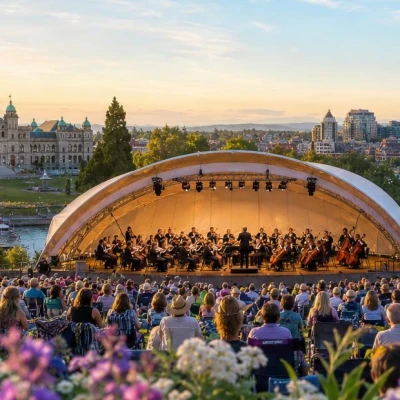
Downtown Bellevue's hotels — the Hyatt Regency Bellevue, The Westin Bellevue, and the Bellevue Marriott — maintain piano bars and lounge acts serving the corporate travel market, providing steady if unglamorous employment for jazz and R&B musicians. The downtown parks, particularly Downtown Park with its circular canal and amphitheater area, host summer concert programming under Bellevue's Parks & Community Services umbrella.
Festivals and Signature Events
Bellevue Arts Museum ARTSfair (late July, Bellevue Square vicinity) is the city's largest annual cultural event, drawing over 300,000 visitors across three days. While primarily a visual-arts fair, its outdoor performance stages book acoustic and world-music acts continuously throughout the weekend.
The Bellevue Jazz and Blues Festival (held at Crossroads in late June/early July) is the city's most music-specific recurring event, presenting regional jazz and blues acts on outdoor stages with free admission. Its programming leans toward accessible, family-friendly jazz rather than avant-garde experimentation, but the festival has expanded its booking range as the local scene has grown.
Diwali at Crossroads (October) features Bollywood dance performances, classical Indian music, and live dhol drumming, drawing several thousand attendees and representing the most visible intersection of Bellevue's South Asian community and its public performance calendar.
The Bellevue Philharmonic presents its annual concert season at Meydenbauer Center, with programming that includes pops concerts drawing 400–600 attendees and classical subscription series serving the city's educated, affluent audience.
Sakura Con (held at the Washington State Convention Center in Seattle but organized by the Eastside-based Animation Research Club) draws tens of thousands of anime fans whose musical taste has helped establish J-pop, visual kei, and video-game soundtrack concerts as a regular feature of the regional entertainment calendar — a genre thread that runs directly through Bellevue's gaming-industry workforce.
Demographics and Cultural Complexity
Bellevue is roughly 47% white, 35% Asian, 9% Hispanic or Latino, and 3% Black or African American — a demographic profile shaped heavily by tech-industry immigration from India, China, South Korea, and the Philippines. The South Asian community, concentrated in the Crossroads and Overlake neighborhoods, is the largest such concentration in Washington State outside of the Seattle metro's older South Asian enclaves in Redmond and Kirkland. This community has generated a rich private music culture: Carnatic vocal and instrumental instruction, Hindustani classical lessons, Bollywood dance academies, and bhangra competition teams all operate through community centers, temple halls, and private studios largely off the mainstream cultural radar.
The Chinese and Taiwanese communities support Mandarin-language karaoke venues, Chinese New Year performance events, and a network of music schools teaching classical piano and violin that funnel students toward regional competitions. Korean American residents support a robust church-based choral culture — many of Bellevue's megachurches (including several Korean-language congregations) maintain professional-grade music programs that employ working musicians as worship leaders and choir directors.
This internal density of music education and private performance creates a paradox: Bellevue arguably has more trained musicians per capita than many larger American cities, yet its public concert culture is modest relative to that talent base. The explanation is economic: private lessons, studio sessions, worship gigs, and corporate entertainment absorb the time of working musicians who might otherwise build a club circuit or touring culture.
What Ties It Together
What Bellevue offers is not a signature sound but a condition — the Eastside's particular combination of wealth, diversity, and geographic position relative to Seattle creates a city that produces serious musicians who train locally, develop in the Seattle club ecosystem, and then return to Bellevue to teach, record, and sustain the next generation. The tech-industry backbone that funds the city's prosperity also funds its music education, its venue infrastructure, and the recording studios that have given regional artists access to professional resources without relocating to Los Angeles or New York. Bellevue is, in this sense, a support city — a place where the Pacific Northwest's broader musical culture recharges, professionalizes, and plans its next move.