

Lévis occupies a dramatic position on the south shore of the St. Lawrence River, rising steeply from the waterfront on cliffs that face Old Quebec City across one of the most visually arresting river crossings in North America. The Lévis–Québec ferry — one of the oldest continuously operating ferries in Canada, with service dating to the 17th century — has carried workers, commuters, artists, and tourists across the half-kilometre channel for centuries, making the river crossing itself a cultural institution. With a population of roughly 143,000 in the amalgamated city (formed in 2002 from Lévis, Saint-Romuald, Saint-Nicolas, and a cluster of smaller municipalities along the Chaudière River corridor), Lévis is the second-largest city in the Chaudière-Appalaches region and one of the most economically vital cities in the Quebec City Census Metropolitan Area.
The city's economy is anchored by the Chantier Davie Canada shipyard at Lévis — the largest and oldest active shipyard in Canada, with continuous operation since 1825. Davie has built naval vessels, icebreakers, and commercial ships for Canadian and international clients across nearly two centuries, and its workforce has shaped Lévis's class character: a union-organized, technically skilled, francophone working city that grew alongside the shipyards and the rail lines that served the south shore. The Desjardins Group — the largest cooperative financial institution in Canada, with origins in the Lévis cooperative movement founded by Alphonse Desjardins in 1900 — headquartered its early operations here, and the Desjardins cooperative model remains central to Quebec's economic identity. That mix of industrial pride and cooperative culture runs through Lévis's civic life and, indirectly, its music.
A brief history
The territory on the south shore of the St. Lawrence was home to the Abénaki and Algonquin peoples before French colonization. French settlers established a presence at what became Lauzon (one of the oldest municipalities in New France) in the early 1600s. The British fortifications on the Lévis heights — Fort No. 1 and Fort No. 2, built in the 1860s as part of a ring of citadels defending Quebec City against potential American invasion — are among the best-preserved British military earthworks in Canada and now form a national historic site. That strategic position, directly across from the Citadelle in Quebec City, defined Lévis as a military and commercial gateway to the inland river system.
By the late 19th century, Lévis was already a significant industrial town: the Davie shipyard was building ironclad ships, the railway corridor was established, and a dense working-class French-Canadian community had built parishes, schools, and cultural associations in the hillside neighbourhoods overlooking the river. The 2002 municipal amalgamation brought together the old City of Lévis, Saint-Romuald (a bedroom community with its own music scene), and Saint-Nicolas into the current unified city — though residents of the former suburbs retain strong local identities.
Music identity
Lévis is not a music city in the sense that Montreal or Quebec City is a music city. It has no historic Bourbon Street, no Plateau-Mont-Royal indie-rock district, no internationally known festival that puts it on the global map. What it has is something different and arguably more durable: a dense, participatory francophone rock and folk tradition that is sustained by community halls, church basements, local festivals, and a CÉGEP-and-bar circuit that gives young musicians a genuine working environment.
The most significant musical contribution Lévis has made to Quebec culture is as the hometown and early base of Les Cowboys Fringants — the Longueuil-area rock-folk band that became one of the defining acts of Quebec rock in the 2000s and 2010s. While the Cowboys are formally from Repentigny, multiple band members are from the south shore Lévis-Quebec corridor and the band built part of its early following through the south shore circuit. More squarely Lévis-rooted is Radio Radio, the Acadian electro-hip-hop duo, who although from New Brunswick embedded themselves in the Quebec francophone scene and played Lévis regularly. Groupa Bizarre, Les Breastfeeders, and a range of Québécois rock acts passed through the Lévis bar circuit in the 2000s as part of the broader south-shore touring loop.
The francophone rock scene in Lévis feeds directly off the CÉGEP de Lévis-Lauzon campus and the Université du Québec satellite campus, both of which generate young bands and support student radio programming. Local acts like Stéphane Côté (singer-songwriter, south shore) and a rotating cast of regional folk and chanson performers sustain a vibrant folk tradition. The metal scene in Lévis is notable for a mid-sized city: the industrial hinterland, the bridge-and-ferry culture, and the working-class demographics have sustained heavy metal, death metal, and black metal bands at the club level for decades — a micro-ecosystem shared with the broader Quebec City metal scene.
Country and americana have modest but real roots in the rural parishes surrounding the city, and the Chaudière Valley communities south of Lévis sustain a country dance-hall tradition that predates Nashville's influence. Traditional Quebec folk — chanson québécoise, trad, and the step-dance tradition — is woven into the community celebrations, parish festivals, and heritage events that mark the Lévis civic calendar.
The Caribbean diaspora in Lévis is modest compared to Montreal but growing — a Haitian community established in the 1970s and 1980s supports gospel, konpa, and Caribbean programming through community organizations. The Congolese and West African communities that have settled in the Quebec City CMA over the past decade extend into Lévis through community centers and church programming.
Venues and neighbourhoods
Lévis's venue geography is modest and neighbourhood-rooted rather than concentrated in a single entertainment district. Le Cercle is the primary small venue in the broader Quebec City area (technically in Quebec City itself), and Lévis musicians often migrate across the river for larger bookings. Within Lévis proper, Le Batailleur, Bar l'Anarchiste (a long-running punk and metal room in the Lauzon area), and a cluster of bars and brasseries on Rue Saint-Joseph and Rue Bégin in the old Lévis centre-ville support live music on the weekends.
The Vieux-Lévis neighbourhood — the historic upper town above the ferry terminal, with its tight streets of 19th-century row houses and former merchant buildings — is the cultural and social heart of the city, with the best concentration of bars and restaurants. Saint-Romuald (downstream along the river) and Saint-Nicolas (at the mouth of the Chaudière River) sustain community-hall music scenes rooted in parish and family networks. The Centre Caztel and the Salle Léo-Roussel host mid-scale events including theatrical and musical programming. Cégep de Lévis-Lauzon's campus spaces function as de facto small venues for student music programming.
Fort No. 1 and the Terrasse de Lévis — the dramatic clifftop boardwalk facing Quebec City — anchor the outdoor event geography. The ferry terminal plaza and the riverfront park below the cliffs are the natural outdoor performance spaces for summer festivals.
Festivals and signature events
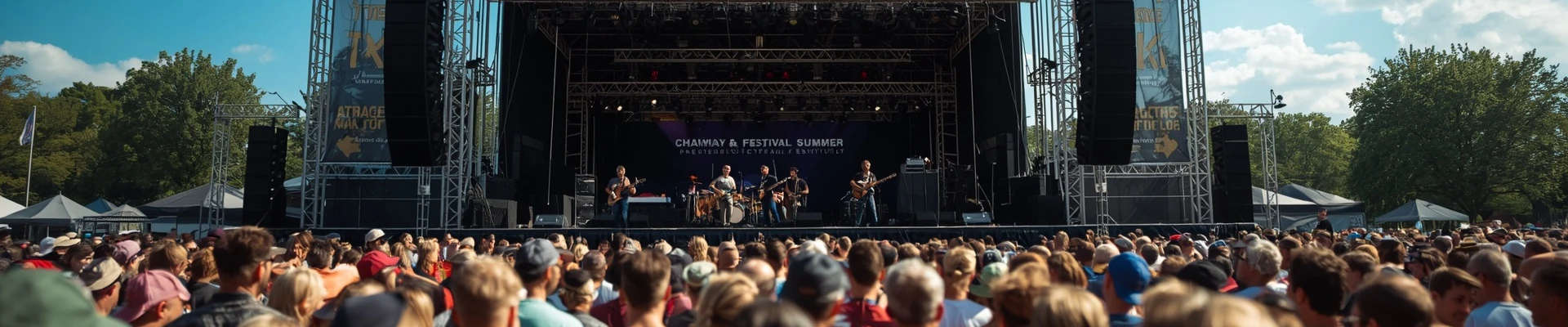
Festivent Lévis is the city's signature summer music festival, held in August on the clifftop terrasse overlooking the St. Lawrence. It programs a mix of Quebec francophone pop, rock, country, and folk acts alongside the occasional headliner from the broader Canadian market — a model similar to the regional festival circuits across Quebec's mid-sized cities. The festival's backdrop — the river below, Old Quebec's Château Frontenac glittering across the water — is among the most dramatic outdoor festival settings in the province.
Festival des Harmonies et Orchestres Symphoniques du Québec rotates through Quebec cities including Lévis on a biennial basis, programming community and youth orchestras in a province-wide celebration of classical and wind-ensemble music. The Carnaval de Lévis (winter) and the various Fête nationale du Québec celebrations on June 23–24 program live folk, rock, and chanson in the parks and squares of the old city. Fête des Voisins (neighbourhood street-party events) and parish-level summer fairs sustain a grassroots live music circuit through the summer calendar.
The St. Lawrence River is itself a cultural event axis: the ferry crossing is a year-round ritual, and the river views from both sides have been the backdrop for ad-hoc performance, street music, and informal summer sessions since the city was founded.
What ties it all together
Lévis is defined by its position — across the river from one of the most beautiful and historically resonant cities in North America, linked to it by a ferry that has been running since before Canada existed. That proximity to Quebec City gives Lévis musicians easy access to a larger market, a more diverse venue circuit, and a broader cultural conversation than a city of 143,000 would normally sustain on its own. But Lévis is not just Quebec City's bedroom. The shipyard culture, the Desjardins cooperative tradition, the dense francophone parish networks, and the industrial working-class character of the south shore have given Lévis a civic pride and a music scene that are distinctly its own. The francophone rock bands rehearsing above the Chaudière River valley, the metal kids at the Lauzon brasseries, the folk singers at the community centres in Saint-Nicolas — they are playing the music of a city that has always looked across the water toward something larger while remaining firmly rooted on the south shore.