
Longueuil sits on the south bank of the St. Lawrence River directly across from the Island of Montreal, connected to the metropolis by the Jacques Cartier and Samuel De Champlain bridges and the Longueuil–Université-de-Sherbrooke metro station — the first stop outside Montreal on the yellow line. With a population of approximately 229,000 in its core municipal boundaries and more than 410,000 across the greater Longueuil agglomeration (which encompasses Brossard, Saint-Lambert, Boucherville, and Saint-Bruno-de-Montarville), it is the fifth-largest city in Quebec and the largest city on Montreal's South Shore. Longueuil is neither a suburb in the satellite sense nor an independent regional centre in the way that Québec City or Sherbrooke are — it is something in between: a dense, historically layered francophone city whose identity has been shaped by its simultaneous closeness to and distinctness from Montreal.
A brief history
The territory along the south shore of the St. Lawrence was home to Haudenosaunee (Iroquois) and Algonquin peoples long before European settlement. The seigneury of Longueuil was granted to Charles Le Moyne in 1657 — one of the earliest and most substantial land grants in New France — and the Le Moyne family's château became one of the most fortified private residences in 17th-century North America. The town grew through the 18th and 19th centuries as a river port and agricultural centre, developing at a pace set partly by its relationship with Montreal across the water. The completion of the Victoria Bridge in 1859 and later the Jacques Cartier Bridge in 1930 transformed the South Shore from a semi-isolated ferry crossing into a commuter and industrial zone. The post-WWII boom brought rapid suburban expansion through the 1950s, 1960s, and 1970s, swallowing the former independent municipalities of Saint-Hubert, Greenfield Park, and Jacques-Cartier into the growing city. The 2002 municipal mergers under the Parti Québécois government — and the partial 2006 demergers that let some South Shore municipalities re-separate — left Longueuil with its current boundaries and a lingering political complexity around agglomeration governance. The city's economic base has long been anchored by the aerospace and aviation sector: Pratt & Whitney Canada has operated a major research and manufacturing campus in the former Saint-Hubert sector since 1928, and the Saint-Hubert Airport (now the Longueuil aéroport de Saint-Hubert) remains one of the busiest general aviation airports in Quebec.
Music identity
Longueuil's musical identity is inseparable from Quebec's broader chanson, rock québécois, and indie francophone traditions, inflected by its particular South Shore geography. The city is not the origin point of a signature sound the way Motown Detroit or Bakersfield California are — but it has been a consistent incubator of talent, particularly in the late 1990s through 2010s wave of Quebec indie rock and pop.
Tricot Machine, the beloved Quebec indie folk-pop duo of Mara Tremblay and collaborators, built their catalog out of the South Shore orbit and are among the most respected voices in modern francophone Quebec pop. Mara Tremblay's long solo career — running in parallel with Tricot Machine across albums like Paradoxe and Révolution douce — made her one of the most consistent singer-songwriter voices in Quebec over three decades. Kevin Parent, born in Sept-Îles and one of the defining voices of 1990s rock québécois, based much of his career in the Greater Montreal orbit that includes the South Shore; his Pigeon d'argile (1995) remains one of the most celebrated Quebec albums of its decade.
The city's connection to Cœur de pirate — Béatrice Martin — is one of its most internationally recognized. Martin grew up in and around Montreal's South Shore communities before becoming one of the most successful French-language pop artists of her generation; her eponymous debut (2008) and subsequent albums made her a global ambassador for Quebec chanson, sung across France, Belgium, and Switzerland. The South Shore's dense network of high school music programs, including those in the Saint-Hubert and Jacques-Cartier sectors, has fed a steady pipeline of trained musicians into the Montreal scene for decades.
The Longueuil area's rock and metal underground has roots going back to the 1980s, when the South Shore's community halls, church basements, and VFW-style salles communautaires hosted early thrash, punk, and metal shows for teenagers too young for Montreal's downtown clubs. The Cégep Édouard-Montpetit and Cégep Saint-Laurent pipelines — the South Shore's collegiate institutions — have fed generation after generation of trained musicians, many of whom crossed the river to make careers in Montreal while retaining South Shore addresses and social networks. Jonathan Painchaud, the Quebec country and roots singer, built his career out of the Montreal-South Shore circuit. The late 1990s and 2000s Quebec punk and ska scene — centred on labels like Dare to Care and bands that crisscrossed the Montreal/South Shore divide — gave the city a modest but real role in Quebec's most internationally watched independent music moment.
Longueuil's Haitian diaspora — one of the largest concentrations of Haitian-Canadians in Quebec — sustains a living kompa, rara, rasin, and Haitian rap kreyòl scene through community events, the Centre haïtien du Québec orbit, and a network of churches (the Haitian Protestant church choral tradition is particularly strong on the South Shore). Maghrebi communities — particularly Algerian, Moroccan, and Tunisian families who settled in the Brossard, Jacques-Cartier, and Vieux-Longueuil sectors — have brought raï, gnawa-influenced acoustic music, and francophone hip-hop into the city's cultural mix. The Longueuil hip-hop and trap underground, largely francophone and carrying influences from both Quebec rap traditions and Caribbean diaspora music, has become more visible since the mid-2010s. Latin American communities in Brossard and Greenfield Park sustain salsa, cumbia, and reggaeton social circuits through local dance studios and community events.
Venues and neighborhoods
Longueuil's institutional anchor for music is the Centre des arts de Longueuil, whose Salle Pratt & Whitney — a 700-seat hall named for the city's signature aerospace employer — presents classical, jazz, world music, and contemporary Quebec chanson programming across the season. The Centre also programs emerging Quebec artists through its annual and one-off presentations. The Maison de la culture de Longueuil operates as both a library-gallery and a community performance space, anchoring francophone cultural programming in the Vieux-Longueuil core. L'Impérial de Québec is a Montreal anchor, but Longueuil acts regularly perform across the river; the South Shore's own bar circuit is more modest but genuine.
Vieux-Longueuil — the historic core along the river and Chemin de Chambly — is the city's most walkable cultural corridor, with bars, restaurants, and a handful of live music rooms in 19th-century commercial buildings. Brasserie La Nuit Blanche and the Pub Le Garage represent the bar-music end of the scene; the summer terrace culture along the St. Lawrence adds outdoor concert programming. The Parc Marie-Victorin on the riverfront hosts summer outdoor concerts with Montreal's skyline as backdrop. The Saint-Hubert sector — home to the aéroport and the aerospace cluster — carries a more suburban texture, but its commercial strips support venues and event halls that host wedding bands, tribute acts, and regional touring. Brossard's massive DIX30 commercial development has brought larger concert and event infrastructure to the agglomeration's south end.
Festivals and signature events
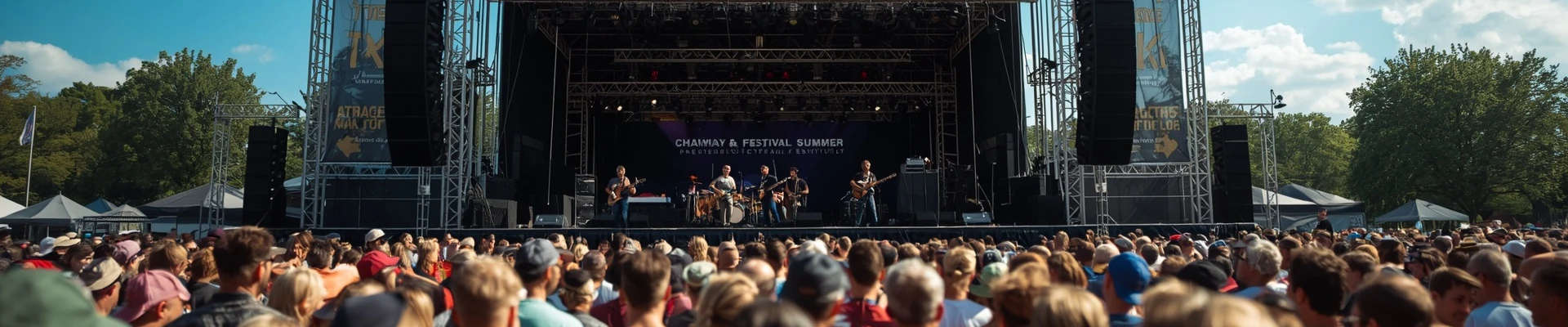
Longueuil's festival programming is anchored by Les Promenades de Longueuil, the summer outdoor music series in the Vieux-Longueuil parks and public squares, and the Festival de Musique de Vieux-Longueuil, which animates the historic district with street performances, bar programming, and free outdoor stages across summer weekends. The Fête nationale du Québec (June 24) brings one of the largest outdoor concerts in the region to Place Charles-De Gaulle and the Vieux-Longueuil riverfront, often programming major Quebec pop and rock acts. Festival Bossa Nova's South Shore programming, Festival interculturel de Longueuil, and the Carnaval haïtien events reflect the city's multicultural demographics. The Longueuil International Tattoo is a military music tradition that brings pipe bands and marching ensembles from across North America and Europe to the city. The Salon de la Chanson de Longueuil and similar songwriter platforms have launched careers in the Quebec scene.
What ties it all together
What defines Longueuil musically is the productive tension between the city's own francophone identity and its proximity to one of the world's great music cities across the river. Longueuil is neither absorbed by Montreal nor wholly autonomous — it is a place where musicians grow up close enough to hear what's happening in Plateau-Mont-Royal, Mile End, and Hochelaga, and far enough to develop their own relationship to Quebec chanson, to the compa and raï of immigrant communities, to the South Shore's rock underground, before crossing the Jacques Cartier Bridge to find their audience. The Salle Pratt & Whitney programs serious music. The summer riverfront fills with outdoor stages and the Montreal skyline glows across the water. The Haitian churches fill on Sundays with choral harmonies. The cégeps graduate trained musicians every spring. That quiet, sustained pipeline — more incubator than destination — is Longueuil's defining musical signature.