
Saguenay occupies a spectacular geographic position at the confluence of the Saguenay River and the Rivière des Ha! Ha!, roughly 200 kilometres north of Quebec City in the region known as Saguenay–Lac-Saint-Jean. The city was created in 2002 through the amalgamation of three former municipalities — Chicoutimi, Jonquière, and La Baie — each with its own industrial character, civic identity, and cultural life, and the amalgamated city has never quite resolved the tension between those three centres. With a population of around 148,000, Saguenay is the economic and cultural capital of a region that is simultaneously one of the most homogeneously francophone in Canada and one of the most geographically isolated from Montreal's gravitational pull.
The landscape around Saguenay is among the most dramatic in eastern Canada. The Saguenay Fjord — a glacially carved trench up to 275 metres deep, flanked by sheer basalt cliffs rising to 300 metres — runs from the city westward to Lac Saint-Jean, the massive glacial lake that gives the region its second name. The fjord, now protected as a marine park, has shaped the region's imagination for generations and shows up in the imagery of its music, its literature, and its visual arts in ways that are impossible to ignore. To understand Saguenay musically is to understand a city that knows it lives at the edge of something immense and untameable.
A brief history
The region's history begins with the Ilnu (Montagnais) people of the Pekuakamiulnuatsh First Nation, whose territory at Mashteuiatsh on the western shore of Lac Saint-Jean has been continuously inhabited for millennia. European contact came through the fur trade in the early 17th century; Samuel de Champlain mapped the Saguenay in 1603. The first permanent French Canadian settlement in the area dates to the 1830s, when colonization societies organized by the Catholic Church sent farming families northward from the overcrowded lower St. Lawrence to clear the boreal forest.
The industrial transformation began with the Price Brothers lumber operations in the mid-19th century and accelerated dramatically with the arrival of the aluminum industry in the early 20th century. Alcan (the Aluminium Company of Canada) built its first smelter at Arvida (now part of Jonquière) in 1926, creating one of the world's largest planned industrial towns and establishing the economic character that would define the region for a century. By mid-century, the Saguenay region was producing a substantial fraction of the world's aluminum, and the smelter towns — Jonquière, Arvida, Kénogami — were built around the rhythms of shift work, union halls, and the particular working-class francophone culture that aluminum money produced. That culture — proud, insular, self-reliant, skeptical of Montreal pretension — is the cultural soil in which Saguenay's music grew.
Music identity
Saguenay's most internationally significant musical export is Plume Latraverse, one of the most anarchic and beloved figures in the entire Quebec chanson tradition. Born Michel Latraverse in 1946 in Jonquière, Plume constructed a career defined by deliberate irreverence — absurdist lyrics in thick Saguenay joual, DIY recording, refusal of major-label packaging, and a persona that was simultaneously poet, clown, drunk, and sage. His records, from the early 1970s albums through the 1980s output on his own label, are canonical texts of the Quebec counterculture. Songs like "La Mauvaise Chanson" and the anthology of characters he built across dozens of albums made him a cult figure who influenced an entire generation of Quebec songwriters who wanted to make music that felt true to their own streets and syntax, not sanitized for radio.
Claude Gauthier — born in Saint-Gédéon near Lac Saint-Jean in 1939 — is another foundational figure. His 1962 song "Le Plus Beau Voyage" became one of the defining texts of the Quebec folk revival, a meditation on the land and language of Quebec that sits alongside Gilles Vigneault's work as an expression of what the Saguenay–Lac-Saint-Jean landscape sounds like when turned into song. Gauthier spent decades performing and recording, and his rooted, place-specific folk poetry is an important counterpoint to the more urbanized chanson of Montreal.
Kevin Parent — born in 1972 in Chicoutimi — is the region's most commercially successful artist of the modern era. His 1995 debut album Pigeon d'Argile was one of the best-selling Quebec francophone albums of the decade, a sophisticated blend of folk-rock and singer-songwriter introspection that demonstrated that Saguenay could produce polished, radio-ready music without sacrificing emotional authenticity. Parent's "Seigneur" and "Pour te trouver" were inescapable on Quebec radio through the mid-1990s; he remains one of the region's most celebrated cultural exports.
The rock and metal underground that developed through Chicoutimi and Jonquière in the 1980s and 1990s was fierce and locally oriented. With fewer avenues to Montreal's music industry, bands in Saguenay built their own circuits — small venues, university bars, basement shows — and the isolation produced music with an edge and a particularity that more metropolitan scenes often lack. Groovy Aardvark, one of Quebec's landmark funk-metal and alternative acts of the 1990s, had their roots in the Quebec City/Saguenay corridor. The Université du Québec à Chicoutimi (UQAC) has been a consistent incubator for local bands, hosting a student bar scene and occasional larger concerts that give emerging artists a real, if small, stage.
The regional dialect — the Saguenay–Lac-Saint-Jean variety of Quebec French, sometimes called joual saguenéen — is notably distinct even within Quebec, with its own vocabulary, cadences, and pronunciations. For musicians from the region, writing in that dialect is both a political act (asserting the validity of a voice that Montreal media has sometimes coded as provincial) and a practical one (the dialect simply sounds different and creates a particular sonic texture in sung French). Plume Latraverse made this most explicit, but the influence runs through dozens of artists from the region.
Venues and neighborhoods
The venue landscape in Saguenay follows the three-city geography closely. Chicoutimi retains the largest concentration of downtown venues, centred around rue Racine — the main commercial artery — and the surrounding blocks. La Salle du Royaume in Chicoutimi is the city's largest enclosed venue, a 2,500-seat arena that hosts touring acts, Cirque du Soleil runs, and major Quebec pop stars. Le Centre des arts et de la culture in Chicoutimi provides a home for the performing arts — theatre, classical music, and occasional rock and chanson programming. The Vieux-Port de Chicoutimi area, with its historic pulpmill buildings now converted to cultural uses, hosts outdoor concerts and festivals in summer.
Jonquière has historically had the more working-class bar circuit, shaped by the Alcan smelter culture. The area around boulevard Harvey and the Jonquière sector has a legacy of live music bars catering to the shift-work crowd. The Arvida neighbourhood within Jonquière — the planned aluminum company town built in 1926 and still remarkably intact as an urban heritage district — hosts community events and occasional summer concerts in its parks. La Baie, the smallest of the three former cities, has its own smaller scene oriented around the dramatic Ha! Ha! Bay waterfront.
UQAC's campus in Chicoutimi functions as a reliable mid-size concert venue through its student union facilities, and the student population of roughly 7,000 provides a consistent audience for touring indie acts, hip-hop, and local rock shows.
Festivals and signature events
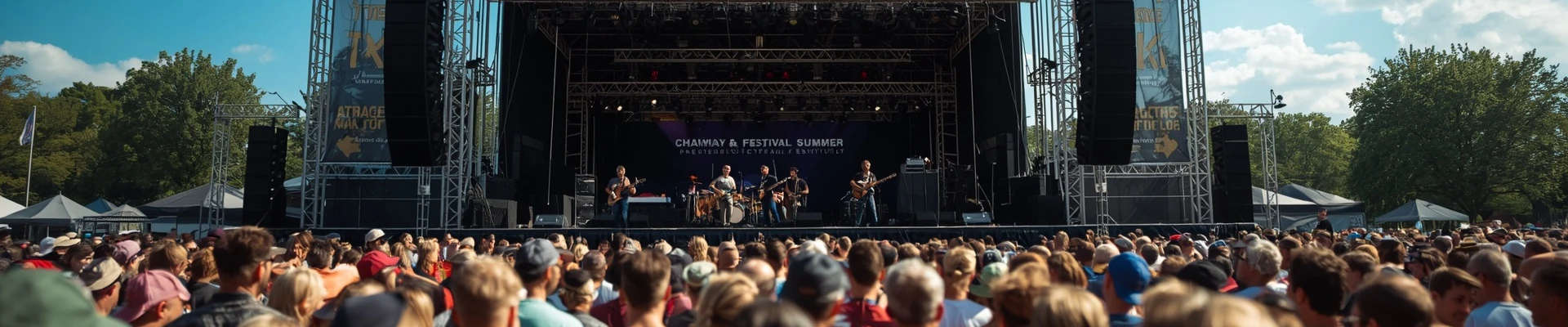
The Festival International des Rythmes du Monde (FIRM) is Saguenay's signature music event — a world-music festival held in Chicoutimi each August that draws artists from across the globe and audiences from throughout the Saguenay–Lac-Saint-Jean region. FIRM is known for programming ambitious, genuinely international lineups — West African percussion ensembles, Brazilian batucada groups, Moroccan Gnawa musicians — alongside Quebec and Canadian acts, and for its use of outdoor sites in the Vieux-Port area that give the festival a spectacular backdrop. For a city of Saguenay's size, FIRM is a remarkable cultural achievement, and it functions as a proof-of-concept that world-class programming can thrive far from the major metropolitan centres.
Festival Épic is a more recent addition to the calendar, a summer rock and pop festival with a younger demographic and a lineup that skews toward Quebec indie and emerging artists. It occupies the early-summer calendar slot and has built a reputation for presenting credible acts without the corporatized sheen of the larger Quebec festival circuit.
The Traversée internationale du lac Saint-Jean — the open-water swimming race across Lac Saint-Jean that draws competitors from around the world — is accompanied by concerts and cultural programming that effectively turns the region's largest annual sporting event into a broader festival occasion.
The Carnaval souvenir de Chicoutimi is one of Quebec's oldest winter carnivals (predating the Quebec City Carnaval in its origins) and incorporates live music programming through its events. The Festival du cinéma international en Abitibi-Témiscamingue in nearby Rouyn-Noranda draws some cultural cross-pollination with Saguenay's arts community.
What ties it all together
What makes Saguenay's music scene distinctive is not scale but rootedness. The distance from Montreal — cultural, geographic, psychological — has forced the city to develop its own infrastructure and its own standards of authenticity. When Plume Latraverse sang in Jonquière joual on homemade records that he sold at shows, he was not trying to be discovered; he was trying to say something true about where he came from. When Kevin Parent built his introspective folk-rock on the emotional terrain of a Chicoutimi childhood, he brought that particularity to a large audience without sanding it down. The Saguenay–Lac-Saint-Jean region's intense French-Canadian cultural identity, shaped by the fjord and the boreal forest and the aluminum economy and the Ilnu presence at Mashteuiatsh, produces artists who have something specific to say — and that specificity, at its best, is what transforms local music into something that resonates well beyond the city limits.