

Sherbrooke is the largest city in the Eastern Townships (Estrie) region of Quebec, situated at the confluence of the Magog and Saint-François rivers about 150 kilometres east of Montréal and 80 kilometres north of the Vermont border. With approximately 172,000 residents in the greater metropolitan area, it is the fourth-largest city in Quebec and the sixth in the country when measured by the broader census metropolitan area. It occupies a distinctive place in Quebec life: a majority francophone city with a historically significant anglophone community rooted in the United Empire Loyalist settlements of the 19th century, home to two universities with very different cultural profiles — the massive, francophone Université de Sherbrooke and the small, anglophone Bishop's University in the adjacent community of Lennoxville — and a growing immigration-driven demographic layer that has been reshaping the city's cultural output for two decades. Long nicknamed "La Reine des Cantons de l'Est" (Queen of the Eastern Townships), Sherbrooke has spent much of the past century being underestimated, and much of the past two decades quietly becoming one of Quebec's more interesting mid-size music cities.
A brief history
The Eastern Townships were settled primarily by Loyalists fleeing the newly independent United States after 1783. The town that became Sherbrooke developed at the falls of the Magog River — a natural mill site — and grew into an industrial centre through the 19th century on textiles, lumber, and later pulp and paper. The railway made it a regional commercial hub; the post-Confederation decades brought Irish, Scottish, and Eastern European immigration alongside the dominant British-origin settler population. The 20th century brought French-Canadian demographic dominance as rural Quebecers moved into industrial employment; by the 1960s, Sherbrooke was majority francophone and the anglophone community, once the social elite, had become a minority within the city, though Bishop's University in Lennoxville kept an English-language institutional anchor alive. The Quiet Revolution of the 1960s remade Quebec's cultural institutions, and Sherbrooke's university community — particularly the rapidly expanding Université de Sherbrooke — became a vector for the new nationalist, French-language cultural projects of the era. Today the city's population is roughly 85% francophone, with an anglophone community concentrated in the Sud-Ouest and Lennoxville areas and a growing layer of newcomers from French-speaking Africa, Latin America, and the Maghreb.
Music identity
Sherbrooke's most internationally recognized musical export is Men Without Hats, the synth-pop band formed by the Doroschuk family — primarily Ivan Doroschuk — who grew up in Montréal but whose family roots and early formation were deeply connected to the Eastern Townships. Their 1982 single "The Safety Dance" became one of the definitive Canadian pop songs of the decade and one of the best-selling Canadian singles internationally of the 1980s. While their formation is shared with Montréal, the Sherbrooke connection runs through family and community networks that were central to the band's identity.
The deeper Sherbrooke music lineage runs through French-language chanson and rock. La Chicane, the Sherbrooke-based Quebec folk-rock and chanson band anchored by guitarist and songwriter Philippe Labbe, built one of the most beloved catalogs in Quebec popular music through the 1990s and 2000s — accessible, melodic, roots-flavoured songs in the tradition of Quebec's folk revival. Their albums Attache ta tuque and L'esclave defined a strand of the province's pop-folk sensibility. Claude Gauthier, the veteran Quebec singer-songwriter and playwright, is a native Sherbrookois and one of the most decorated figures in Quebec's chansonnier tradition — his 1967 song "Le grand six pieds" became an anthem of Quebec identity. Anik Jean, the Sherbrooke-born singer-songwriter and actress who built a parallel career in French chanson and theatrical performance, represents the continuity of the city's singer-songwriter tradition. The chansonnier lineage connects backward to the broader Eastern Townships folk revival of the 1960s and the resonance of Félix Leclerc's influence across the region.
The student scene at the Université de Sherbrooke and Bishop's University has been one of the city's most generative musical environments. The UdeS campus supports a large, French-language student rock and pop circuit through the student union's programming (the Agora des arts at the university being a key early-career venue), while Bishop's has historically supported an English-language indie and folk scene — small, insular, but producing a steady output of acts that migrate toward Montréal on graduation. The English-language Sherbrooke scene has rarely translated internationally, but it has served as a genuine incubator for musicians who went on to careers in the national indie and folk circuit.
Sherbrooke has also contributed to Quebec's metal and rock circuits. The city has a documented heavy music history through a club and bar circuit that has supported regional touring, and a number of acts with Eastern Townships roots have connected into the broader Quebec metal and prog-rock scenes. Groovy Aardvark, one of the more durable acts in Quebec alternative rock, has connections to the Sherbrooke region. The city's punk and hardcore community, while never achieving national prominence, has sustained a local circuit through rehearsal studios, DIY events, and bar shows. The broader Sherbrooke indie and alternative scene — operating in both French and English — has maintained a consistent presence in Quebec's regional touring network for three decades.
Sherbrooke's immigration-driven musical changes are among the most interesting developments of the past 20 years. The city has received substantial numbers of newcomers from French-speaking Africa (particularly the Democratic Republic of Congo, Rwanda, and Cameroon), the Maghreb (Morocco, Algeria, Tunisia), Haiti, and Latin America (Colombia, Mexico). These communities have brought Congolese rumba and soukous, Maghrebi chaabi, Haitian kompa, and Latin cumbia and salsa into a city that previously had a relatively homogeneous European-derived music culture. The Centre multiethnique de Sherbrooke and a network of cultural associations have organized performance spaces for these communities. The Université de Sherbrooke's international student population — substantial and growing — has also introduced Brazilian, West African, and Asian music cultures into the city's institutional venues.
The city's classical and choral tradition runs through the Orchestre symphonique de Sherbrooke (OSS), one of the major regional symphony orchestras in Quebec, and through a deep choral culture anchored by university choirs, church choirs, and the city's strong Catholic musical heritage. The OSS has been one of the most important institutional music organizations in the Eastern Townships for decades.
Venues and neighborhoods
The venue ecosystem reflects the city's university character and mid-size scale. The largest venue is the Centre de foires de Sherbrooke (exhibition and convention centre used for large concerts), supplemented by Parc Rousseau and Place du Peuple for outdoor summer programming. The mid-size tier is anchored by La Salle Maurice-O'Bready, a 800-seat performing arts venue at the Université de Sherbrooke that is the city's premier classical, theatre, and chanson stage. L'Agora des arts, the UdeS student cultural space, has been among the most active early-career programming venues in the city. L'Escalier, a longtime Sherbrooke rock club, has anchored the city's live rock circuit for decades. Bar Le Fou-Bar, Le Kana, and a rotating set of bars and smaller venues along Rue Wellington Nord (the city's historic commercial strip) and Rue King Ouest have sustained the bar and club scene. The Vieux-Nord neighbourhood, the original industrial core north of the Magog River, has seen arts and music infrastructure develop alongside gentrification. Lennoxville (now amalgamated into Sherbrooke) retains a village-scale English-language scene tied to Bishop's University.
Festivals and signature events
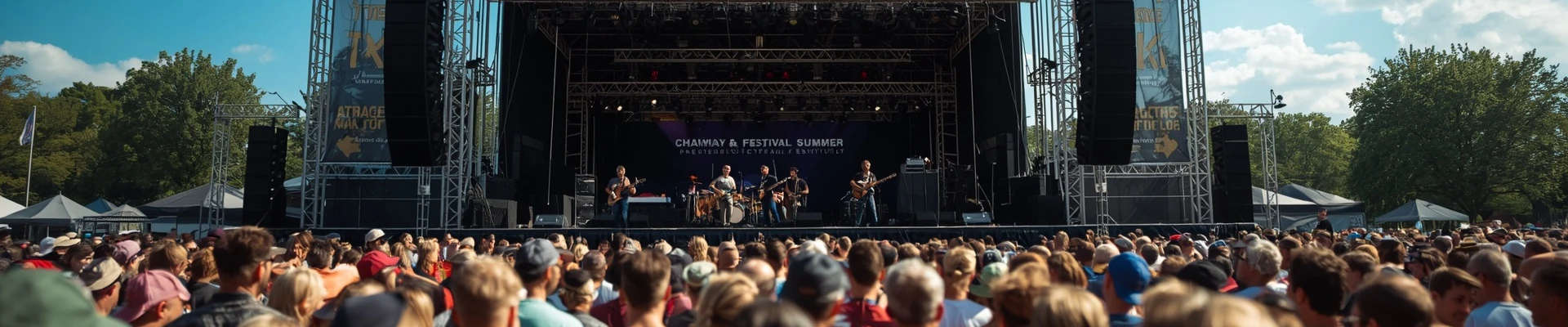
The Festival de la chanson de Sherbrooke, founded in 1988, is one of the most respected competitive chanson and singer-songwriter festivals in the country and has launched dozens of careers — it is to Quebec chanson what the Granby Festival is to broader Quebec pop. The Festival des traditions du monde programs music, dance, and food from dozens of cultures and has become one of the city's more ambitious multicultural programming efforts. Fête de la Saint-Jean-Baptiste programming in Sherbrooke is among the most enthusiastic in Quebec's Eastern Townships, with major outdoor concerts on the St-Jean holiday. The Festival de musique actuelle de Victoriaville (Victo Festival), about an hour's drive north of Sherbrooke, draws Sherbrooke musicians and audiences into the experimental and new-music circuit that connects across the region. Bishop's University's campus concert series and Université de Sherbrooke's programming add a steady institutional layer. La FestIVE and summer parc programming at Parc Blanchard round out the calendar.
What ties it together is the particular bilingual, university-city quality of Sherbrooke's music life — a French-language majority culture that carries the full weight of Quebec chanson, rock, and contemporary pop traditions, intersecting with a small but persistent English-language scene and a growing multilingual newcomer community. The city that gave Quebec Claude Gauthier's chansonnière nationalism, La Chicane's approachable folk-rock, and (by partial claim) Men Without Hats' transatlantic synth-pop has also given the country one of its most well-organized competitive chanson festivals and an OSS that punches well above its city's weight. Sherbrooke doesn't need to announce itself as a music city — the Festival de la chanson has been doing that quietly for nearly 40 years.