

Terrebonne is a city of roughly 119,000 people on the north shore of the Rivière des Mille-Îles, in the Lanaudière administrative region of Quebec, about 25 kilometres northeast of downtown Montréal. The municipality was formed in its current shape in 2002, when the historic Ville de Terrebonne merged with the neighbouring municipalities of Lachenaie and La Plaine — a consolidation mandated as part of Quebec's province-wide municipal reorganization. The result is a sprawling suburban and semi-rural territory whose western flank is dense commuter development and whose eastern reaches open into agricultural land and the broad lakes of the lower Laurentian foothills.
Geography and setting
The Rivière des Mille-Îles forms Terrebonne's southern border and separates it from Laval across the water. The old downtown — historically called Île-des-Moulins after the cluster of mills that once operated there — occupies a small island in the river and is the most photographed corner of the city: stone grist mills, a notary's house, and a seigneurial manor that date from the 18th and early 19th centuries, all carefully restored and open to visitors. North and east of this heritage core the city sprawls through relatively recent subdivisions anchored by commuter arterials and regional shopping. Highway 25 and Highway 640 connect Terrebonne to the Autoroute Métropolitaine and from there to Montréal's core, a drive of thirty to forty minutes in light traffic.
History
The seigneury of Terrebonne was granted in 1673, and the settlement grew as a milling and trading post serving the fur trade and later the agricultural hinterland of the lower Laurentians. The Île-des-Moulins complex — built in stages between the 1740s and the 1850s by successive seigneurs, notably the powerful bourgeois seigneur Simon McTavish and later the Masson family — was by the early 19th century one of the most productive milling sites in British North America, processing wool, lumber, and grain for export. The community remained a market town through Confederation and into the 20th century, but it was the postwar expansion of Montréal's suburban ring that fundamentally transformed Terrebonne, drawing waves of French-Canadian families out of the island city and into newly built bungalows across the north shore. Lachenaie, once a separate agricultural village to the east, grew its own suburban core. La Plaine remained largely rural. The 2002 merger stitched these histories into one administrative unit, though residents of the older sectors still identify strongly with the pre-merger names.
Music identity
Terrebonne does not have a globally known recording scene of its own — that distinction belongs to Montréal, thirty kilometres to the southwest, which absorbs the creative energy of the entire metropolitan region. But Terrebonne and the broader Lanaudière territory have a distinctive relationship with music rooted in the region's deep francophone folk tradition and in one of Quebec's most celebrated outdoor classical events.
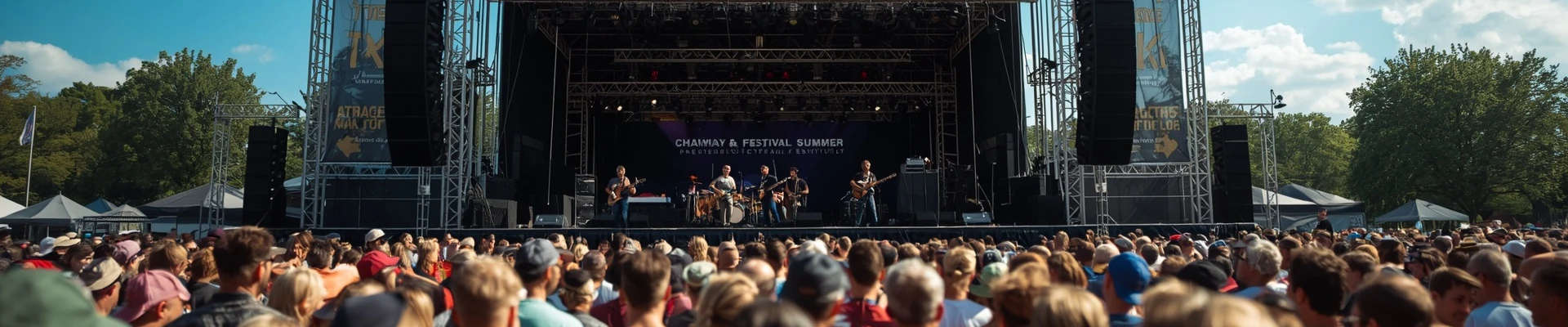
The Festival international de Lanaudière, held annually since 1978 in the neighbouring city of Joliette (roughly 60 kilometres north of Terrebonne), is the pre-eminent outdoor classical music festival in Quebec and one of the largest in North America by attendance. Its central venue, the Amphithéâtre de Lanaudière, is an open-air amphitheatre carved into a hillside that seats more than 8,000 people under the sky, with thousands more on the surrounding lawn. The festival draws major international orchestras and soloists — the Philadelphia Orchestra, the Orchestre Métropolitain, Renée Fleming, Yannick Nézet-Séguin — and its reputation radiates across the region, giving Lanaudière as a whole an unlikely prestige in the classical world. Terrebonne's residents are among the festival's core audience, and the city's proximity to Joliette means the festival week has cultural weight throughout the north shore.
Within Terrebonne itself, French-language popular music — chanson, country-folk, and contemporary Quebec pop — is the dominant idiom. The city has contributed artists to Quebec's broader pop industry. Patrick Bruel, the French singer who recorded several albums with Quebec connections, has performed regionally here, though he is based in France. More locally, the north shore has produced vocalists and songwriters who work within the Quebec French-language system — artists signed to labels like Les Disques Audiogram or Bonsound, both Montréal-based, who draw on the creative pool of the entire greater metropolitan area including Terrebonne.
The city's most enduring musical identity is folk and traditional. The Lanaudière region has long been a stronghold of Quebec's musique traditionnelle — fiddle-driven reels, gigues, and rondes that trace directly to the French colonists of the 17th century and later to Irish and Scottish immigrants who settled the Ottawa and St. Lawrence valleys. Organizations like La Bottine Souriante — the internationally touring trad-folk ensemble from nearby Saint-Ambroise-de-Kildare in Lanaudière — have carried that music around the world, and the regional festivals that celebrate it (including events in Terrebonne's own old town) are genuinely well-attended. Les Charbonniers de l'Enfer and Genticorum are other Lanaudière-connected trad acts that have built reputations internationally in folk festival circuits.
Catholic choral music has also been a thread running through Terrebonne's community music life. Parish choirs, the classical training offered through regional CEGEP programs, and the proximity of the Lanaudière festival all sustain a culture of serious amateur and semi-professional choral singing that is less visible than the festival world but no less real.
Venues and neighborhoods
Terrebonne's live music infrastructure is modest by comparison to larger Quebec cities, befitting its role as a suburban and semi-rural community whose residents commute to Montréal for most professional-tier entertainment. The Centre culturel de Terrebonne (also referred to as the Théâtre du Vieux-Terrebonne in older contexts) operates in the historic core and hosts theatrical performances, community concerts, and touring Quebec acts. The Île-des-Moulins heritage complex itself is a summer performance site — the riverfront grounds and the old stone buildings make a memorable backdrop for outdoor concerts and cultural events during the warmer months.
Local bars and restaurants in the city's commercial strips — particularly along Boulevard des Seigneurs in the Terrebonne sector and Boulevard de la Pinière in Lachenaie — host cover bands, open-mic nights, and small touring acts serving the suburban nightlife market. These are neighbourhood establishments rather than destination venues; the serious club and concert-going public drives into Montréal.
The Théâtre Gilles-Vigneault in neighbouring Saint-Jérôme (in the adjacent Laurentides region, about 30 minutes northwest) is the regional performing-arts anchor for the north shore corridor and draws Terrebonne audiences for mid-scale productions and touring Quebec artists. For arena-scale acts, the Centre Bell in downtown Montréal is the destination.
The broader cultural context
Terrebonne sits within a French-language cultural world that is dense, regionally proud, and increasingly confident in its place within the global music economy. Quebec's French-language music industry — built around chanson québécoise, French-language pop, hip-hop, and an unusually strong traditional-music sector — operates with a degree of institutional support (the CALQ, the SODEC, FACTOR's francophone stream, provincial tax credits for music production) that has no real parallel in anglophone North America. For artists living in Terrebonne or the surrounding north shore, Montréal's infrastructure — its studios, booking agencies, music publishers, and festival circuit — is the professional context. The commute is short enough that north-shore artists are genuinely plugged in.
The city's growing and diverse population — which includes significant communities of immigrants from the Caribbean, North Africa, and sub-Saharan Africa — is beginning to reshape the local music ecology. Haitian kompa and Afrobeat are audible in certain neighbourhood venues and community events, reflecting Quebec's ongoing demographic transformation. These currents do not yet define the city's external identity but they are real and growing.
What ties it all together
Terrebonne is not a city that exports a signature sound to the world the way Montréal or Québec City does. Its contribution to Quebec music is more diffuse: a steady supply of francophone artists and audiences who feed into the larger regional machine; a folk and traditional culture rooted in Lanaudière's rural heritage; a gateway community for one of North America's finest outdoor classical festivals; and a growing suburban population whose musical appetite sustains the north shore's modest live-music infrastructure. The Île-des-Moulins — stone mills beside a wide river, summer concerts in the old town — is the image that captures it best: history, water, francophone pride, and music as a community ritual rather than an industry.