
Where Three Rivers Meet
Trois-Rivières sits at one of the most strategically important confluences in Canadian history: the point where the Saint-Maurice River empties into the St. Lawrence, roughly midway between Montréal (130 km to the southwest) and Québec City (135 km to the northeast). Founded in 1634 as New France's second permanent settlement, the city is among the oldest continuously inhabited urban centres on the continent — a fact that reverberates through its architecture, its institutional fabric, and the particular pride its residents carry. The name itself is a misnomer: European explorers saw three channels at the Saint-Maurice's mouth, not three separate rivers, but the name stuck across four centuries.
The Saint-Maurice valley made the city wealthy. Iron forges at the Forges du Saint-Maurice — Canada's first industrial enterprise, operating from 1730 to 1883 — established a working-class identity that persisted long after the smelters went cold. By the twentieth century Trois-Rivières had become one of the world's great newspaper-print capitals; at its peak the city produced more newsprint than anywhere on earth, earning the nickname "La Capitale mondiale de l'imprimerie." The paper mills are mostly gone now, but their legacy lives in the city's compact, blue-collar energy and its outsized investment in arts and culture as an economic alternative.
Today the city of roughly 144,000 anchors the Mauricie region and serves as an administrative, educational, and commercial hub for a vast swath of central Québec. The Université du Québec à Trois-Rivières (UQTR) injects a permanent student population that keeps the arts scene young and restless. Winters are long and fierce — the kind of cold that drives musicians indoors into rehearsal rooms, studios, and bars, and historically has produced intense, inward-looking music.
A Francophone Cultural Stronghold
Trois-Rivières is overwhelmingly francophone. French is not merely the dominant language here; it is the medium of nearly every artistic, political, and social interaction. That cultural coherence has produced a local music scene operating almost entirely in French — tied to the broader Québec chansonnier tradition while also embracing the province's capacity for noise, aggression, and experimentation.
The city produced Félix Leclerc, the poet, singer-songwriter, and playwright widely regarded as the godfather of the Québec chanson. Born in La Tuque but closely associated with the Mauricie region, Leclerc's influence on subsequent generations of Québec singer-songwriters was foundational — his emphasis on literary lyricism, the land, and a distinctly Québécois identity threads through the local scene to this day.
The Festival international de la poésie de Trois-Rivières, launched in 1985, is one of the most important poetry festivals in the French-speaking world and has embedded spoken-word and literary performance deep into the city's cultural identity. For a mid-sized city to host an internationally recognized poetry festival each October speaks to the literary seriousness that local musicians often absorb — many of the most interesting singer-songwriters to emerge from the region write with a poet's attention to text.
Rock, Metal, and Noise: The Scene in Full
Trois-Rivières has a music scene that consistently produces quality acts relative to its population. The pivot toward rock and heavier music accelerated through the 1990s and 2000s alongside similar shifts in Montréal, Québec City, and Sherbrooke, creating a province-wide circuit of French-language rock clubs and festivals.
Galaxie — the indie rock duo of Olivier Langevin and Laurence Lafond-Beaulne — emerged from the Trois-Rivières area to become one of Québec's most acclaimed acts of the 2010s. Their brand of cinematic, effects-laden rock, delivered entirely in French, earned them multiple Félix Awards (Québec's equivalent of the Junos) and placed them on international stages. Langevin's guitar work and Lafond-Beaulne's vocals created something immediately recognizable as rooted in Québec while drawing on British post-rock and shoegaze textures.
Les Breastfeeders — formed in Montréal but deeply embedded in the Trois-Rivières-to-Montréal axis — exemplified the garage rock revival of the early 2000s with records that mixed '60s trash rock with francophone swagger. The cross-pollination between TR musicians and the Montréal scene (Constellation Records, Bonsound, Blow the Fuse) has historically been fluid; the distance between the cities is close enough for bands to play both markets regularly.
The heavier end of the spectrum has long been well represented. Local metal and hardcore bands cycle through L'Anti Bar & Spectacles in Québec City and La Sala Rossa in Montréal while maintaining home turf. The city's punk and hardcore scene, fed by the UQTR student body, has sustained DIY venues and house shows across successive generations.
Victime — the noise-rock duo of Sophie Trudeau's adopted circles, though more closely linked to Montréal's No Wave underground — represents the kind of experimentalism that often has roots in smaller cities where musicians have more space, cheaper rent, and less commercial pressure to conform. Trois-Rivières has been a quiet incubator for this kind of uncompromising music, producing acts that tend to be discovered only after relocating to Montréal or beyond.
Étienne Fletcher, the indie folk and chamber-pop songwriter, brought a quieter register to the city's output — introspective French-language songs that drew comparisons to the best of Québec's singer-songwriter tradition while finding audiences far beyond the province.
Venues and Live Music Infrastructure
The city's live music infrastructure is modest but functional. The anchor for classical and major touring acts is the Salle J.-Antonio-Thompson, a grand late-nineteenth-century concert hall that serves as home to the Orchestre symphonique de Trois-Rivières — one of the oldest symphony orchestras in Québec — and hosts major theatrical and musical productions. The hall's presence gives the city an institutional classical music life that feeds into the broader arts ecosystem.
For rock, metal, and indie music, Zénob has been the city's most important venue — a bar and concert room that over the years has hosted local acts, touring Québec bands, and international artists passing through the corridor between Montréal and Québec City. Venues of this type are the circulatory system of any mid-sized city's scene: they provide the stage time, the door money, and the community gathering point that keeps musicians working.
The Amphithéâtre Cogeco — an outdoor amphitheatre on the St. Lawrence waterfront — serves as the city's largest concert space for summer seasons, hosting major Québec and Canadian touring acts. The riverfront setting, with the water and the historic district as backdrop, makes it one of the more atmospheric outdoor venues in the province.
Le Gambrinus has functioned as a neighbourhood bar and music room, part of the informal network of drinking establishments that support original music at the grassroots level. The city's old quarter, with its concentration of bars and restaurants in restored historic buildings, creates a walkable nightlife corridor that sustains live music on weeknights as well as weekends.
Festivals That Define the Cultural Calendar
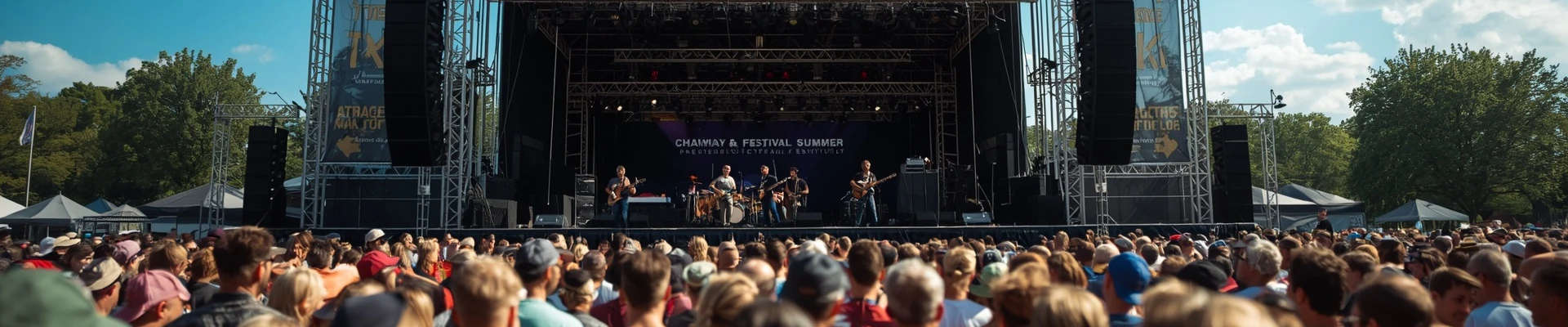
Festivoix de Trois-Rivières is the city's flagship popular music festival, typically held in June or July, drawing acts from across Québec, Canada, and internationally to the outdoor amphitheatre and various indoor stages. Programming skews toward Québec francophone artists but has historically included anglophone Canadian and international headliners, making it one of the summer season's notable events in Mauricie.
The Festival international de la poésie, held each October, is perhaps the city's most globally recognized cultural event. While not a music festival per se, it has consistently featured performances that blend spoken word with music, and its presence has attracted a literary and artistic community that bleeds into the music scene's most thoughtful members.
Festival Urbain has addressed hip-hop, street arts, and urban culture — reflecting a younger demographic in the city and acknowledging genres that the traditional chansonnier and rock scenes have been slower to embrace. The festival has provided a platform for francophone rap and R&B artists from the Mauricie region and Québec more broadly.
The Grand Prix de Trois-Rivières, a motorsport event held on a street circuit through the old city each August, draws tens of thousands of visitors and has historically incorporated major concert programming in its entertainment package — making it one of the largest attendance events in the city's annual calendar and an opportunity for live music at scale.
Roots, Radio, and Recording
The city's recording infrastructure has historically been limited compared to Montréal, and many serious recording projects have been taken to studios in the province's larger centres. However, smaller local studios have served the community of working musicians who form the bedrock of any healthy scene — the bands playing every weekend, teaching lessons, and keeping the circuit alive between the celebrated alumni who move to bigger markets.
CFLM-FM and regional radio have played a role in supporting francophone artists from the Mauricie region, though the dominant radio pipelines for Québec music run through Montréal stations like CISM, CIBL, and the commercial networks that program French-language pop and rock across the province.
The UQTR music programs have supplied a steady stream of trained musicians to local and provincial scenes — players who fill orchestral chairs, back touring acts, and form original bands of their own.
What Ties It Together
Trois-Rivières does not have a single genre-defining sound the way Detroit has techno or Nashville has country. What it has instead is something older and quieter: a French-language cultural confidence that threads through every corner of its music, from the literary precision of its singer-songwriters to the sheer volume of its metal acts. The Saint-Maurice River, the paper mills, the long winters, and the particular pride of being Québécois in a province that fought hard for its cultural survival — these forces shaped a music scene that is earnest, literary, and unafraid of difficulty. In a province where language is identity, making music in French is never just an aesthetic choice; it is a political and cultural act that musicians in Trois-Rivières have always understood instinctively.