
Saint Paul occupies the east bank of the Mississippi River at the point where the river bends sharply southward, directly across from Minneapolis. It is the capital of Minnesota, the county seat of Ramsey County, and with roughly 303,000 residents the state's second-largest city — though the two-city metro together forms a single economic and cultural zone of more than 3.7 million people, the 16th-largest metropolitan area in the United States. Saint Paul is older than Minneapolis, founded as a fur-trade and steamboat depot in the 1840s on ground the Dakota called Imnizha Ska ("White Cliff"), and the city's character reflects that seniority: grand Victorian and Beaux-Arts public buildings, a Catholic institutional backbone (the Cathedral of Saint Paul and Cretin-Derham Hall among them), tight ethnic neighborhoods, and a political culture historically more rooted in Irish, German, and Eastern European Catholic Democratic ward politics than Minneapolis's more Scandinavian and progressive Protestant one. That difference matters for music: Saint Paul's scene has always been slightly grittier, slightly more working-class, slightly more punk in its instincts than Minneapolis, and several of the most consequential bands in the Twin Cities canon claimed Saint Paul addresses.
A brief history
The Dakota — specifically the Bdewakantunwan Oyate (Mdewakanton Sioux) — lived along the Mississippi bluffs for centuries before European contact. The site of present-day Saint Paul was near Pike Island, where the Minnesota and Mississippi rivers meet, and the Dakota name for the broader area was Bdote — a sacred confluence. French fur traders were the first Europeans in the region; the American military established Fort Snelling at the confluence in 1820. A shantytown settlement grew near the fort in the 1830s around the tavern of Pierre "Pig's Eye" Parrant, a bootlegger whose nickname gave the settlement its first informal name — Pig's Eye. A Catholic mission renamed it Saint Paul in 1841. The city grew explosively through the steamboat era, became the Minnesota territorial capital in 1849, and served as the eastern terminus of the Great Northern Railway under James J. Hill, whose mansion still stands on Summit Avenue. By the 1880s Saint Paul was a prosperous industrial and commercial city — meatpacking, grain, banking, rail — with a substantial Irish and German Catholic working class, a German-Jewish mercantile elite, and growing Scandinavian, Czech, and Polish communities. The early 20th century layered in Italian, Mexican, and African American communities through the Rondo neighborhood (the historic Black heart of Saint Paul, destroyed by the construction of I-94 in the 1960s in a displacement still grieved by the community). Post-WWII immigration brought Hmong refugees from Laos (Saint Paul has the largest urban Hmong population in the world) and, from the 1990s onward, Somali, Oromo, and other East African communities that transformed the city's demographics and its music.
Music identity
Saint Paul's most internationally recognized cultural contribution is literary, not musical — F. Scott Fitzgerald was born and raised on Summit Avenue and Laurel Avenue in the Summit-University neighborhood, and his novels, saturated with jazz-age glamour and melancholy, are inseparable from the music of the 1920s even if Fitzgerald himself was primarily a novelist. But the city has a deep and consequential musical lineage of its own.
The most important band in Saint Paul's rock canon is The Replacements, who formed in 1979 in the Longfellow neighborhood of Minneapolis but whose circle extended deep into Saint Paul's working-class punk community and whose sound — ragged, drunk, emotionally unguarded, simultaneously brilliant and self-sabotaging — became one of the defining aesthetics of American indie rock in the 1980s. Bassist Tommy Stinson was a Saint Paul native. The Replacements' catalog — Sorry Ma, Forgot to Take Out the Trash (1981), Hootenanny (1983), Let It Be (1984), Tim (1985), Pleased to Meet Me (1987) — runs from chaotic hardcore to heartbroken pop and remains one of the most influential bodies of work in American alternative rock. Westerberg's songwriting echoes through thirty years of indie and emo.
Soul Asylum, another foundational Minneapolis-Saint Paul band, formed in 1981 and built their reputation on the Twin Cities club circuit before breaking through with Grave Dancers Union (1992) and the ubiquitous "Runaway Train." Semisonic, from Minneapolis, were Twin Cities stalwarts whose "Closing Time" (1998) became one of the most-played songs of the decade. The broader Twin Cities scene — Hüsker Dü (another Minneapolis-based punk/hardcore foundational act), The Suburbs, Babes in Toyland — shared the same club circuit and scene infrastructure, and Saint Paul venues were part of the rotation.
The gravitational center of the Twin Cities music world during the 1980s was, of course, Prince, who lived and worked primarily in Chanhassen (the Paisley Park studio compound in the western suburbs) but whose influence on the entire metro — including Saint Paul venues, session musicians, and the Minneapolis Sound that blended funk, R&B, rock, and electronic pop — was total. Prince drew musicians from all over the Twin Cities into his orbit. Saint Paul musicians, studios, and venues all participated in that culture.
The Hmong-American music scene in Saint Paul is one of the largest and most distinctive in the world, a direct reflection of the city's status as home to the largest urban Hmong community on earth. Hmong pop, lam vaj (a traditional Hmong vocal style), Hmong hip-hop and R&B, and Hmong-language Christian music all have active communities, performance circuits, and recording operations in Saint Paul. Artists like Priscilla Cha, Tou SaiKo Lee (Hmong-American spoken-word poet and hip-hop artist, a Saint Paul native), and Doualy Xaykaothao represent the public cultural voice of the community. The Hmong New Year celebration at the Saint Paul RiverCentre is the largest Hmong New Year festival in the world and features extensive music programming.
The Somali and East African community has established a thriving music scene centered around the Cedar-Riverside neighborhood in Minneapolis and the Capitol Hill and Frogtown (Thomas-Dale) districts in Saint Paul. Somali pop, hip-hop, and traditional music; Oromo popular music; Eritrean and Ethiopian musical communities all contribute to one of the most culturally diverse music ecosystems in the Midwest. K'naan, the Somali-Canadian rapper and poet (raised partly in Minneapolis after leaving Mogadishu), emerged from this community. Saint Paul's Frogtown neighborhood is a focal point of this East African creative energy.
Jazz has a long Saint Paul lineage. The Artists' Quarter, a beloved Saint Paul jazz club that ran for decades on Seventh Street before closing in 2013, was the center of the Twin Cities jazz scene and featured national and regional artists. The Dakota Jazz Club & Restaurant in Minneapolis has partially absorbed that role. The Twin Cities jazz tradition runs through musicians like Dave Brubeck sideman Paul Desmond (who spent time in the metro), local pianist Judi Donaghy, and a continuous lineage of jazz education through McNally Smith College of Music (which operated in Saint Paul until closing in 2018) and the University of Minnesota and Macalester College programs.
Gospel and church music anchors the African American community centered in the historic Rondo neighborhood corridor (now Summit-University and Selby-Dale). The destruction of Rondo by I-94 in the 1960s scattered the community but did not break it; gospel, R&B, soul, and hip-hop continue through a network of Black churches and community organizations. KFAI Community Radio in Minneapolis serves the entire metro's diverse music communities. Hip-hop has a strong Saint Paul chapter through artists like Brother Ali, Atmosphere (Slug and Ant), and the broader Rhymesayers Entertainment ecosystem — Rhymesayers is a Minneapolis-based indie hip-hop label that is one of the most respected independent labels in American hip-hop, with national and international reach.
Venues and neighborhoods
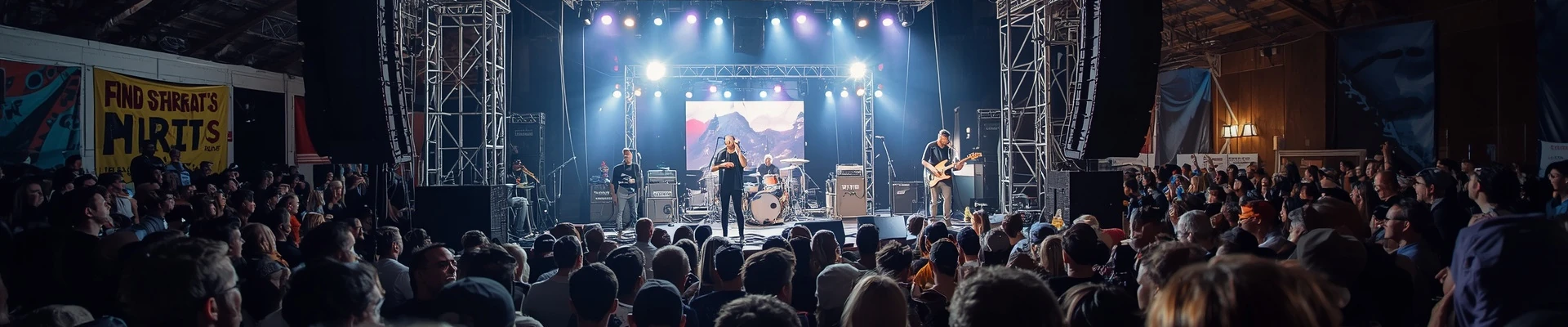
Saint Paul's venue landscape is anchored at the top by Xcel Energy Center, the 18,000-capacity arena that is home to the Minnesota Wild and hosts major tours. The mid-size tier features the Palace Theatre on Wabasha Street (a beautifully restored 1916 vaudeville house, 2,800 capacity), the Ordway Center for the Performing Arts (home of the Minnesota Opera, the Saint Paul Chamber Orchestra, and Broadway touring productions), and the Fitzgerald Theater on Exchange Street — the oldest surviving theater in Saint Paul (1910), home of A Prairie Home Companion for decades under Garrison Keillor and now a concert hall anchoring the downtown cultural zone. Smaller venues include Amsterdam Bar & Hall on Seventh Street, Turf Club on University Avenue (a landmark bar and live music room with a long history of rock, Americana, and indie programming), and the Nook in the Macalester-Groveland neighborhood. The Historic Hamm's Brewery complex has been redeveloped and contains event spaces. The Palace and Fitzgerald are the two venues that most define Saint Paul's live music identity.
The Selby-Dale corridor and the Summit-University neighborhood are the cultural heart of the city's African American and progressive communities, with bars, restaurants, and event spaces that have hosted jazz, R&B, and spoken-word traditions for generations. Frogtown (Thomas-Dale) is the most densely Hmong neighborhood and the center of East African commercial and cultural life. Lowertown — the warehouse district at the east end of downtown along the river — has gentrified into the city's arts district, with galleries, studios, the Lowertown Farmers Market, and event spaces. West Seventh Street runs southwest from downtown into working-class Irish and Mexican-American neighborhoods. Payne-Phalen on the East Side is a working-class neighborhood with a strong Latino and Hmong presence.
Festivals and signature events
Saint Paul Winter Carnival, founded in 1886 and one of the oldest winter festivals in the United States, programs music across its ten-day run in late January and early February — though the musical component is secondary to the ice palace and outdoor events. Lowertown Sounds, the free outdoor concert series in Mears Park during the summer, anchors live music in the arts district. Hmong New Year (November–December at the RiverCentre) features the largest gathering of Hmong musicians and performers outside Southeast Asia. The Twin Cities Jazz Festival in June programs across both cities, with major events at Mears Park in Saint Paul's Lowertown. The Rondo Days Community Celebration in July commemorates the destroyed Rondo neighborhood and its Black cultural legacy. The Festival of Nations at the RiverCentre programs music and dance from more than 80 cultures. The Pride Parade in Minneapolis and the Saint Paul events around it draw major music programming. The broader Twin Cities music scene — including Rock the Garden (Minnesota Public Radio's outdoor concert at the Walker Art Center), the Soundtown Music Festival, and the summer festival circuit — operates as a single ecosystem across both cities.
Saint Paul's musical identity is, finally, defined by the tension and synthesis between its distinctness and its fusion with Minneapolis. It is the older, more ethnic, more Catholic, more working-class twin — and that identity produced The Replacements' torn-denim punk-pop, the Hmong community's worldwide musical diaspora, the East African spoken-word and hip-hop scenes in Frogtown, and the jazz lineage of the Artists' Quarter. Across the river, the Minneapolis Sound and Paisley Park cast a long shadow. But Saint Paul's contribution to American music is real, specific, and tied to the streets — Summit Avenue, University Avenue, Selby-Dale, and the Lowertown riverfront — in ways that are distinctly its own.