

Laval is the third-largest city in Québec and the second-largest in the Greater Montréal region, with roughly 438,000 residents on Île Jésus — the island immediately north of Montréal Island, separated from it by the Rivière des Prairies and from the Laurentian shore to the north by the Rivière Jésus. Laval is a single-tier municipality that absorbed all 14 former municipalities on Île Jésus in a 1965 amalgamation, creating one of the largest planned suburban cities in Canada. Functionally, Laval is Montréal's largest suburb — connected to the island city by bridges, highways, and the Montréal Métro Orange Line — and many of its residents work, shop, and attend concerts in Montréal. But Laval has its own civic identity, its own cultural infrastructure, and, given its population, its own substantial music scene. The city is roughly 20% immigrant, with very large Haitian, Lebanese, Algerian, Moroccan, Italian, Greek, and Vietnamese communities, and a growing Middle Eastern presence — and those immigrant communities have increasingly shaped Laval's musical character alongside its historically French-Canadian working and middle-class base.
A brief history
The land on Île Jésus was Algonquin and Huron-Wendat territory before French missionaries and settlers arrived in the mid-17th century. The island was granted to the Sulpician order and to the Jésuites in the late 1600s and divided into parishes and seigneuries that developed slowly through the French colonial era. Through the 19th and early 20th centuries Île Jésus remained primarily agricultural — market gardens, dairy farms, and orchards supplied Montréal's markets across the river. The 1965 amalgamation and the simultaneous explosion of postwar suburban development transformed the island; the construction of Highway 15, the Montréal Métro's Orange Line extension to Laval in 2006, and a building boom in the 1980s and 1990s built the modern city of towers and subdivisions. Laval is today one of the most densely developed suburban municipalities in Canada, and one of the most rapidly diversifying, with immigrant populations arriving primarily from Haiti, Lebanon, Algeria, Morocco, and the wider Maghreb.
Music identity
Laval's most internationally famous musical export is Cœur de Pirate (Béatrice Martin), born in Montréal but raised in the suburb of Duvernay in Laval and identified strongly with the city through her childhood and teenage years. Her self-titled debut (2008), recorded largely at home on her laptop, became one of the most celebrated francophone pop albums of the decade — intimate, piano-driven, and immediately placing her in the lineage of French chanson while remaining unmistakably contemporary. Her subsequent albums, including Blonde (2011) and Roses (2015), and her bilingual work have made her one of the most commercially successful and critically acclaimed Quebec pop artists of the 21st century. Her Laval upbringing is frequently referenced in her public identity, and the city has embraced her as its own.
Beyond Cœur de Pirate, Laval's francophone music scene runs deep. Vincent Vallières, the Québec singer-songwriter and folk-rock artist, spent significant time in Laval through his formative years. Ima (the francophone R&B and soul artist), Mélissa Ouimet, Les Frères à ch'val, and a current generation of francophone pop, indie, and hip-hop artists working through the broader Montréal-Laval orbit continue the lineage. Laval's Haitian-Canadian community — one of the largest in the Greater Montréal region, concentrated in the Chomedey, Vimont, and Saint-François districts — fuels a deep Haitian music scene: konpa-direk, rara, Haitian gospel, and modern Haitian urban music run through community halls, churches, and clubs across the island. The Haitian community has produced a steady stream of musicians who work across Laval and Montréal, and Laval's Radio communautaire CKVL and the broader bilingual community media serve the French-Creole music world. Lebanese, Algerian, and Moroccan communities fuel thriving Rai, Arabic pop, and Maghrebi electronic scenes through community halls and cafés across the city.
Laval's classical and institutional music tradition runs through the Orchestre de la Vallée and a network of school and community music programs. The Laval des Rapides and Vimont community centres program regular music events. The Cosmodôme (Laval's science museum) has hosted popular science-and-music programming. Laval's extensive network of community radio stations — including CKVL 850 AM (the French-Haitian community station) and religious broadcasters — anchor the community music ecosystem.
Venues and neighborhoods
Laval's venue ecosystem is centred on a cluster of municipally operated facilities and commercial entertainment venues. At the top sit the Place Bell (the 10,000-capacity arena that opened in 2017, home of the AHL Laval Rocket and the city's largest concerts — it has become a significant regional venue attracting major touring acts who might previously have only played Montréal's Bell Centre), the Salle André-Mathieu (the city's primary concert hall, home of the Orchestre symphonique de Laval), and the Théâtre Marcelline-Bonheur at Collège Montmorency. The midsize tier includes the Comicazé's music programming, the Cabaret BMO at Place Bell (the smaller club-format venue attached to the arena), and the Le Triton and various club spaces. Beneath them is a club layer running through the Chomedey, Pont-Viau, and Laval-des-Rapides commercial corridors, with Haitian, Lebanese, and francophone bars and dance halls spread across the island. Laval's proximity to Montréal means most mid-size and large concerts draw on Laval audiences at Montréal venues — Place des Arts, MTELUS, Théâtre St-Denis, the Bell Centre — rather than requiring Laval-specific infrastructure.
Different neighborhoods carry different musical identities. Chomedey and Fabreville (western Laval) anchor the Lebanese, Italian, Greek, and broader immigrant community music scenes. Vimont, Auteuil, and Saint-François (eastern and central Laval) anchor the Haitian-Canadian and Franco-Caribbean music scenes. Laval-des-Rapides and Pont-Viau (southern Laval, directly across the river from Montréal) anchor the most urban and arts-adjacent scenes. Sainte-Rose and Sainte-Dorothée (northern Laval) support a smaller country and folk circuit.
Festivals and signature events
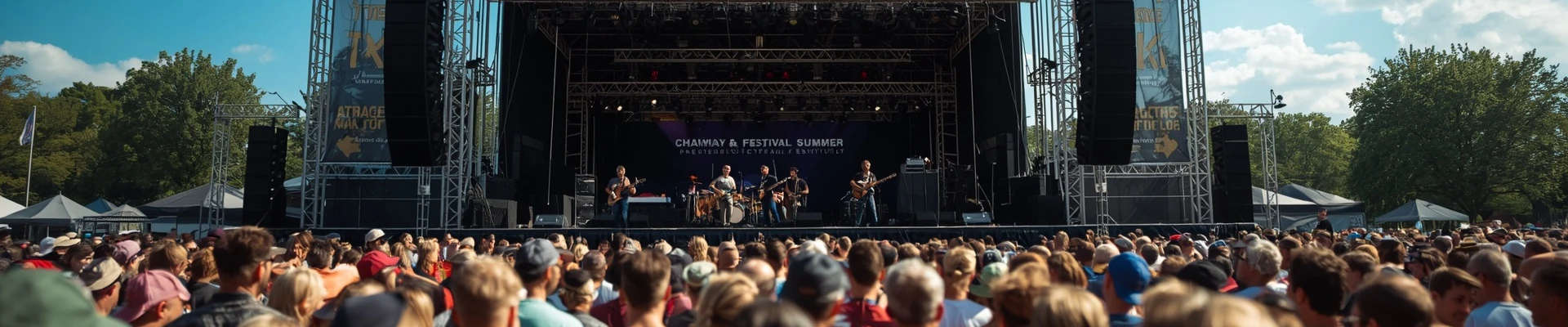
The festival calendar reflects the city's range. Festival de Laval (the city's flagship summer music festival at the Parc de la Rivière-des-Mille-Îles) programs major francophone, pop, and world music acts. Caribana Laval and broader Haitian Heritage Month events program Haitian konpa, gospel, and urban music. Fête nationale du Québec (June 24) is a major outdoor event across Laval with strong francophone music programming. Salon du livre de Laval's music programming, Festival Celtique de Laval, Laval Pride, Laval African Music Festival, Ramadan concerts at the Islamic cultural centres, and the Laval en musique summer outdoor concert series round out the calendar. Place Bell's year-round programming is increasingly drawing major English and French touring acts that previously only played Montréal.
What ties it all together is Laval's identity as simultaneously a bedroom community of Montréal and a city of its own — one of the largest francophone cities in North America, home to one of the most consequential Haitian diaspora communities in Canada, and the childhood suburb of one of the most internationally celebrated francophone pop artists of the 21st century. Laval is the city where Cœur de Pirate learned the piano and wrote her first songs in a Duvernay bedroom, where the Haitian konpa tradition runs through churches and community halls from Chomedey to Saint-François, where Place Bell has given the city its first truly major concert venue, and where a generation of Maghrebi, Caribbean, and Franco-québécois musicians are building careers in the shadow of Montréal's larger cultural infrastructure.